Fitness, Nutrition, Health and Sports Blog In the HSNstore Blog you will find tips about Fitness, sport in general, nutrition, and health – HSNstore.com

Completely.
The ketogenic diet is a dietary approach based on intense restriction, usually to less than 10% of the daily energy intake of dietary carbohydrates, replacing them with fat and maintaining, or slightly increasing, protein.
Whereas intermittent fasting is nothing more than a variable period (from hours to days) of food restriction.
Many people following ketogenic diets practice more or less prolonged fasting, and vice versa, as some of the beneficial effects of both protocols have been replicated in their counterpart, and vice versa.
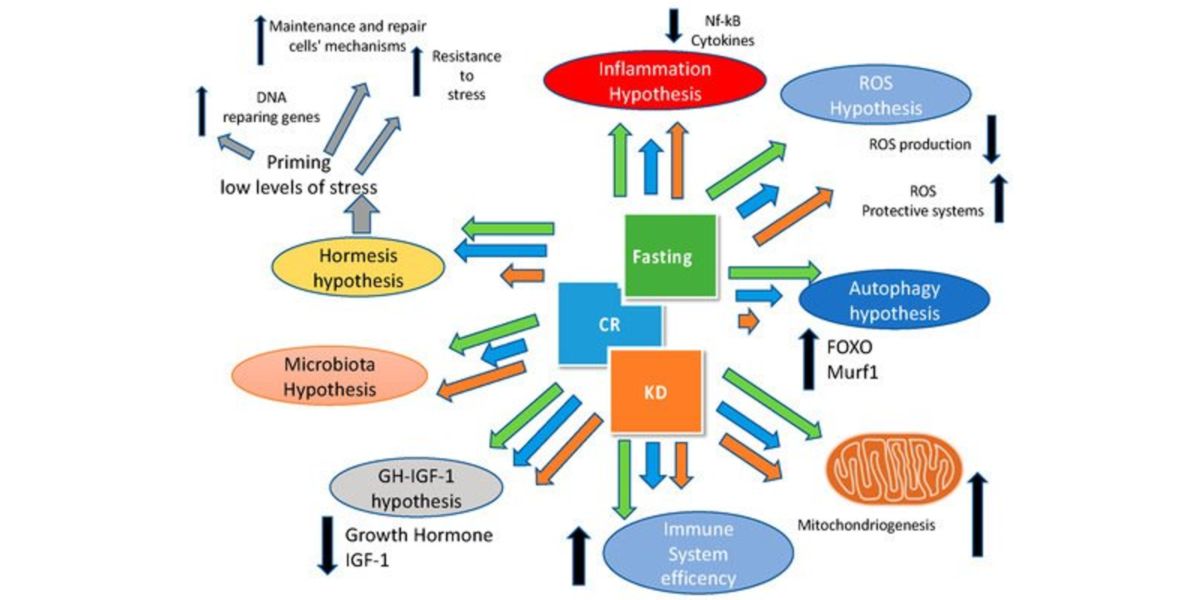
Beneficial effects of different dietary approaches, CR: Calorie restriction / KD: Ketogenic diet / Fasting, on health markers related to the immune, endocrine and metabolic systems (Paoli et al., 2019).
You can do intermittent fasting and ketogenic dieting without coming across any problems, as long as at the end of the day (or a period of several days) you cover your nutritional requirements established according to your characteristics and objectives (calories, macro and micronutrients).

Remember that both the ketogenic diet and fasting require a certain adaptation period, so it’s preferable to be adapted to one of the two approaches before starting with the other.
How to fast on the Keto diet
Not eating for a variable amount of time.
Sounds easy, right? It is.
The way to combine fasting and keto dieting is to do your normal ketogenic diet and limit the times of day you allow yourself to eat.
A smart strategy is to adapt your keto diet so that the last meal before fasting is the most energy-dense meal to control hunger during the period of food restriction.
A possible keto diet protocol + intermittent fasting, in a person who is used to ketogenic food, could be:
| Week | Fasting hours: Feeding hours |
| 1 | 8:16 |
| 2 and 3 | 16:8 |
| 4, 5, 6, 7 | 24:24 (day on, day off) |
| 8 | 23:1 (every day) |
| 9, 10, 11, and 12 | 48:24 (two days of fasting, one day of feeding) |
Why do intermittent fasting on a keto diet?
Because it’s possible for them to act synergistically.
Calorie restriction was the first “big boom” in nutrition, postulating the possibility that this practice would increase the longevity and health expectancy of subjects.
The ketogenic diet and intermittent fasting share mechanisms with calorie restriction, taking advantage of their possible endocrinometabolic benefits.
It’s possible to combine ketogenic diet and intermittent fasting and obtain a greater overall effect, and it can contribute to:
- The maintenance and/or restoration of the biodiversity of the intestinal microbiota.
- The reduction of cell damage due to oxidative stress, the cause of ageing and cell death.
- The promotion of autophagy, or cellular recycling, a mechanism that safely and self-managed eliminates damaged cells before they cause damage or die abruptly and uncontrollably.
- Decreasing the production of anabolic hormones and growth factors related to hyperplasia and metaplasia.
- Maintaining the correct structure and function of neural networks, decreasing inflammation and protecting nerve cells.
These and other positive effects are theoretical or preclinical, which means that they have not been firmly and unequivocally proven in humans, but the evidence is beginning to be strong in certain results (neurological and metabolic, especially), and is growing steadily.
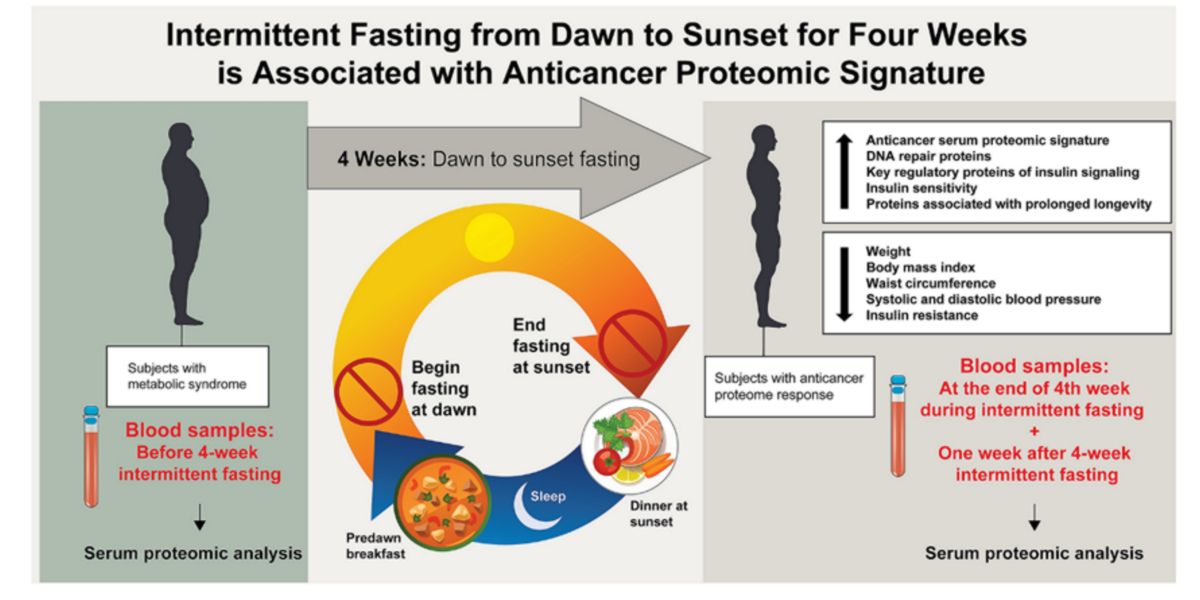
Changes in the proteomic profile of subjects with metabolic syndrome after 4 weeks of fasting during the day. They reduced their body weight, BMI, fat, blood pressure, insulin resistance; and improved markers of autophagy and cellular repair (MIndikoglu et al., 2020).
Is fasting recommended on the keto diet?
It depends.
Both dietary schemes have benefits that, in healthy people, outweigh any possible detriment they generate (such as initial fatigue until adaptation).
Therefore, the combination of both is advisable to the extent that we sequence the adaptation of one and the other, first using the one that’s more comfortable, simple or attractive, and gradually introducing the other.

In general, it’s advisable to combine both types of diet only as long as they fit into your daily life:
Because it’s possible that for certain people, (such as high-level athletes, night shift workers, type 1 diabetics and other people with immuno-metabolic pathologies), intermittent fasting is not the most advisable practice, though a convenient tool for a large part of the population.
Try IF + Keto and you won’t look back!
What can you consume on a Keto fast?
Good question, with a very difficult answer.
The RAE (Royal Spanish Academy) dictionary defines fasting as: “Abstaining totally or partially from eating or drinking”.
A closer look at the definition quickly reveals why the answer to this question is so complex:
Fasting can be conceived in many different ways, from total restriction of food and drink, to allowing calorie-containing or calorie-free drinks, or even allowing non-glycemic foods (such as oils).
Based on this, we can establish 5 levels of “restrictive fasting” and look at what can be consumed during their practice:
| Level | Restriction | Allowed foods |
| 1 |
|
|
| 2 |
|
|
| 3 |
|
|
| 4 |
|
|
| 5 |
|
|
*That produce an endogenous insulin secretion response.
Do KetoSeries supplements break the fast?
The products in the KetoSeries range have been developed to reach level 3 of restrictive fasting.
Let’s now analyse each of them so that you can find out whether their use is permitted in your particular case:
| Product | Level |
| KETO OCTANE | |
| KETO MATCHA LATTE (WITHOUT MILK) | 3 |
| KETO INSTANT COFFEE | 3 |
| KETO HYDROLYSED COLLAGEN (BOVINE) POWDER | 2 |
| KETO WHEY PROTEIN | 2 |
| KETO INSTANT COFFEE + COLLAGEN | 2 |
| KETO CREAMY COCOA | 3 |
| KETO CREAMER | 3 |
Recommendations
There are many reasons for fasting, and each reason has a sense of restriction.
There are Islamic practices known as Ramadan, where practitioners of the religion in its original conception restrict food and drink completely from sunrise to sunset.
Fasting that’s carried out for functional reasons (its potential health benefits), should not reach level 5 on any occasion, and fluctuate between levels 3 and 4 depending on the interest of the individual.
Bibliographic References
- Mindikoglu, A. L., Abdulsada, M. M., Jain, A., Jalal, P. K., Devaraj, S., Wilhelm, Z. R., … Jung, S. Y. (2020). Intermittent fasting from dawn to sunset for four consecutive weeks induces anticancer serum proteome response and improves metabolic syndrome. Scientific Reports, 10(1), 18341.
- Paoli, A., Tinsley, G., Bianco, A., & Moro, T. (2019). The influence of meal frequency and timing on health in humans: The role of fasting. Nutrients, 11(4).
Related Entries.
- Everything you need to know about the Ketogenic Diet: go now.
- Do you know the benefits of IF (intermittent fasting) on Autophagy? Find out by clicking here.
- A selection of supplements specifically for your keto diet…. continue reading.