 Fitness, Nutrition, Health and Sports Blog In the HSNstore Blog you will find tips about Fitness, sport in general, nutrition, and health – HSNstore.com

The muscle’s ability to produce a large amount of force in a short time is boosted after subjecting the muscle to maximal or submaximal contractions. This ability is known as Post-Activation Potentiation (PAP), and it could be super useful for athletes by producing a greater amount of force and power, temporarily, at a given moment.
Physiological and mechanical explanation
Let’s say a sprinter wants to get ready for a race. During the warm-up, besides doing joint mobility and ballistic stretches, including exercises that require maximal force production (high intensities around 90-95% 1RM) will allow the sprint power to be higher than if those exercises weren’t done. This happens because the force of a muscle contraction increases after performing a maximal voluntary contraction (MVC).

Scientific evidence supports the following mechanism:
- Performing MVC
- Phosphorylation of the regular myosin light chain
- Increases the calcium sensitivity of the myofilaments.
- Amplified level of actin-myosin cross-bridge activity for the same submaximal concentration of myoplasmic calcium.
- Improvement in power developed in a subsequent exercise.
Keep in mind that the agonist muscles of the first movement should be the ones mainly involved in the movement we want to improve later. In other words, doing a bench press before a sprint wouldn’t help much.
Watch out for fatigue
However, you gotta be careful with fatigue production. After the activating exercise, two types of effects can kick in:
- Fatigue, which would mean a decrease in neuromuscular performance.
- Potentiation, which would mean an increase in neuromuscular performance.

Force increases with frequency level until it plateaus even if stimulation frequency keeps rising (solid line). After the activating exercise, PAP (dashed line) increases low-frequency force but not high-frequency force. That means we’ll improve in exercises done at high speed.
Optimal recovery time before the main exercise
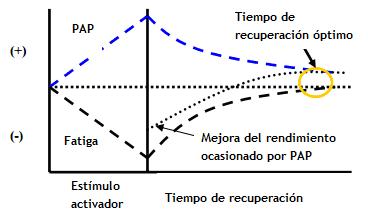
Data estimates that potentiation happens approx. 3-4’ after the stimulus, although in some individuals with low strength levels it can happen earlier than in those with high maximal strength. You can see a practical example in the following video by our buddy Explosivo, who performs isometric MVCs before going for a bench press record.
Sources
- Bustos, AF. (2007). The phenomenon of muscle potentiation. A review. http://www.fuerzaypotencia.com. Retrieved April 25, 2014 from http://www.fuerzaypotencia.com/articulos/Download/potenciacion.pdf
- Hodgson, M., Docherty, D., & Robbins, D. (2005). Post-activation potentiation: underlying physiology and implications for motor performance. Sports Medicine, 35(7), 585-595.
- Sale, DG. (2002). Postactivation potentiation: Role in human performance. Excerc. Sport Sci. Rev. 30: 138-143.
- Verkhoshansky, Y. and Siff, MC. (2009). Supertraining (6th ed). SSTM.