 Fitness, Nutrition, Health and Sports Blog In the HSNstore Blog you will find tips about Fitness, sport in general, nutrition, and health – HSNstore.com
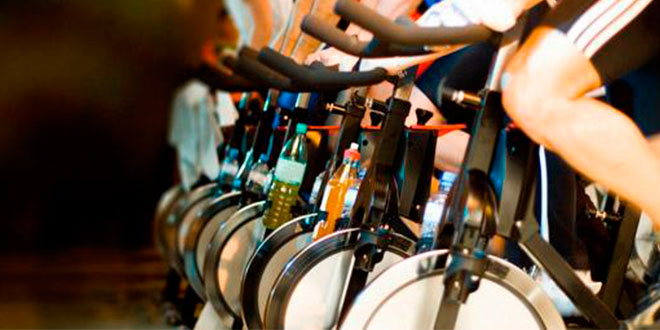

Among the group physical activities you can find at gyms, the huge boom of indoor cycling, also commercially known as Spinning® (a registered trademark by Madd Dog Athletics, Inc.), stands out, mostly practiced by women whose main goal is to lose body fat mass.
Nowadays, the benefits of physical exercise on improving fitness levels and preventing so-called hypokinetic diseases are well established. This holds true if the physical activity is done systematically, with proper duration, intensity, and recovery, and is adapted to personal and individual conditions and characteristics.
The American College of Sports Medicine (ACSM) recommends that cardiorespiratory endurance exercise intensity, from a physiological point of view, should be set between 60% and 90% of maximum heart rate (HRmax), between 40% and 85% of heart rate reserve (HR reserve), or, based on psychological parameters like the subjective perception of effort, between 12 and 16 points on the Borg scale.
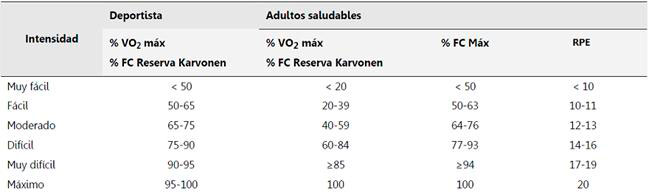
Since most sports and fitness centers don’t have a lab with specific equipment to control intensity through oxygen consumption (VO2), measuring heart rate via a heart rate monitor and subjective perception of effort methods could be the easiest way to prescribe and (self)monitor intensity in these facilities. In this regard, the Borg Rate of Perceived Exertion (RPE) scale is the most affordable and widely used tool.
One aspect little evaluated so far is whether there are statistically significant differences between men and women in recorded intensities; so, to find out, as well as to determine if the predominant effort intensity in the main phase of the session falls within the ACSM recommended parameters to improve and maintain cardiorespiratory endurance, and to analyze the validity of the Borg subjective perception of effort scale as a tool to control intensity in indoor cycling, values were recorded during this activity in 133 people (38 men and 95 women) aged between 22 and 64 years.
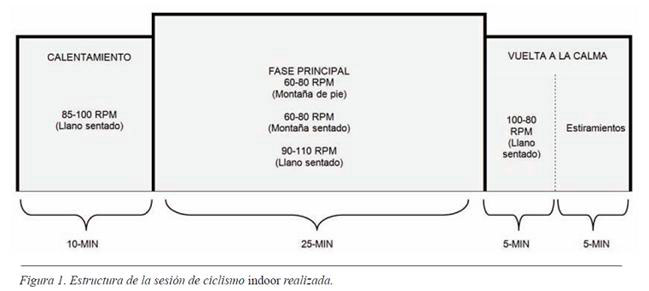
- Heart rate was recorded every 5 seconds throughout the session using a Polar Team System® telemetry device.
- Subjective perception of effort (RPE) was determined using the 15-point Borg scale ranging from 6 points “no effort” to 20 points “maximum effort.” This scale was used due to its high correlation with heart rate.
Results
It’s important to highlight that the results are relevant because, once the theoretical maximum heart rate (206.9 – (0.67 x age)) and resting heart rate were determined, the intensity percentage for each subject (meaning it was individualized) was calculated in each of the training zones.
From this, the following image shows that the average intensity percentage reached and the subjective perception of effort reported in the main phase were:
- Men: High intensity (80.60% ± 6.74%) and high RPE (15.11 ± 1.90 points)
- Women: High intensity (80.85% ± 7.54%) and high RPE (15.49 ± 1.51 points)
Therefore, there are no significant differences between men and women
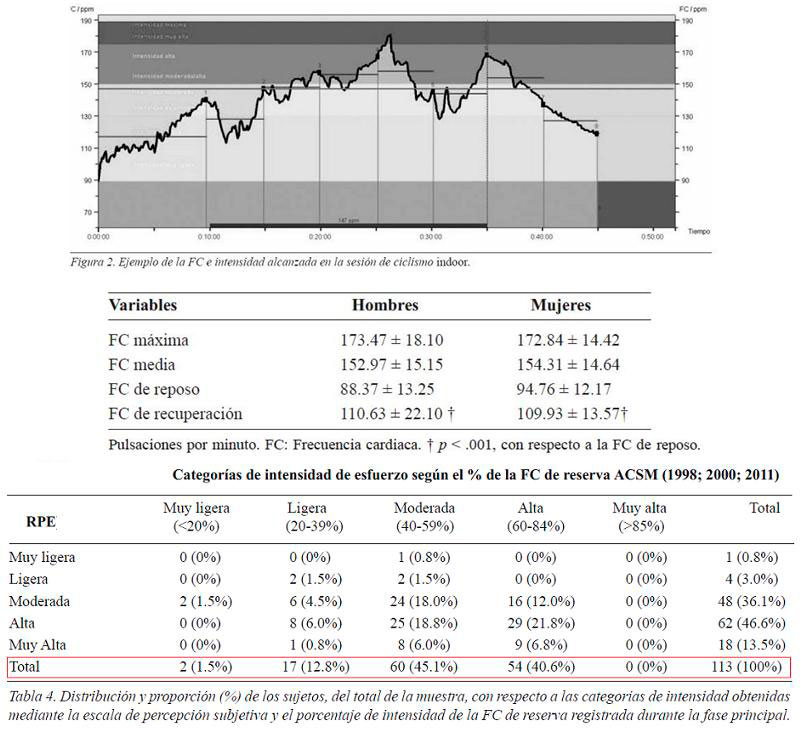
Also, the average intensities reached are at the upper limit of ACSM recommendations. However, it’s very notable that the Borg subjective perception of effort scale (RPE) from 6 to 20 points is not a valid tool to use for controlling effort intensity in this activity, although it could complement (not replace) heart rate monitoring via a heart rate monitor. In other words, individual perception of fatigue doesn’t match the actual intensity reached.
Among the most supported reasons to explain this is the lack of familiarity of subjects with the RPE scale, as well as limited experience in the activity. Especially for beginners, there’s a deficit in the real perception of their fitness level, particularly at moderate and high intensities (> 40% VO2). On the other hand, RPE alone seems to be a better indicator in more trained subjects who know this scale.
How to estimate calories burned?
If you don’t have an accelerometer, a heart rate monitor that estimates calories, or any other training control device besides the subject’s own perception, you can estimate (never pinpoint exactly) that the energy consumed during these classes, at a medium-high intensity, is 0.169 kcal / min / kg.
Example:
For a 60-kg woman in a 45-min class: kcal burned = 0.169 x 60 x 45 = 456 kcal
Sources
- Ainsworth, B. E., Haskell, W. L., Herrmann, S. D., Meckes, N., Bassett Jr, D. R., Tudor-Locke, C., … & Leon, A. S. (2011). 2011 Compendium of Physical Activities: a second update of codes and MET values. Medicine and science in sports and exercise, 43(8), 1575-1581.
- Rodríguez, J. M. M., Cristobal, R. V., Cárceles, F. A., & Miñarro, P. A. L. (2015). Subjective perception of effort as a tool to control intensity in indoor cycling (Spinning®). Journal of sport psychology, 24(1), 45-52.