Fitness, Nutrition, Health and Sports Blog In the HSNstore Blog you will find tips about Fitness, sport in general, nutrition, and health – HSNstore.com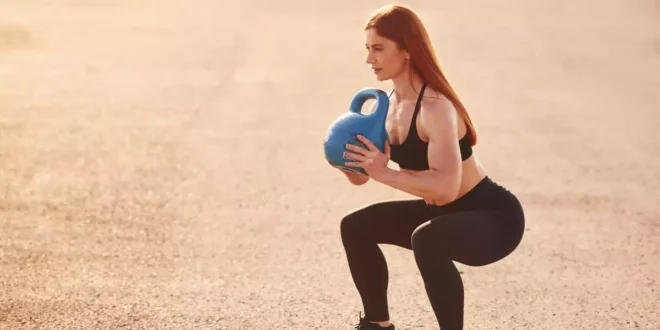

The goblet squat is a squat variation in which the weight is held in front of the chest, usually with a dumbbell or kettlebell. It is a very useful exercise for working the lower body while learning to control important aspects such as posture, depth and stability throughout the movement.
How do you do a goblet squat?
To perform a goblet squat, hold a dumbbell or kettlebell in front of your chest and place your feet in a stable position. Bend your knees and hips to lower yourself while keeping your torso controlled. Descend to a comfortable depth and push through the floor with your feet to return to the starting position.

- Hold a dumbbell or kettlebell with both hands in front of your chest.
- Place your feet approximately shoulder-width apart, with your toes pointing slightly outwards.
- Engage your core and keep your torso stable before starting the movement.
- Bend your knees and hips simultaneously to begin the descent.
- Lower yourself in a controlled manner until you reach a depth you can maintain with good form.
- Push through the floor with both feet to extend your knees and hips.
- Return to the starting position while keeping the weight close to your chest.
:contentReference[oaicite:0]{index=0}
Kettlebell goblet squat

- Stand with your feet shoulder-width apart, holding a kettlebell with both hands in front of your chest by the handles (“horn grip”).
- Keep your chest up, core engaged and back straight, allowing your knees to naturally bend forwards as you lower yourself.
- Lower into a controlled squat until your thighs are parallel to the floor, then push through your heels to return to the starting position, primarily engaging your quadriceps, glutes and core.
Reps and sets: for the best results, perform 3-4 sets of 8-12 repetitions, with 45-60 seconds of rest between sets.
Muscles worked: quadriceps, glutes, hamstrings, core and spinal erectors, with support from the adductors and calves.
Dumbbell vs Kettlebell Goblet Squat Comparison
| Aspect | Dumbbell goblet squat | Kettlebell goblet squat |
|---|---|---|
| Grip | Holding one end of the dumbbell | Holding the handles (more natural) |
| Comfort | May feel less stable | More comfortable and ergonomic |
| Weight control | Slightly harder to stabilise | Better control and balance |
| Core activation | Moderate | High |
| Safety | Lower if grip is lost | Higher due to the kettlebell’s design |
| Most common use | Traditional gyms | Functional training |
Goblet squat variations
Here are some of the most important variations of this exercise to do at home or in the gym:
1 Sumo squat
- Stand with your legs wider than usual, as if you were imitating a sumo wrestler.
- Your feet should point outwards rather than forwards.
- From this position, lower yourself as you would in a normal squat, but you will feel more work in your inner thighs and glutes.
With a dumbbell

With a kettlebell

2 Jump squat
- Perform a goblet squat, but as you come up, jump.
- As you land, bend your knees gently to absorb the impact.
With a dumbbell

With a kettlebell

HSN recommendation: if you are a beginner, start without the jump and simply rise onto your toes. Once you feel confident, add the jump.
Common goblet squat mistakes and how to avoid them
We all make mistakes, but with these tips you can learn how to avoid them.
| You arch your back |
|
| Incorrect foot position |
|
| You don’t squat low enough |
|
| You hold your breath |
|
Related posts
- Complete Deadlift Guide
- Complete Squat Guide
- How to Perform the Glute Bridge Correctly
- Complete Guide to Leg Exercises
- Hip Mobility Exercises