Fitness, Nutrition, Health and Sports Blog In the HSNstore Blog you will find tips about Fitness, sport in general, nutrition, and health – HSNstore.com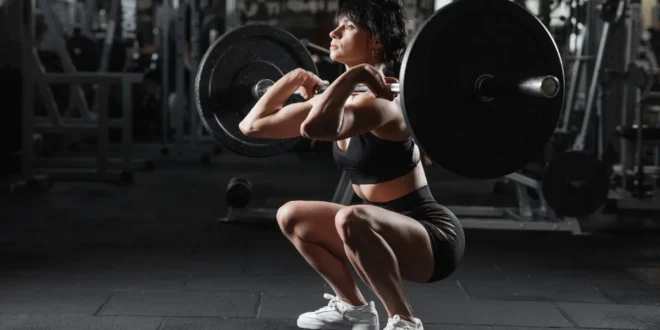

The front squat is a lower-body strength exercise that is excellent for working the quadriceps and core, as well as, to a lesser extent, the stabilising muscles of the back. It helps develop strength throughout much of the anterior chain of the legs, lower back and shoulders, depending on the grip position.
How to do the front squat?
To perform it correctly, follow these steps:
- Choose your grip: The clean grip (as used in weightlifting, with the fingers under the bar) is the most recommended option if your wrist mobility allows it. Otherwise, the cross-arm grip (arms crossed over the bar) is a perfectly valid alternative.
- Keep your elbows high: Your elbows should point forwards and upwards, almost parallel to the floor. This keeps the bar stable and your torso upright. If your elbows drop, the bar moves forwards and you lose position.
- Chest up, core engaged: Before starting the descent, keep your chest slightly lifted and brace your core as if you were about to take a hit.
- Descend under control: Keep your knees tracking in the same direction as your feet, move your hips back and down, and keep your heels in contact with the floor.
- Depth: Ideally, descend until your hips are level with your knees or slightly below, provided you can maintain proper technique.
- Drive through the floor to stand up: Keep your elbows in position and avoid letting your torso lean forwards.
Which muscles does the front squat work?
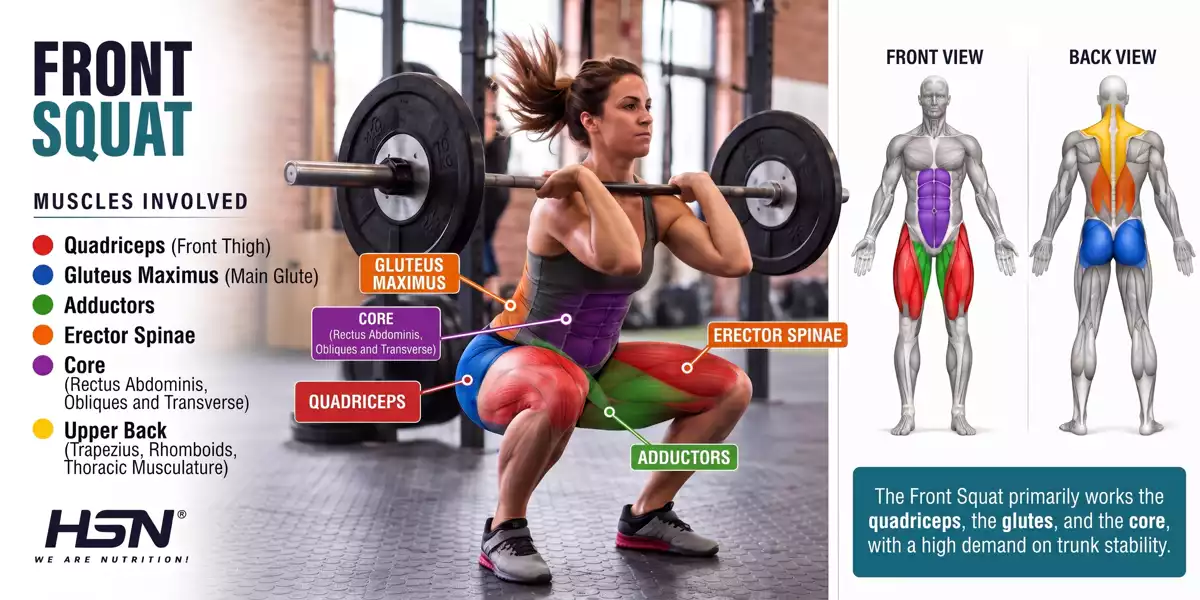
Benefits of the front squat
Greater core and stabilising muscle activation
Keeping your torso upright with the load positioned in front of you requires constant isometric work from the abdominal muscles and spinal erectors.
- In practice, every front squat repetition is also, to some extent, a core exercise.
Less stress on the lower back
By reducing forward torso lean, the lever arm acting on the lumbar spine is reduced compared with the back squat when using the same load. This does not mean that the front squat is risk-free (no exercise is if performed incorrectly), but for the same load, it generally produces less lumbar shear stress.
- This is one of the reasons it is often recommended for people who want to squat with added resistance but experience discomfort in the lower back with the back squat.
Greater emphasis on the quadriceps
The more upright torso position shifts some of the work from the posterior chain (glutes and hamstrings) towards the quadriceps compared with the back squat.
- If your goal is specifically to develop your quadriceps, the front squat is a very effective option.
Improved joint mobility
Performing a technically correct front squat requires good ankle mobility (to keep the heels on the floor while maintaining an upright torso), as well as hip and wrist mobility (for the clean grip).
- Practising it progressively can itself provide a stimulus to improve this mobility over time.
Transfer to other sports and disciplines
If you practise weightlifting, the front squat is practically essential: it replicates the receiving position of the clean.
- But its usefulness goes beyond weightlifting: contact sports, martial arts and disciplines that require an upright torso under load (such as CrossFit) can also benefit directly from this transfer.
An extra boost for your everyday posture
Repeatedly training the pattern of keeping an “upright torso under load” can help reinforce better movement mechanics outside the gym.
- Especially during everyday movements such as lifting weight from the floor.
Common mistakes and how to fix them
| Common mistake | Solution |
|---|---|
| Elbows drop during the descent | Focus on keeping them high and pointing forwards; work on wrist mobility if you find it difficult to maintain the position |
| Torso leans forwards | Engage your core before starting the movement and avoid using more weight than you can control with proper technique |
| Heels lift off the floor | Work on ankle mobility and adjust your stance width until you find a stable base |
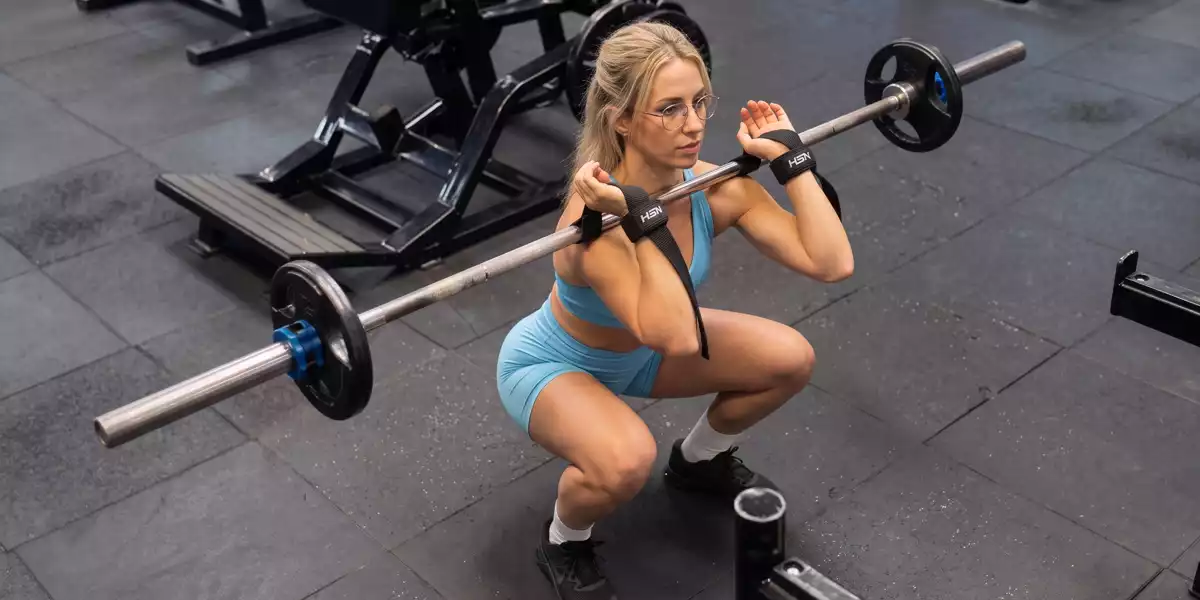
| Wrist pain or discomfort | Try the cross-arm grip or use straps while you work on improving your mobility |
| Insufficient depth or incomplete squat | Reduce the load and prioritise a full range of motion before increasing the weight |
| Knees collapse inwards | Strengthen the gluteus medius and make sure your knees track in the same direction as your feet throughout the movement |
Front squat vs. back squat: which should you choose?
It is not a question of one being “better than the other”: they complement each other.
- If your goal is maximum strength, the back squat will probably allow you to move more weight.
- If you want to target your quadriceps, improve transfer to weightlifting or reduce stress on the lower back, the front squat has plenty to offer.
| Feature | Front squat | Back squat |
|---|---|---|
| Muscular emphasis | Quadriceps, core | Glutes, hamstrings |
| Load capacity | Lower | Higher |
| Technical demands | High (wrist/ankle mobility) | Moderate |
| Relative lower-back stress | Lower | Higher |
Ideally, if your training programme allows it, include both.
How to progress towards the front squat if you are not comfortable with it yet
- Start with the goblet squat: Holding a dumbbell or kettlebell against your chest is an excellent first step for learning the upright torso pattern without the technical demands of a barbell.
- Work on wrist and ankle mobility: Use specific stretches and mobility exercises before each session.
- Use straps for your grip: If your wrist mobility does not yet allow you to use the clean grip, straps are a perfectly valid temporary solution while you progress.
- Don’t rush to increase the load: Technique comes first; the weight comes later.
Nutrition and recovery: the other side of the equation
Training the front squat regularly, especially as you progressively increase the load, is demanding on both your muscles and nervous system. Certain nutrients can provide useful support as part of a balanced diet:
- Protein: meeting your daily protein requirements supports the maintenance and development of muscle mass following strength training.
- Creatine monohydrate: daily consumption of 3 g contributes to increased physical performance in successive bursts of short-term, high-intensity exercise, such as sets of front squats.
- Magnesium: contributes to normal muscle function, which is particularly relevant during periods of high-volume or high-intensity training.
Conclusion
The front squat is not simply “the other squat”: it is an exercise in its own right, with specific benefits for the core, posture, quadriceps and overall mobility.
It requires a little more patience with technique at first, but that investment can result in a more complete movement and, for many people, one that places less stress on the lower back than the back squat.
If it is not yet part of your routine, it may be time to start with a goblet squat and gradually build the movement pattern until you are ready to perform it with a barbell.
Related Posts
- How to do goblet squats step by step
- Bulgarian squat vs traditional squat
- When to use knee wraps for squats