Fitness, Nutrition, Health and Sports Blog In the HSNstore Blog you will find tips about Fitness, sport in general, nutrition, and health – HSNstore.com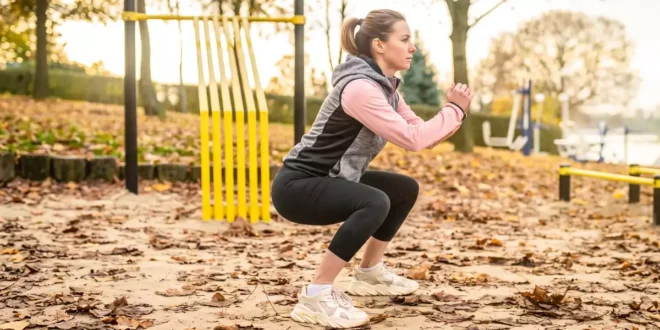

If you train regularly or coach others, you’ve probably seen (or felt) the knees “cave inward” when descending into a squat. It’s one of the most commonly discussed movement patterns in the weight room—and also one of the most misunderstood: it doesn’t always mean an injury is imminent, but it shouldn’t simply be ignored either.
Let’s break down why it happens:
What Exactly Is Knee Valgus?
Dynamic knee valgus occurs when, during the descent or ascent of a squat, the knee moves medially relative to the foot and hip instead of remaining aligned over the toes.
- It isn’t an isolated problem at a single joint: it’s the result of how forces are distributed between the foot, knee, and hip throughout the entire kinetic chain.
The Most Common Causes
Weakness or Reduced Activation of the Gluteus Medius and Hip External Rotators
These muscles play a key role in controlling femoral internal rotation and adduction during the squat. When they don’t generate enough tension, the femur can “collapse” inward, taking the knee with it.
Limited Ankle Mobility (Dorsiflexion)
If the ankle doesn’t allow sufficient range of motion, the body looks for a compensation to continue descending. One common strategy is internal rotation of the tibia, which can contribute to the knee moving into valgus.
Motor Control and Learned Movement Patterns
Sometimes the issue isn’t strength or mobility, but movement patterning: the person may never have learned to consciously control the position of their knees during the squat, so the nervous system doesn’t automatically prioritize that alignment.
Loads That Exceed Stabilization Capacity
With loads close to maximal, some degree of knee valgus can occur even in athletes with good movement control, as the body prioritizes completing the lift over maintaining perfect alignment.
The key here is to distinguish between mild, occasional valgus under maximal loads and pronounced, consistent valgus with submaximal loads.
Individual Anatomy
Factors such as the Q-angle—the relationship between the hip, femur, and knee—vary from person to person and may make some individuals naturally more prone to displaying knee valgus without necessarily indicating dysfunction.
Is It Always a Problem?
Not necessarily. Mild, occasional knee valgus, particularly during the final repetition of a heavy set, isn’t usually a cause for alarm in healthy athletes.
What does deserve attention is pronounced valgus that occurs repeatedly on every repetition and is present even with light loads, as this may increase stress on structures such as the anterior cruciate ligament and the patellofemoral joint.
How Is It Usually Addressed?
- Specific work for the gluteus medius and hip external rotators (clamshells, monster walks, banded hip abductions).
- Ankle mobility work if dorsiflexion is limited (this can be assessed using the knee-to-wall test).
- Motor-control cues: cues such as “knees out” or using a resistance band around the knees as proprioceptive feedback while learning the movement pattern.
- Load progression that matches the individual’s actual ability to maintain control, without forcing loads that compromise technique.
Knee valgus doesn’t have a single cause, so there isn’t a single solution either. Identifying whether the main contributing factor is strength, mobility, or motor control is the first step before prescribing any corrective exercise.
Sources
- Bloom, N., & Cornbleet, S. L. (2014). Hip rotator strength in healthy young adults measured in hip flexion and extension by using a hand-held dynamometer. PM&R, 6(12), 1137-1142.
- Contreras, B. (2015). Why Do People’s Knees Cave Inward When They Squat?. http://bretcontreras.com/. Retrieved March 3, 2015, from http://bretcontreras.com/peoples-knees-cave-inward-squat/
- Vaarbakken, K., Steen, H., Samuelsen, G., Dahl, H. A., Leergaard, T. B., Nordsletten, L., & Stuge, B. (2014). Lengths of the external hip rotators in mobilized cadavers indicate the quadriceps coxa as a primary abductor and extensor of the flexed hip. Clinical Biomechanics, 29(7), 794-802.
Related Posts