Fitness, Nutrition, Health and Sports Blog In the HSNstore Blog you will find tips about Fitness, sport in general, nutrition, and health – HSNstore.com

We explain everything you need to know about fat loss in women. All the factors involved: training, diet throughout the menstrual cycle…
Women and the Menstrual Cycle
The first thing we need to know is that hormonal fluctuations in women are very different from those in men:
- In men, testosterone levels remain stable throughout the month, so there is no need to worry. In other words, simply train, rest and eat properly, and the results will come…
- In women, our familiar menstrual cycle comes into play, causing hormonal and metabolic changes and even changes in behaviour.
When we talk about the menstrual cycle, we can divide it into two phases:
- Follicular phase, which, as its name suggests, is characterised by the development of the follicles. One of them will mature and release the egg, which will travel towards the fallopian tube.
- Luteal phase, during which the corpus luteum develops and, if fertilisation does not occur, it breaks down, leading to menstruation.
Why am I mentioning this?
Simply because hormone levels vary considerably between the two phases. In this article, I will focus mainly on two hormones: oestrogen and progesterone.
Oestrogen
Although oestrogen has often been portrayed as the villain of the story, it helps to:
- Improve insulin sensitivity in muscle;
- Oxidise more carbohydrates;
- Reduce appetite (Czaja & Goy, 1975); and, in general,
- Provide more energy for physical activities.
This effect may be linked to its interaction with leptin, a hormone that plays a key role in controlling the number of calories we consume and burn.

It has been observed that when oestrogen levels are low, the central effects of leptin decrease, especially in the arcuate nucleus, affecting AgRP and POMC.
PMS (Premenstrual Syndrome)
On the other hand, during PMS (premenstrual syndrome), appetite increases (Asarian & Geary, 2002), carbohydrate sensitivity worsens, and women tend to be less physically active.
This creates an ideal environment for increasing body fat.
Some studies1 have observed that during the premenstrual phase, women increase their calorie intake through foods high in fat and refined sugar, while reducing their protein intake.
As a reminder, women tend to store more fat in the lower body, particularly around the hips and glutes.
In these areas, larger adipocytes (fat-storing cells) have been observed, together with a greater number of alpha receptors and fewer beta receptors. This makes it more difficult for the body to use these cells to release fatty acids as an energy source.
Hormones and fat
Can you guess which two hormones also regulate the amount of “fat” we store?
Exactly: oestrogen and progesterone.
In very simple terms:
- Oestrogen reduces the activity of LPL, an enzyme (protein) that promotes body fat storage.
- Progesterone increases the activity of this enzyme3, 4.
Diet and Training throughout the Menstrual Cycle
We can divide our planning into two parts:
- A high-carbohydrate diet with higher-intensity exercise.
- A high-fat diet with more aerobic or less demanding exercise.
Naturally, this will be determined by the menstrual cycle, with more carbohydrates before ovulation and more fat after ovulation, during the week leading up to menstruation.
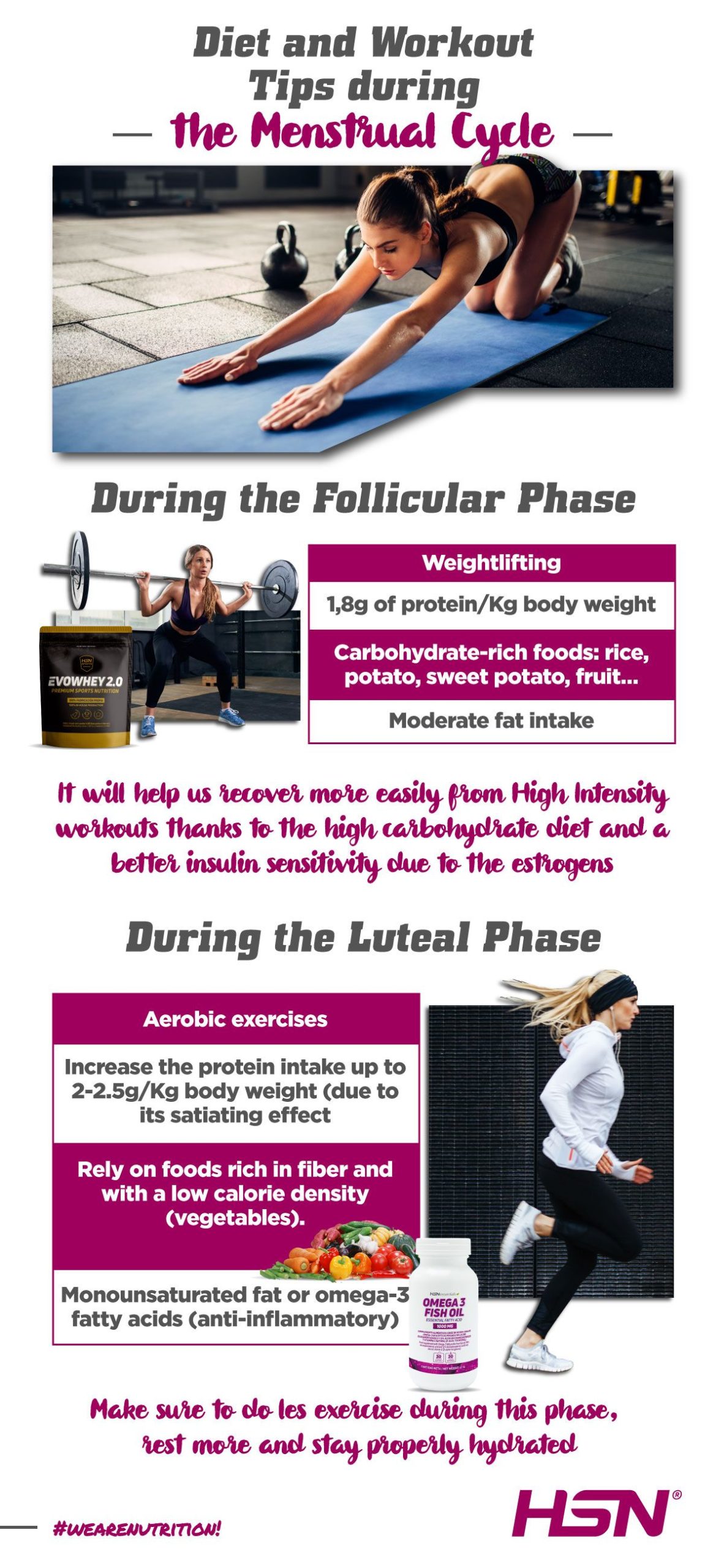
During the Follicular Phase
During this post-menstrual phase:
- Exercise with weights.
- High-intensity training, which we will recover from more easily thanks to a high-carbohydrate diet and, to a large extent, the improved insulin sensitivity associated with oestrogen.
- During this phase, we will consume around 1.8g of protein/kg of body weight.
- Foods such as rice, potatoes, sweet potatoes, honey, fruit and quinoa, among others, without forgetting a moderate intake of fats and vegetables.
During the Luteal Phase
After ovulation:
- We will perform aerobic exercise.
- We will increase protein intake to 2-2.5g/kg of body weight due to its satiating effect.
- We will base our diet on high-fibre foods with a low calorie density, such as vegetables.
- Monounsaturated fats or fats rich in omega-3 (anti-inflammatory).
Buy premium-quality Omega-3 at HSN
Supplements for PMS
When it comes to PMS (premenstrual syndrome), there are supplements that may help reduce symptoms such as anxiety, stress, low mood and tiredness.
Buy supplements for female hormones at HSN
I hope you find this useful and, above all, that it helps you stick to your nutrition plan more easily.
References
- Changes in nutrient intake during the menstrual cycle of overweight women with premenstrual syndrome. Cross GB1, Marley J, Miles H, Willson K.
- Modest changes in dietary intake across the menstrual cycle: implications for food intake research. Bryant M1, Truesdale KP, Dye L.
- Estrogen regulation of adipose tissue lipoprotein lipase— Possible mechanism of body fat distribution. Thomas M. Price, MD,a Susan N. O’Brien, PhD,b Brenda H. Welter, MT(ASCP),b Richard George, MD,b Jyoti Anandjiwala, PhD, b and Michael Kilgore, PhDb
- Effect of Local Application of Progesterone on Human Adipose Tissue Lipoprotein Lipase. M. Rebuffe-Scrive, A. Basdevant and B. Guy-Grand
Related Articles
- To discover 4 reasons why women should do strength training, click here.
- How can cellulite be treated? Find out more in this article.
- Supplements for the Menstrual Cycle.
- Should women take creatine? We answer your questions.