 Fitness, Nutrition, Health and Sports Blog In the HSNstore Blog you will find tips about Fitness, sport in general, nutrition, and health – HSNstore.com

Tired of your training routine? Don’t enjoy it? Don’t you see any results?… Take note of the following High Intensity Training Exercise Routine
Then it’s time to add the following bunch of exercises to your routine. And I can assure you, you won’t be getting bored with this one. In fact, it’ll get you motivated!
They’re mainly functional exercises, which help to improve cardiopulmonary capacity (metabolic conditioning), and you can even do them at home, even if you have to invest a little money first, I assure you that it’ll be worth it 😉
High Intensity Training is not HIIT
Sometimes, High Intensity Training is being confused with HIIT
Although they may seem to be the same, in my view, they are two different developments in training methodology:
The main difference lies in effort and duration: in this version, a few sets or repetitions of the activity in question will be performed to the maximum of our capacity, followed by a previously established recovery time.
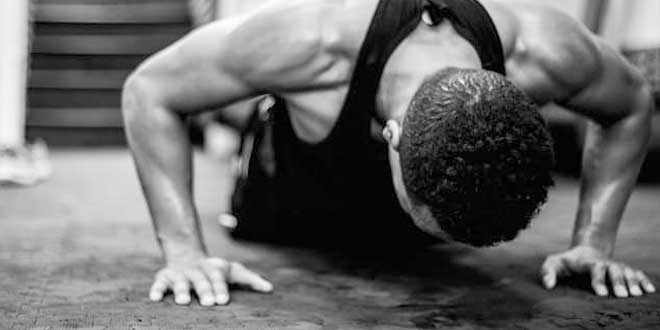
If done correctly, chances are you won’t be able to complete too many rounds or “sets” (maybe around 6…)
What is High Intensity Training?
What I intend to explain in this article is related to Circuit Training
It aims at:
Increasing the heart rate to the set training zone and maintaining it during the course of the session in order to induce improvements in cardiovascular endurance and, at the same time, muscular endurance.
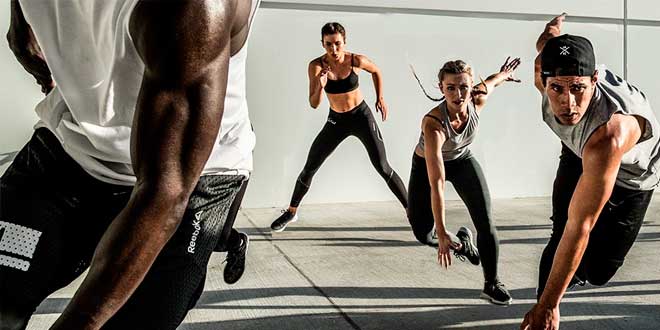
High Intensity Workouts at Home?
The exercises and routine that I propose in the article are totally feasible to do at home
The main drawbacks will be:
- Space to store the “tools” and the place you can use them: for the second issue, you can always go down to a park…
- Financial
What are High Intensity Exercises?
In the following list of exercises, I’ve divided them into 3 fields:
- With equipment: kettlebells, ropes, jump boxes…
- Using machines: rowing, airdyne…
- Without using machines: running, swimming, walking…
High Intensity Exercises Using Equipment
Sled
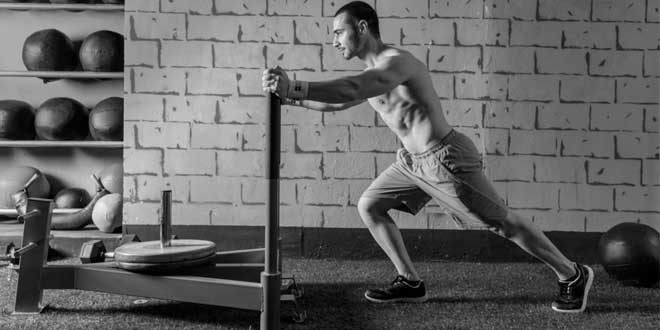
After pushing the sled, you can throw in everything you want, which will be effortless to push… The effort made when pushing the sled is concentric (cancelling out the eccentric), which indicates that we’re going to see a reduction in DOMS (these are magnified in the eccentric phase of a movement). The sled also has a low joint impact. And there’s also a great deal of power involved, which is going to transfer to other activities.
Clubbells
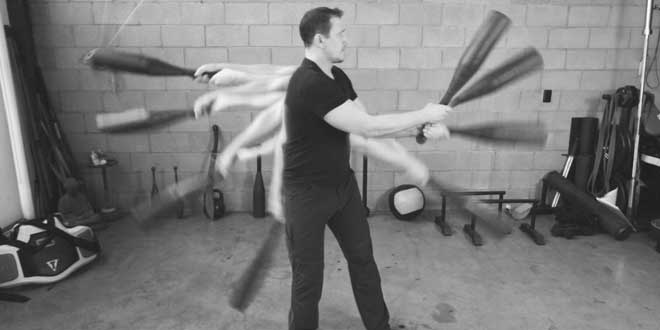
Clubs for beating in the air. This would be a good definition of them. One thing’s for sure, you’re going to have a lot of fun with them. You might not have heard of them, as they’re often not easily found in commercial gyms. So you might have to look for them on your own. Clubbells combine strength, coordination, balance, among other abilities, as well as being able to work on different levels. Many routines using them directly inherit similar movements used in combat of yesteryear. You’ll see a demonstration in this video.
Keep an eye out for anyone crossing paths with you while you’re training with them!
Ropes
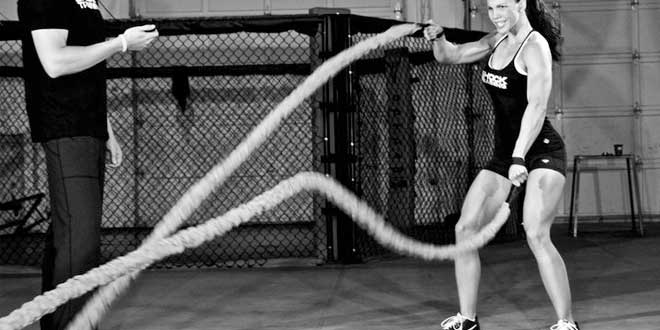
How can a simple rope make us sweat like that? This is what you’ll be thinking every time you beat the “waves” out of the ropes. Once again, it is our cardiorespiratory system that will be feeling the most “thrashing” with this training tool. Try to keep your back in a neutral position (don’t shrink…) and use the tension of your abdomen so that your arm swing is effective.
Kettlebells

We’ve already looked at Kettlebells before. The main feature of this tool is based on the shape of its grip, which keeps the centre of gravity displaced (unlike a conventional dumbbell) and forces us to generate an extra stabilising force. This applies to the different exercises, one of the most common being the Swing. Postural control in this exercise is key, as is breathing control, which we’ll see increase exponentially after several reps.
Box Jumps
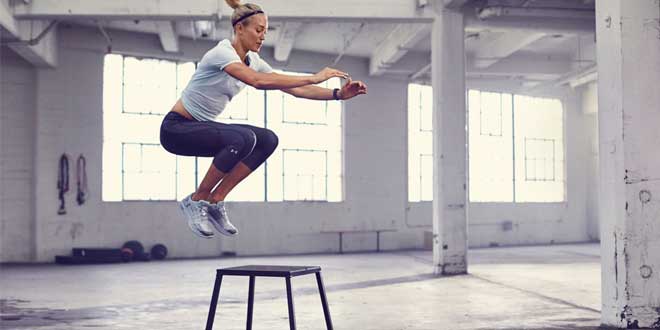
This is a plyometric exercise. The peculiarity of this training lies in the “minimum contact time with the ground”. Therefore, in each repetition, our task, once we’ve jumped on the platform, is to land back on the ground and to be as fast as we can to generate another jump. Once we’re on the platform, our hip extension should be fully developed. On the other hand, be careful, as when you get tired during the exercise, if you don’t jump well, “your tibias will be punished” 😯
Skipping
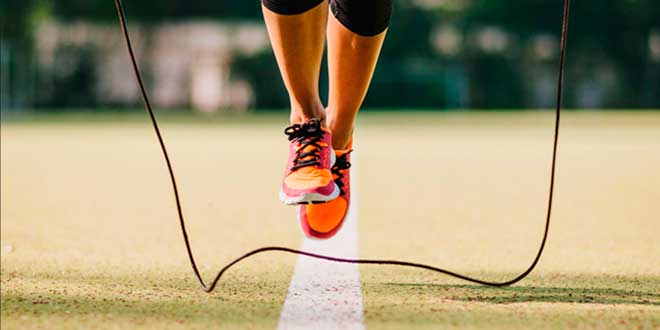
Skipping ropes aren’t child’s play. Or maybe during our childhood it was easier for us to skip it…? Even so, it’s a classic exercise – affordable and easy to practice anywhere (here the only thing that’s needed is space to ensure it doesn’t hit anyone. We can start our routine by doing this exercise as a warm-up, or include it within the circuit.
If you want to add extra intensity, try doing Double Jumps:
Punching Bag

Have a bad day at work? Something stressing you out? How about a little shot on the punching bag? You can use it at any time (to de-stress…), when you return home, as soon as you get up… You also get variations that stand alone, without the need to hang them.
The punches that you’ll execute will be: “uppercuts”, “crochets”, and punches while moving your leg forward then returning to the starting position… The role of the hips is always important, as well as the position of the legs and feet, always in semi-flexion, and when we move we do so on our toes, and when we throw the punch, for example an uppercut, we rotate on the ball of our foot…
Medicinal Ball

This peculiar ball is heavy enough to add a certain intensity to the different exercises that can be performed with it. Among the best known are the “ball throws”. In these, we’ll look for a point on the wall, at a height of 2.5-3 meters, and we’ll try to “hit the target”. Of course, all this through a squatting and throwing movement.
How do you do a wall ball shot?
There are other exercises that can be performed as long as we have a wall to throw a number of “balls” against.
Here’s a compilation:
High Intensity Exercises Using Machines
This will be the “most expensive” part if you intend to set up a high-intensity gym in your own home. However, apart from the economic aspect, everything else is great.
Rowing Machine

The rowing machine is the perfect candidate for both moderate intensity training over a prolonged period of time, as well as high intensity training, all while minimising the joint impact that could be caused by, for example, running for more than an hour. With each row, we’ll be working muscle groups from both the lower and upper body, which makes it a very complete tool. If you have the chance, buying one of these is sure to bring success.
Assault Bike (Airdyne)
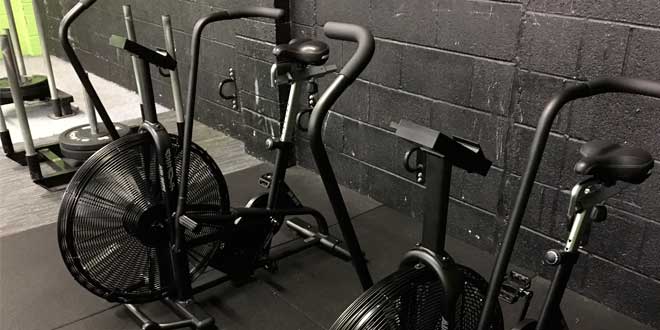
According to some athletes who train with them, they’re the hell machine… And there’s a reason for that. Simply riding it for several minutes will give you one of the most powerful sensations that any fitness machine can give you. Its metabolic benefits are incredibly high. As with rowing, both the legs and arms are worked, in a continuous effort to move the huge blade. This training system isn’t new, but it was thanks to the breakthrough of CrossFit that it became “fashionable” again. If you want to get rid of the cold in one fell swoop, try it…
Ski Erg
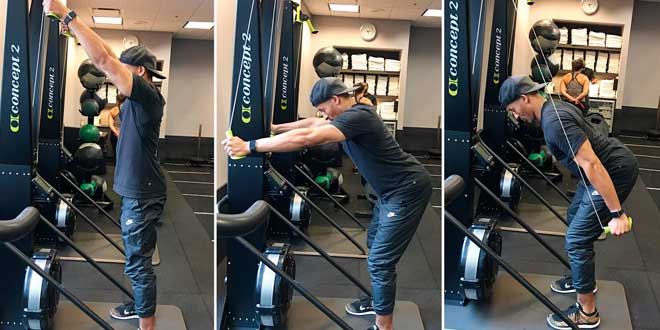
The cross-country skiing simulation machine. One of the great advantages is the zero joint impact, meaning we can exercise even if we’re convalescing from an injury. It allows us to train the whole body, being quite easy and comfortable to control the intensity of the exercise, making it an excellent complement to any strength or other type of training programme. You don’t have an excuse not to ski anymore!
High Intensity Exercises Without Machines
Running

Running isn’t for the faint hearted… It’s the quintessential movement that humans have repeated since they first stood up. It’s helped us survive predator attacks and escape with flying colours, and get our prey for the night’s feast. However, my general view on running is that I wouldn’t recommend prolonged duration, unless, of course, our goal is competition. In any case, it’s not the most efficient if you’re looking for weight control, and it can give you some headaches in terms of injury.
After experiencing the Aerobic Capacities applied to Crossfit Seminar myself, my vision changed, and improved my understanding of the activity, applying it in parallel to strength training.In the BPT training system, sessions are planned that work according to this methodology, where training at a certain capacity is prioritised: Lactate Threshold, VO2MAx, Speed, or Resistance.
Swimming

A perfect activity that requires – and I’m sure we can agree on this – a mastery of technique. Everything is technical, any activity. But when you’re in the pool or in the sea itself, it becomes even more important. Basically because efficiency is key. “Any” person in good shape, even if they don’t have an optimal technique, may be able to perform sprints of 25, 50 or even 100m (in a 25m pool). Then it’s about practice, practice, practice…
But even so, it’s a great activity, again with zero joint impact, meaning you can do it as much as you like. We can also use it in high-intensity training.
Climbing Stairs

After a good warm-up, we can do a great high intensity session climbing stairs. And you’ll really feel it. You’ll notice how your “ppm” will start rising almost straight away. If you’re fit, you can increase the intensity from the get go and start running up the stairs… The descent should be done walking, however.
Walking

Walking alone is not a high-intensity activity. But if you put on a weighted vest, and adjust the pace to a military rhythm, you’ll get the results you’re looking for. Otherwise, my suggestion is to intersperse our “walk” with lunges. A very easy way to do this: at the beginning of each minute, do 5 walking lunges on each side, and continue for the rest of the minute walking in the usual way.
High Intensity Exercise Routine
The following routine is fully customisable and can be adjusted to each person. My recommendation, if you can, is to train early in the morning, either on an empty stomach, or after a small snack.
Weekly Outline
We’re going to train for four days. Active rest is recommended one day a week, such as walking at a normal pace for 30-60min.
How are we going to train?
As this is High Intensity Training, we can’t lengthen the effective part of it too much. We can use the Tabata method, EMOM, supersets, times rounds…
Routine
Day 1 Activation: 3min Rowing Machine + 5 Intervals 20″ on 40″ off 1) Complete 5 Rounds per time period - 10x Deadlift with Double Kettlebells
- 10x Rows with Double Kettlebells
- 10/10x 1-Hand Swing with Kettlebells
2) Box jumps 15 12 9 6 *between each round -> Push the Sled 15m
3) Running: 5min EMOM Sprint 50m Day 2 Activation: 3min Ski Erg + 5 Intervals 20″ on 40″ off 1) Complete Circuit with Clubbells for 15min *use the above video
2) Complete rowing circuit -> 30 25 20 15 10 *between each round -> 12x wall ball shots
3) Assault Bike: “Reverse” Tabata: 8x 10″ on 20″ off Day 3 Activation:Swimming 5min 1) Complete 5 Rounds - 25m sprint
- Get out of the water and do 20x push-ups
- 25m sprint
- Get out of the water and do 20x air squats
60sec break between rounds
2) 12min EMOM - Min -> 25m sprint
- Min -> breaststorke or backstroke
Related Entries
- Overtraining exists, but we help you to recognise it.
- All About Functional Training
- Motivation to Train