Fitness, Nutrition, Health and Sports Blog In the HSNstore Blog you will find tips about Fitness, sport in general, nutrition, and health – HSNstore.com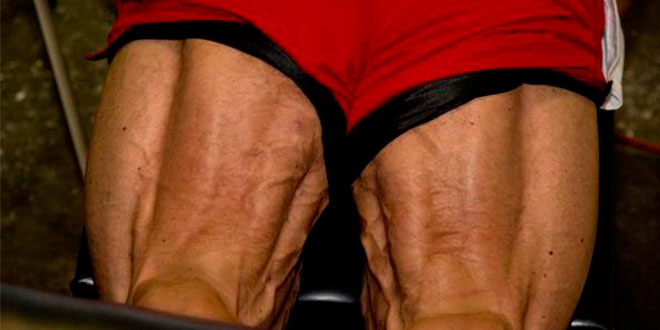

The world of professional sports is deeply involved in studying muscle injuries caused by overexertion in the hamstrings since they are the most common in football, rugby (excluding contact injuries), and athletics, especially in more explosive events. This has led to some pretty interesting findings for injury prevention work (the classic strength training) and for those looking to improve the back of the thighs (hamstrings) to benefit from in their workout routine.
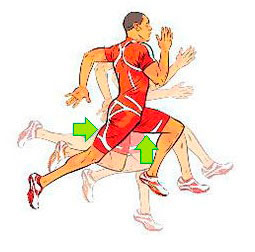
During the final push phase in sprinting, the hamstring muscles act as decelerators of hip flexion and knee extension as the leg strikes the ground. This is quickly followed by hip extension, accompanied by knee flexion to bring the heel toward the glutes. All of this forms a stretch-shortening cycle (SSC) in the hamstrings. The need to increase hamstring strength also supports the success of their hypertrophy (size increase) through the most efficient exercises.
Specific behavior
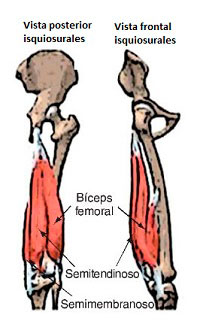
Measurements reflect the activity of the biceps femoris and semitendinosus. The third muscle in the group, the semimembranosus, was not measured since its injury incidence is low compared to the other three heads of the hamstring group (long and short heads of the biceps femoris, and semitendinosus).
Also, previous and known data show that semimembranosus and semitendinosus work synergistically (joint action) during their concentric and eccentric actions: extending the hip (thigh toward the back), flexing the knee, and contributing to internal rotation of the knee.
The long head of the biceps femoris differs significantly in activation compared to the rest. Its maximum voluntary activation is lower during eccentric phases compared to the other hamstrings. This suggests the existence of a neural inhibitory mechanism and, therefore, the voluntary inability to support excessive load during sprints, especially when fatigue accumulates. That’s why it’s the main target for strengthening in physical preparation work for explosive, mixed, and team sports.
The best exercises
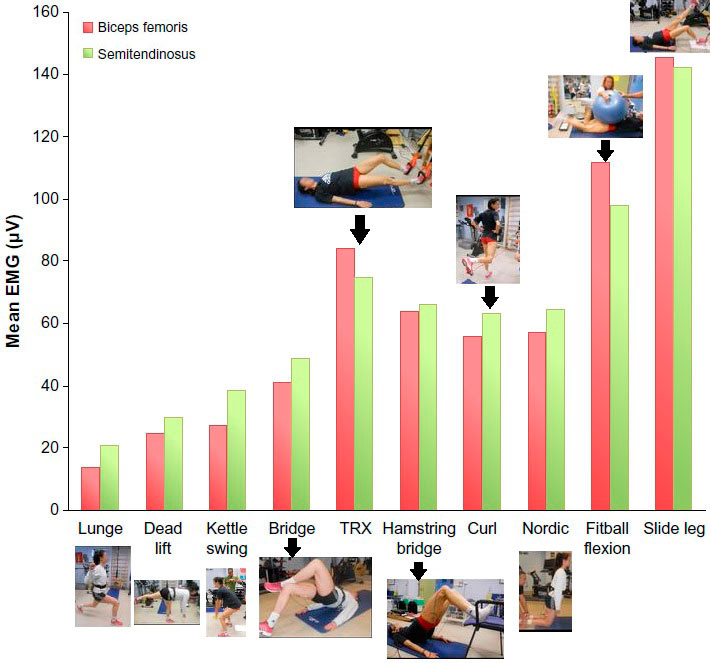
I think with the info we have nowadays, it’s time to switch up the typical leg curls (seated, lying, and/or standing) for other exercises where activity is higher. The following chart shows the results of 10 exercises that can be included in your leg routine, hip-dominant, knee-dominant, rehab, back of the thigh, etc. Also, you can check out the stiff-legged deadlift or the hip thrust as alternative exercises.
Sources
- Higashihara, A., Ono, T., Kubota, J., & Fukubayashi, T. (2010). Differences in the electromyographic activity of the hamstring muscles during maximal eccentric knee flexion. European journal of applied physiology, 108(2), 355-362.
- Onishi, H., Yagi, R., Oyama, M., Akasaka, K., Ihashi, K., & Handa, Y. (2002). EMG-angle relationship of the hamstring muscles during maximum knee flexion. Journal of Electromyography and Kinesiology, 12(5), 399-406.
- Tsaklis, P., Malliaropoulos, N., Mendiguchia, J., Korakakis, V., Tsapralis, K., Pyne, D., & Malliaras, P. (2015). Muscle and intensity based hamstring exercise classification in elite female track and field athletes: implications for exercise selection during rehabilitation. Open access journal of sports medicine, 6, 209.