Fitness, Nutrition, Health and Sports Blog In the HSNstore Blog you will find tips about Fitness, sport in general, nutrition, and health – HSNstore.com

If you’re looking for Exercises to Slim Down Legs, you’ve found your article!
Usually, when we talk about leg training, we aim for maximum volume.
That’s the goal for many gym regulars, but some are after other training benefits, and depending on their motivations, might want to slim down or reduce leg size. Not everyone has the same goal…
Lean but Strong Legs
When we mention slimming down legs, don’t confuse it with a somewhat “scrawny” look; quite the opposite, reducing volume doesn’t mean looking worse.
What we can do, and will do, is improve our shape (“tone”) by focusing on reducing accumulated fat

Calories
Obviously, if your goal is to slim down legs, it’s important to keep calorie intake in check.
In this regard, the diet profile should be slightly hypocaloric (calorie deficit), but avoid prolonging this deficit by doing controlled periodic carb reloads

Slimming legs shouldn’t mean looking weak, quite the opposite: better muscle tone!
Exercises and Muscle Fiber Types
Here, we’ll talk about the fiber type we want to activate to burn the most calories, and their origin. Each fiber type uses a different energy substrate depending on exercise intensity.
So, within the muscle fiber types, we find 3 types:
| Fiber Type | Energy Metabolism | Characteristics |
| Type I or Oxidative Fibers | Fats | High Endurance (hours); Long Duration, Low Intensity Activities (walking, jogging, cycling at an easy pace…) |
| Type IIA or Oxidative Glycolytic Fibers | Fats and Glucose | Medium Endurance (minutes); Medium Duration and Intensity Activities (running at a moderate pace…) |
| Type IIB or Glycolytic Fibers | Phosphagens | Low Endurance (seconds); Explosive or Power Activities (sprints, Olympic lifts…) |
Plyometric Exercises
These are very fast movements involving a quick stretch or loading of the muscle followed by a strong contraction. Examples: jump rope, vertical jump, burpee onto a box…
In other words, we train type IIB fibers.
The benefits of plyometric training are pretty impressive, like:
- Burning calories: due to the oxygen debt they create, even after the session ends
- Power and speed: transferable to any sport discipline
- Fun: these exercises break away from conventional training and are usually very enjoyable, plus you get to feel like a pro athlete
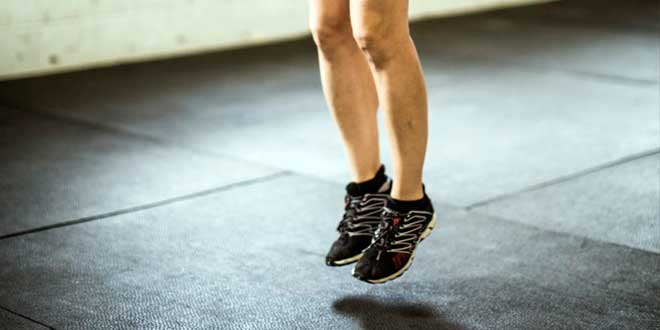
We’ll do a combo of exercises keeping these physiological muscle behavior traits in mind, to maximize our goal. In this case, alternating fatigue exercises with explosive ones.
Top Exercises to Slim Down Legs and Burn Fat
Jump Rope
Who hasn’t jumped rope at least once, especially after watching Rocky…
Nowadays, jump ropes have evolved with terms like “ultra speed,” especially in CrossFit, where “Double Unders” are common — jumping rope passing the rope twice per jump.
Whichever you choose, jump rope is a complete exercise that boosts coordination, muscle work, and high calorie burn.
Alternatively, do 1-minute jump, 1-minute rest (simple jumps), or 30″ on – 30″ off for Double Unders, until you reach 15-20 minutes total. Another way is the TABATA method, meaning 8 rounds of 20″ work and 10″ rest.
Set a 20-minute countdown timer and start at 3, 2, 1…..
Jumping Lunge
Also called “Split Jump Lunge.” As speed increases, so does the fun… It’s super important to master technique here to avoid injury (twisting an ankle, bad knee movement), so start slow, there’ll be time to pick up pace. Definitely one of the exercises that will spike your bpm in seconds.
Another great use is in a metabolic circuit (or WOD in CrossFit lingo)
Box Jump
Box jumps are the clearest example of plyometric exercise: you have to overcome gravity to jump onto a platform (or obstacle), with no time to hesitate mid-air, so you gotta be committed.
One main downside is overestimating your ability, especially when fatigued or after many reps, or else your shins will pay the price ;(
Do 10-15 reps per round. Adjust box height to your level
Burpees Over the Bar
Seeing burpees in a workout usually gets a reaction. Add another element, and alarms might go off. If you don’t know them, I recommend practicing burpees alone until you “master” them (though in the end, they always master you…).
This exercise involves jumping over a bar or similar height object (kettlebell, cone… or even jumping over the rowing machine :O). You can jump over frontally or sideways (I prefer sideways from experience…).
Do 5 sets of 10 jumps with 60″ rest
Shuttle Run
Now a running exercise that probably reminds you of childhood (well, some of you played it…), basically sprint there, touch, sprint back. It’s also common in performance tests or job fitness tests.
Still, it’s an excellent high-intensity cardio exercise and fits our goal.
The exercise is always from start (0 meters) to first mark (5 meters), touch the ground, sprint back to 0, touch ground, sprint to second mark (10 meters), touch, sprint back…
Do 10 rounds of this sequence (up to 20 meters) with 60-90″ rest
Combined Exercises for Explosion and Sprinting
These produce a strong post-exercise oxygen consumption effect (EPOC) because they pre-fatigue fibers to explode in a final sprint.
This is similar to high-intensity interval training (HIIT), and I assure you each set will leave you breathless, needing extra rest to tackle the next.
Here’s a list from easier to harder so you can pick your poison! (video refers to the first exercise since we all know what a sprint is…)
Walking Lunges + Sprint
Do 5 sets of 10 lunges (alternating) followed by a 30 m sprint
Tuck Jumps + Sprint
Burpees + Sprint
Use EMOMs (complete the work within the minute, rest for the remainder). Simple example: EMOM 5min 5x Burpees —> means 5 sets (5 min) each with 5 burpees. Start the timer, do 5 burpees, rest for the remaining time until the minute ends. Do EMOM 7 min of 7x Burpees + 15 m Sprint
Related Posts
- Bodyweight Exercises for Strong Legs
- Quadriceps Exercises
- Burpee, Everything You Need to Know