 Fitness, Nutrition, Health and Sports Blog In the HSNstore Blog you will find tips about Fitness, sport in general, nutrition, and health – HSNstore.com


Strength training in kids and teens has been a controversial topic, especially strength training itself
The risks of working with a body still developing, doubts about adaptive possibilities at these ages, and the lack of scientific knowledge in this field have led experts to give overly cautious recommendations.
Luckily, everything we know today about the physiological response to different training loads in kids and teens lets us explain some realities with a broader perspective.
Myths and beliefs about strength training in kids and teens
Brown, 2007
- “Strength training stunts a kid’s growth”: a properly designed training doesn’t put much stress on kids’ growth plates; in fact, muscle contraction stimulus is key for proper bone development.
- “Kids can’t get stronger because they lack testosterone”: when comparing strength gains relative to muscle mass, kids’ strength gains are similar to adults’. Plus, we know strength gains aren’t caused only by testosterone’s anabolic effects.
- “Strength training isn’t safe for kids”: the risks linked to strength training in kids aren’t different from any physical activity at that age. The key is proper supervision and suitable exercises.
- “Strength training makes kids less flexible”: doing strength exercises through the full range of motion doesn’t reduce flexibility; actually, strength training combined with stretching improves flexibility.

Physical activity at this stage
Endurance
As the heart and lungs grow, endurance capacity increases due to higher cardiac output and inspiratory volume. Daily physical activity involving large muscle groups at about 75% of max HR is recommended. Total volume is hard to determine since intense exercises aren’t common except in aquatic sports.
Strength
Strength is quite trainable, with greater development happening post-puberty, around 14 years old.
Flexibility and Coordination
These qualities develop well in kids and teens. Flexibility starts to decline from adolescence if not trained.
Effects of exercise in kids
- On bone: Exercise helps achieve a higher peak bone mass.
- On body fat: It promotes fat distribution, reducing it and fighting overweight and obesity. Also, intensities above 70% boost HDL levels.
- Cardiovascular: Blood pressure reaches adult-like values and exercise effects are the same. In hypertensive youth, physical activity helps normalize BP values.
Benefits of strength training in kids and teens
- Improvements in muscle strength and power.
- Improvements in local muscular endurance.
- Increases in bone mineral density.
- Improvements in lipid profile.
- Improvements in body composition.
- Improvements in motor skills.
- Improvements in sports skills.
- Increased injury resistance related to sports practice.
- Better self-image and self-concept.
- A more positive attitude towards healthy lifestyle habits.
Types of strength training exercises for kids and teens
Regarding the most suitable training type, it should always be progressive and tailored to each kid/teen’s needs, but methods like these seem best:
- Bodyweight exercises (calisthenics)
- Cardio machines
- Work with resistance bands, medicine balls, and age-appropriate machines
- Flexibility training
- Free weight training, like the others, requires a long technique learning period.
Before starting a weight training program for kids
Keep these recommendations in mind:
- Each kid should understand the benefits and risks linked to weight training.
- Training sessions must be supervised by competent and responsible fitness professionals.
- The training area must be safe, hazard-free, with equipment and machines in good condition and sized for each kid.
- Start sessions with warm-up and flexibility exercises.
- Carefully monitor each kid’s tolerance to exercise stress.
- Begin with light weights to allow proper adjustments.
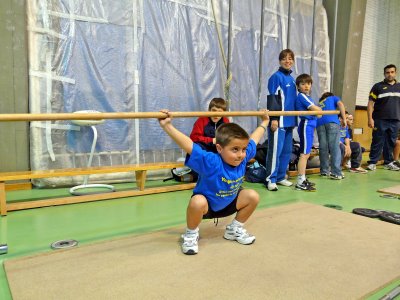
- Increase lifting weight gradually (e.g., 5 to 10%) as strength improves.
- Depending on individual needs and goals, do one to three sets of 6 to 15 reps with a variety of single-joint or multi-joint exercises.
- Advanced multi-joint exercises like snatch, clean and jerk, and presses can be included if proper weights are used and technique is carefully maintained.
- Two or three non-consecutive training sessions per week are recommended.
- Adults should be nearby to actively assist kids in case of a failed rep.
- The weight training program should be systematically varied throughout the year.
- Encourage kids to drink plenty of water before, during, and after training sessions.
Sources
- Bitkin EC, Boyraz M, Taşkın N, Akçay A, Ulucan K, Akyol MB, Akçay T. Effects of ACE Inhibitors on Insulin Resistance and Lipid Profile in children with Metabolic Syndrome. J Clin Res Pediatr Endocrinol. 2013 Sep 10;5(3):164-9.
- Falk, B and Eliakim, A. Resistance training, skeletal muscle and growth. Pediatr Endocrinol Rev 1: 120–127, 2003
- Lee E. Brown. Strength Training. Human Kinetics, 2007
- Malina, R. Weight training in youth-growth, maturation and safety: An evidenced based review. Clin J Sports Med 16: 478–487, 2006.
- Pedro J. Benito Peinado. Conceptos básicos del entrenamiento con cargas: de la musculación al wellness. Editorial Kinesis, 2008
- William J. Kraemer. Strength Training for Young Athletes. Human Kinetics, 2005
- Baechle, Thomas R., and Roger W. Earle. Principios del entrenamiento de la fuerza y del acondicionamiento físico. Buenos Aires: Médica Panamericana, 2007. Print.
Related posts
- CrossFit Kids
- Why healthy habits are needed from childhood