Fitness, Nutrition, Health and Sports Blog In the HSNstore Blog you will find tips about Fitness, sport in general, nutrition, and health – HSNstore.com

Creatine, composed of essential and non-essential amino acids (arginine, methionine and glycine), is widely used as a supplement. It is found mainly in skeletal muscle and can be obtained from animal sources in the diet.
Creatine is beneficial for strength development in high-intensity, short-duration activities such as bodybuilding, weightlifting, team sports (baseball, hockey, basketball, football, rugby).
Some ergogenic benefits of creatine are:
- Increased performance in single and repetitive sprints.
- Increased work performed during sets of maximal effort muscle contractions.
- Increased muscle mass gains and strength adaptations.
- Improved glycogen synthesis.
- Higher anaerobic threshold.
- Possible improvement of aerobic capacity through increased ATP transport from mitochondria7.
- Greater work capacity.
- Increased GLUT4 transporters, (Op ‘t Eijnde B.et.al 2001).
- Improved post-exercise recovery.
- Increased tolerance to training.

Creatine intervention studies in children and teenagers.
In sports nutrition research, intervention studies have been conducted to examine the effects of creatine in children and adolescents, with the aim of better understanding its impacts on this population. We will divide the analyses into two categories: sport and non-sport.
In the field of sport
In sports, studies have shown the benefits of creatine supplementation in younger age groups.
These results support the ISSN recommendations and suggest that creatine may be a safe alternative for performance enhancement. Creatine has also been shown to be effective in women, where a study in junior female swimmers showed an increase in power, pull strength and hydrodynamic coefficient after three weeks of supplementation.
Outside the sporting field
Creatine not only has applications in sports, but also in the clinical setting. It has been observed that creatine supplementation can benefit patients with pathologies affecting the musculoskeletal, cardiopulmonary and nervous systems, improving physical function, performance, muscle weakness and atrophy.
Creatine supplementation has been confirmed to be effective in cases of creatine deficiency syndromes, where significant improvements were observed in restoring normal creatine levels in the body.
These clinical studies have revealed improvements in development, speech coordination and muscle tone in patients with growth and developmental delay. The safety of creatine supplementation has been investigated and no evidence of adverse effects, including renal effects, has been found.
So, is creatine safe for children and teenagers?
The organisation that has taken the strongest position is undoubtedly the International Society of Sports Nutrition (ISSN) which stated in a 2007 review published in the Journal of the International Society of Sports Nutrition that supplementation in young athletes was acceptable if appropriate precautions and supervision are provided.1
Subsequently, a review2 published in Frontiers in Nutrition in 2018 considered creatine use in young people, in most cases reporting no gastrointestinal discomfort or changes in blood markers, which was highlighted:
- The cautious view in extrapolating the lack of studies to non-safety in supplementation on young people.
- That the bulk of warnings about creatine use in the adolescent population may be motivated more by legal caution than scientifically based.2
The growing interest in performance-enhancing supplements [CS1] has led to an increase in their use at younger ages in the sporting arena.
Several studies have been conducted to get a true picture of sports supplement use, including a cross-sectional study conducted by the National Health Interview Survey (NHIS) in 2007, which surveyed 9,417 athletes aged 10-18 years and found a 34.1% prevalence of creatine use.15-16-20-21
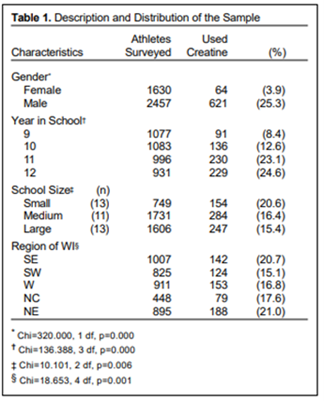
McGuine, T. A., Sullivan, J. C., & Bernhardt, D. A. (2002).
Based on Harmon and colleagues’ study conducted in 2021, the following table on the possible uses of creatine has been compiled:
| EFFECT OF CREATINE SUPPLEMENTATION | |
|---|---|
| EFFECTS WITH THE MOST EVIDENCE | POSSIBLE EFFECTS |
| Increased exercise performance and recovery | Acute injuries |
| Immobilisations | |
| Chronic Obstructive Pulmonary Disease (COPD) | |
| Spinal cord injury | Heart failure |
| Creatine deficiency syndromes (CDS) | Mitochondrial cytopathies |
| Arthritic diseases | Charcot-Marie disease |
| Muscular dystrophy | |
What dose to take, how and when?
Creatine has been extensively researched in adults and is considered safe. However, in children and adolescents further studies are needed due to possible metabolic differences.
There is no solid evidence on the optimal time to take it, but it may be advisable after training because of its role in glycogen replenishment.
In general, there is no additional benefit from a loading phase, and lower doses avoid potential gastric problems.
Which creatine to choose?
Creatine can be found in different chemical forms (creatine hydrochloride, creatine gluconate, creatine phosphate…), but the most widely supported and accessible form is currently creatine monohydrate.
When choosing creatine it is recommended to prioritise sources that are guaranteed to be free of impurities, our Raw Series creatine monohydrate is an excellent choice. Ideal for combining with other products or mixing in your post-workout shake thanks to a neutral taste and solubility due to its 200Mesh particle size.
Conclusions
More and more young athletes are looking to improve their athletic performance by using supplements and ergogenic substances. In adults, creatine is considered safe according to scientific evidence.
Although in younger groups there is no evidence of problems associated with creatine supplementation, studies in young athletes and children/adolescents with certain medical conditions have reported performance and clinical benefits.
Bibliographic sources
- Kreider RB, Kalman DS, Antonio J, Ziegenfuss TN, Wildman R, Collins R, Candow DG, Kleiner SM, Almada AL, Lopez HL. International Society of Sports Nutrition position stand: safety and efficacy of creatine supplementation in exercise, sport, and medicine. J Int Soc Sports Nutr. 2017 Jun 13; 14:18. doi: 10.1186/s12970-017-0173-z. PMID: 28615996; PMCID: PMC5469049.
- Jagim AR, Stecker RA, Harty PS, Erickson JL, Kerksick CM. Safety of Creatine Supplementation in Active Adolescents and Youth: A Brief Review. Front Nutr. 2018 Nov 28; 5:115. doi: 10.3389/fnut.2018.00115. PMID: 30547033; PMCID: PMC6279854.
- Ainsley Dean PJ, Arikan G, Opitz B, Sterr A. Potential for use of creatine supplementation following mild traumatic brain injury. Concussion. 2017 Mar 21;2(2): CNC34. doi: 10.2217/cnc-2016-0016. PMID: 30202575; PMCID: PMC6094347.
- Jagim AR, Kerksick CM. Creatine Supplementation in Children and Adolescents. Nutrients. 2021 Feb 18;13(2):664. doi: 10.3390/nu13020664. PMID: 33670822; PMCID: PMC7922146.
- Preen, D., Dawson, B., Goodman, C., Beilby, J., & Ching, S. (2003). Creatine Supplementation: A Comparison of Loading and Maintenance Protocols on Creatine Uptake by Human Skeletal Muscle, International Journal of Sport Nutrition and Exercise Metabolism, 13(1), 97-111. Retrieved Jun 12, 2023, from https://doi.org/10.1123/ijsnem.13.1.97
- Solis MY, Artioli GG, Otaduy MCG, Leite CDC, Arruda W, Veiga RR, Gualano B. Effect of age, diet, and tissue type on PCr response to creatine supplementation. J Appl Physiol (1985). 2017 Aug 1;123(2):407-414. doi: 10.1152/japplphysiol.00248.2017. Epub 2017 Jun 1. PMID: 28572496.
- Kreider RB, Jung YP. La suplementación con creatina en el ejercicio, el deporte y la medicina. J Exerc Nutr Biochem. 2011; 15 (2):53–69. doi: 10.5717/jenb.2011.15.2.53.
- Smith J, Dahm DL. Creatine use among a select population of high school athletes. Mayo Clin Proc. 2000 Dec;75(12):1257-63. doi: 10.4065/75.12.1257. PMID: 11126833.
- Hickner RC, Dyck DJ, Sklar J, Hatley H, Byrd P. Effect of 28 days of creatine ingestion on muscle metabolism and performance of a simulated cycling road race. J Int Soc Sports Nutr. 2010 Jul 7;7:26. doi: 10.1186/1550-2783-7-26. PMID: 20609257; PMCID: PMC2909923.
- João G Claudino, Bruno Mezêncio, Sérgio Amaral, Vinícius Zanetti, Fabiana Benatti, Hamilton Roschel, Bruno Gualano, Alberto C Amadio & Julio C Serrão (2014) Creatine monohydrate supplementation on lower-limb muscle power in Brazilian elite soccer players, Journal of the International Society of Sports Nutrition, 11:1, DOI: 10.1186/1550-2783-11-32
- DAWSON, BRIAN; VLADICH, TODD; BLANKSBY, BRIAN A.. Effects of 4 Weeks of Creatine Supplementation in Junior Swimmers on Freestyle Sprint and Swim Bench Performance. Journal of Strength and Conditioning Research 16(4):p 485-490, November 2002.
- Del Franco A, Ambrosio G, Baroncelli L, Pizzorusso T, Barison A, Olivotto I, Recchia FA, Lombardi CM, Metra M, Ferrari Chen YF, Passino C, Emdin M, Vergaro G. Creatine deficiency and heart failure. Heart Fail Rev. 2022 Sep;27(5):1605-1616. doi: 10.1007/s10741-021-10173-y. Epub 2021 Oct 7. PMID: 34618287; PMCID: PMC9388465.
- Battini R, et al. Deficiencia de arginina:glicina amidinotransferasa (AGAT) en un recién nacido: el tratamiento temprano puede prevenir la expresión fenotípica de la enfermedad. J Pediatr. 2006; 148 (6):828–830. doi: 10.1016/j.jpeds.2006.01.043.
- Kaviani M, Shaw K, Chilibeck PD. Benefits of Creatine Supplementation for Vegetarians Compared to Omnivorous Athletes: A Systematic Review. Int J Environ Res Public Health. 2020 Apr 27;17(9):3041. doi: 10.3390/ijerph17093041. PMID: 32349356; PMCID: PMC7246861.
- Woodbridge, W. R. S. (s/f). Center for Regulatory Services, Inc. Fda.gov. Recuperado el 14 de junio de 2023, de https://www.fda.gov/media/143525/download
- Kreider, R.B. Effects of creatine supplementation on performance and training adaptations. Mol Cell Biochem 244, 89–94 (2003). https://doi.org/10.1023/A:1022465203458
- Ribeiro F, Longobardi I, Perim P, Duarte B, Ferreira P, Gualano B, Roschel H, Saunders B. Timing of Creatine Supplementation around Exercise: A Real Concern? Nutrients. 2021 Aug 19;13(8):2844. doi: 10.3390/nu13082844. PMID: 34445003; PMCID: PMC8401986.
- Butts, J., Jacobs, B., & Silvis, M. (2018). Creatine Use in Sports. Sports health, 10(1), 31–34. https://doi.org/10.1177/1941738117737248
- Harmon, KK; Stout, JR; Fukuda, DH; Pabian, PS; Rawson, ES; Stock, MS La aplicación de la suplementación con creatina en la rehabilitación médica. Nutrientes 2021 , 13 , 1825. https://doi.org/10.3390/nu13061825
- McGuine, T. A., Sullivan, J. C., & Bernhardt, D. A. (2002). Creatine supplementation in Wisconsin high school athletes. WMJ-MADISON-, 101(2), 25-30.
- Evans, M.W., Ndetan, H., Perko, M. et al. Dietary Supplement Use by Children and Adolescents in the United States to Enhance Sport Performance: Results of the National Health Interview Survey. J Primary Prevent 33, 3–12 (2012). https://doi.org/10.1007/s10935-012-0261-4
- Stöckler, S., Hanefeld, F., & Frahm, J. (1996). Creatine replacement therapy in guanidinoacetate methyltransferase deficiency, a novel inborn error of metabolism. Lancet, 348(9030), 789–790. https://doi.org/10.1016/s0140-6736(96)04116-5
- Ndika, J. D. T., Johnston, K., Barkovich, J. A., Wirt, M. D., O’Neill, P., Betsalel, O. T., Jakobs, C., & Salomons, G. S. (2012). Developmental progress and creatine restoration upon long-term creatine supplementation of a patient with arginine:glycine amidinotransferase deficiency. Molecular Genetics and Metabolism, 106(1), 48–54. https://doi.org/10.1016/j.ymgme.2012.01.017
- Vargas-Molina, S., García-Sillero, M., Kreider, R. B., Salinas, E., Petro, J. L., Benítez-Porres, J., & Bonilla, D. A. (2022). A randomized open-labeled study to examine the effects of creatine monohydrate and combined training on jump and scoring performance in young basketball players. Journal of the International Society of Sports Nutrition, 19(1), 529–542. https://doi.org/10.1080/15502783.2022.2108683
- Vargas-Molina, S., García-Sillero, M., Kreider, R. B., Salinas, E., Petro, J. L., Benítez-Porres, J., & Bonilla, D. A. (2022). A randomized open-labeled study to examine the effects of creatine monohydrate and combined training on jump and scoring performance in young basketball players. Journal of the International Society of Sports Nutrition, 19(1), 529–542. https://doi.org/10.1080/15502783.2022.2108683
- Silva AJ, Machado Reis V, Guidetti L, Bessone Alves F, Mota P, Freitas J, Baldari C. Effect of creatine on swimming velocity, body composition and hydrodynamic variables. J Sports Med Phys Fitness. 2007 Mar;47(1):58-64. PMID: 17369799.
Related Entries
- Pay attention to the safe and effective strength training for young people that we propose.
- Vitamin K for children and teenagers.
- Strength training for children and teenagers.
- The importance of healthy habits from childhood onwards.
- Effects of creatine on women.