Fitness, Nutrition, Health and Sports Blog In the HSNstore Blog you will find tips about Fitness, sport in general, nutrition, and health – HSNstore.com

Are you a runner wondering how to maximise your physical performance? In addition to a healthy and nutritious diet, supplements can be an excellent tool for achieving your goals. In this post, we present the best supplements for runners and their benefits.
Why, as a runner, do you need to take supplements?
Physical activity increases a person’s nutritional needs, which sometimes requires the use of sports supplements to combat fatigue, increase energy and address nutritional deficiencies.
Runners should be aware of their specific goals and needs, taking into account factors such as diet, activity level and physical wear and tear.
Some recommended supplements for runners include multivitamins, proteins and omega-3 fatty acids, among others. The choice of supplements will depend on the individual goal, from running as a hobby to competing in marathons.

Do you know what to take? Follow the guide to supplements for runners that we offer at HSN.
1. Multivitamins
Multivitamin supplements are important for athletes, since they provide the necessary doses of essential vitamins and minerals to maintain an optimal state of health during sports practice.
Benefits of Multivitamins
- They make up for nutritional deficiencies in the runner’s diet.
- Perfect for runners with greater energy and nutritional demands.
- Important for health and sports performance.
How are multivitamin supplements taken?
Supplements can be incorporated into the runner’s daily routine, taking them once a day with meals to improve absorption. During intensive training or competition periods, their continuous use is recommended.
2. Omega 3
Omega-3 is an essential supplement both for runners and for the general population, as its intake is often insufficient in the usual diet. It is found mainly in oily fish such as salmon, tuna, trout and swordfish.
Essential fatty acids such as Omega-3 are fundamental for the proper functioning of the body, including hormone production, regulation of cholesterol and triglycerides, reduction of inflammation and maintenance of skin health.
Benefits of Omega 3
- It has anti-inflammatory properties that can reduce inflammation and muscle pain in runners.
- It reduces pain and muscle stiffness caused by the high impact on the joints after long running sessions.
- It helps regulate blood pressure, which can improve the runner’s performance.
How are Omega 3 supplements taken?
This supplement corresponds to a nutrient that we can obtain from the diet, but which tends to be lacking. Therefore, we can take it with any meal we have. It is not necessary to stop taking it at any time of the year.
3. Glucosamine + MSM + Chondroitin
Running is a high-impact activity for the joints, and one of the possible consequences is the continuous wear of connective tissue and the system involved, such as cartilage or ligaments.
By incorporating elements that can help not only joint regeneration, but also offer lubricating support to the joint, it will be possible to counteract the harmful consequences of this activity. In this regard, supplements containing ingredients such as glucosamine, MSM and/or chondroitin will help make this task easier.
Benefits of Glucosamine + MSM + Chondroitin
- A supplement containing glucosamine, MSM and chondroitin can protect runners’ knees.
- Supplementation should not be the only solution to prevent injuries, but it can help reduce joint pain and stiffness associated with physical activity.
- Glucosamine can be a good supplement for looking after the joints and preventing injuries in runners.
How are Glucosamine + MSM + Chondroitin supplements taken?
As long as we notice discomfort, and provided we maintain our training and competition load, we can use these supplements. Regarding the dose of each one and how to take them: Glucosamine, MSM, Chondroitin.
4. Vitamin D3 + Vitamin K2
Calcium is an important mineral for bone health, but its absorption and use by the body is often overlooked. For this reason, it is recommended to take it together with vitamin D and K2, as they work in synergy and improve the absorption and utilisation of calcium in the body.
Supplementing with these vitamins also has other health benefits, but the main reason is support for the skeletal system.
Benefits of Vitamin D3 + Vitamin K2
- Vitamin D3 helps with the absorption of the mineral that will help your bones.
- Vitamin K2 helps calcium fixation.
- The combination of vitamins D3 and K2 can strengthen the skeletal system, reduce the risk of pathologies and be an essential supplement for anyone.
How are Vitamin D3 + Vitamin K2 supplements taken?
It is important to have regular blood tests to check our vitamin levels, not only D3 and K2. In this way, we will be able to adjust supplementation according to our needs, especially at times of the year when factors such as lack of time or weather changes may affect our vitamin intake.
As a general recommendation, the recommended weekly dose of vitamin D3 is between 20,000 and 30,000 IU.
5. Coenzyme Q10
Coenzyme Q10 is produced by our body and is present in all cells, helping in the production of cellular energy and the synthesis of ATP for muscle contraction.
Although supplementation is not normally necessary if an adequate diet is maintained, certain drugs can reduce the levels of this coenzyme in our body, causing a deficiency.
Benefits of Coenzyme Q10
- Q10 supplementation can increase the runner’s energy levels and improve their energy status.
- Coenzyme Q10 can improve heart function and protect the walls of blood vessels, improving blood flow and reducing platelet build-up in the arteries.
- If you suffer from ongoing fatigue, Q10 supplementation may be an effective solution.
How are Coenzyme Q10 supplements taken?
The recommended dose of Q10 is around 90-200 mg per day. It is recommended to take it with a meal, since it uses an absorption and transport system based on lipids.
6. Beta-Alanine
Beta-alanine supplementation has the main objective of increasing carnosine stores in the muscles, which improves our resistance and endurance capacity.
It also acts as a buffer for lactate, making it an excellent tool for certain moments in a race or specific training sessions. Beta-alanine can be taken on its own or in combination with creatine, and its effects are noticeable.
Benefits of Beta-Alanine
- It can improve the runner’s performance by maintaining a high intensity for longer and delaying fatigue caused by lactate.
- Beta-alanine also has anti-ageing properties that may benefit runners and improve their general health.
How are Beta-Alanine supplements taken?
The recommended dose of beta-alanine ranges between 2-6 g daily. It is not necessary to take it before training; rather, it can be taken throughout the day.
7. Citrulline Malate
This compound is a combination of L-Citrulline and Malate salt that participates in the urea cycle with other amino acids such as L-Arginine and L-Ornithine.
After ingestion, it is transformed into arginine and raises the levels of this amino acid in our body, which improves ammonia recycling and nitric oxide metabolism.
Benefits of Citrulline Malate
- It helps in the resynthesis of ATP, the cellular energy exchange that must be available to meet energy demand.
- It reduces toxic metabolic waste products such as ammonia.
- It facilitates the body’s production of nitric oxide, thereby enhancing nutrient distribution and the oxygenation of muscle tissues.
How are Citrulline Malate supplements taken?
The recommended way to take it would be before starting physical activity (45 minutes beforehand), around 6-8 g.
8. Electrolytes
Hydration is essential for any athlete carrying out intense and prolonged activity. In the case of running, outdoor practice can represent a challenge due to the heat in summer and the cold in winter.
Our body has mechanisms to regulate temperature and eliminate excess heat, which can lead to a loss of water and important electrolytes for the body.
Benefits of Electrolytes
- Electrolytes are minerals necessary for the proper functioning of the body.
- Keeping electrolytes balanced is key to optimal running performance.
- The loss of electrolytes through sweating or exercise can lead to cramps, muscle fatigue and other symptoms.
- Potassium is one of the most commonly lost electrolytes and is necessary for muscle contraction and the exchange of fluids and nutrients through the cell membrane.
How are Electrolyte supplements taken?
Electrolytes must be replenished during and/or after a sports session of a certain intensity and duration in order to aid recovery.
9. Whey Protein
Whey protein is like a food in itself, and it is known as Whey Protein. It is a source of protein that provides multiple benefits to athletes, one of the most significant being its muscle recovery capacity.
Benefits of Whey Protein
- Protein helps with tissue regeneration and repair, which speeds up the recovery process.
- Whey Protein is a source of protein that offers benefits for athletes, especially in recovery.
- Whey protein isolate is low in calories and contains traces of fat and lactose, making it a good option.
How are Whey Protein supplements taken?
The number of protein servings will depend on each athlete’s needs, so the first step is to calculate the requirements. In general, 1-3 servings per day are usually recommended, which may coincide with moments such as breakfast, before and/or after training.
10. Caffeine
Caffeine is a substance that stimulates the brain and nervous system, and it can produce physiological effects such as increasing heart rate, body temperature and blood pressure.
For runners, taking caffeine as a supplement can help mobilise fatty acids to be used as an energy source, which can spare glucose and improve performance in training and competitions.
Benefits of Caffeine
- Increase in energy.
- Concentration and increased alertness.
- Feeling of euphoria and motivation.
- Reduced perception of fatigue.
How are Caffeine supplements taken?
As for the dose, it depends on certain subjective parameters: sensitivity and tolerance, but it may vary between 200-600 mg per day, although for a single serving, it can be adjusted to 3-6 mg per kilo of body weight. It is not recommended to take it regularly, but rather to reserve it for certain moments.
11. Creatine
Creatine is a supplement strongly backed by science for its ability to improve sports performance. It is made up of three amino acids and its main function is to regenerate the energy required for exercise. It is especially useful in high-intensity, short-duration sports, but it can also be beneficial for runners in certain situations.
Benefits of Creatine
- Creatine can help reduce muscle soreness and muscle damage in runners.
- It helps keep muscle cells hyperhydrated, which reduces thermal and cardiovascular strain during exercise in the heat.
- Although there may be some water retention, it does not negatively affect running economy.
How are Creatine supplements taken?
When taking creatine, you can choose to:
- Carry out the loading phase: 4 doses of 5 g for 5-7 consecutive days. Afterwards, move on to a maintenance dose of 5-10 g for 3-4 weeks. Then stop taking it for 2 weeks.
- Take the dose according to body weight: ingest 1 g of creatine for every 10 kg of body weight.
The problem is that the usual dosage mentioned by athletes frequently causes digestive discomfort without additional benefits.
12. Carbohydrates
During running, the energy substrates used depend on its intensity and duration. For high-intensity, short-duration sprints, phosphates or phosphocreatine will be used, whereas for longer distances, carbohydrates and fats will be used through the aerobic system.
The level of experience and training also influences the efficiency of using these energy systems. It is important to keep muscle glycogen at adequate levels to maintain the desired intensity during the run, and it is recommended to provide carbohydrates without causing major glycaemic fluctuations.
Benefits of carbohydrates
- They provide energy for the body during physical activity, which helps prevent fatigue and improve performance.
- They help maintain glycogen levels in the muscles, allowing runners to sustain running intensity and distance for a prolonged period.
- They facilitate recovery after exercise by replenishing glycogen and muscle protein levels.
How are Carbohydrate supplements taken?
Carbohydrate supplements for runners are taken before, during and after exercise to increase glycogen stores and improve performance, delay fatigue and speed up recovery.
The amount and timing of intake will depend on the duration and intensity of the exercise, as well as the individual needs of each runner.
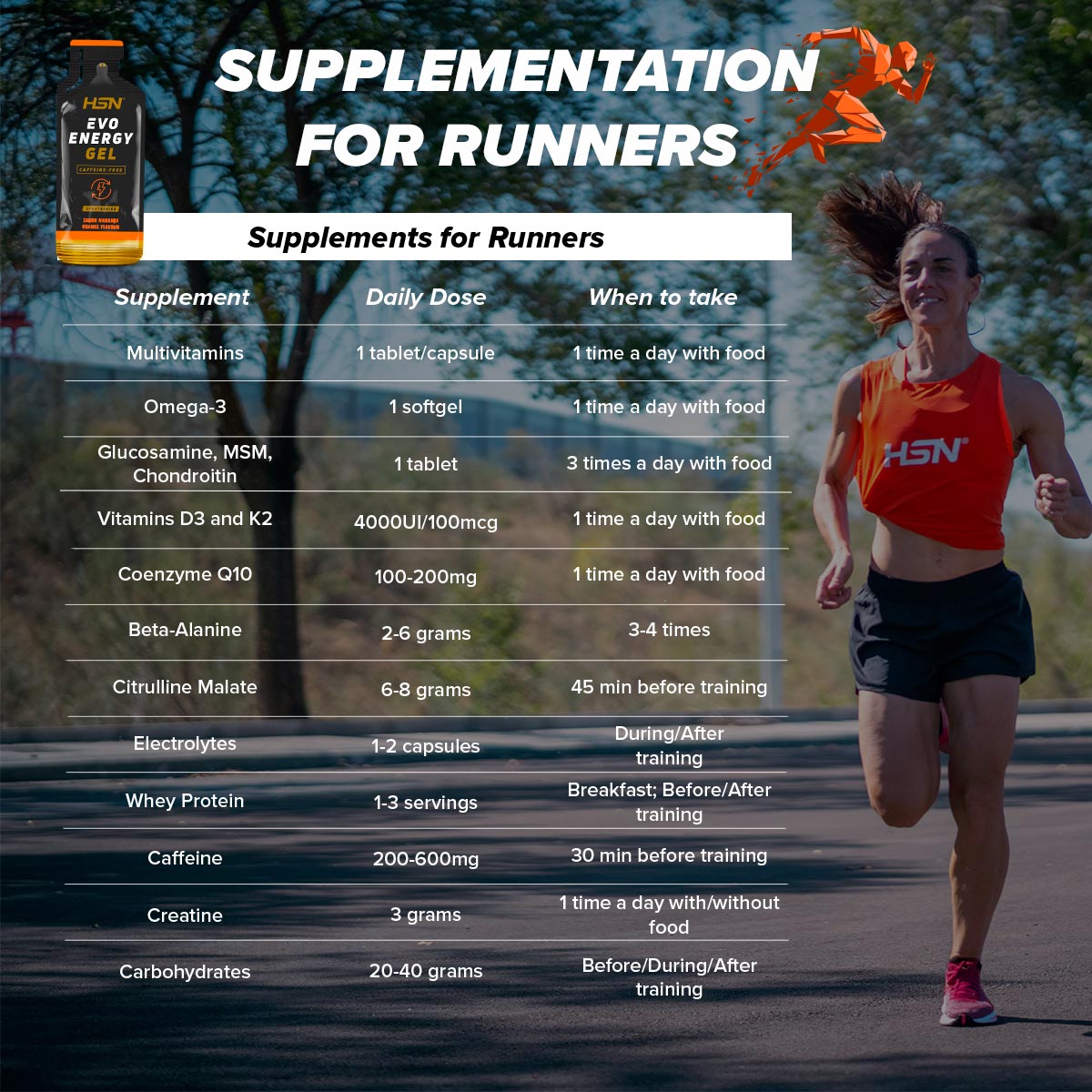
Summary Table of the Best Supplements for Runners
Related posts on the topic:
- Do you know the POSE method? Read Post.
- The importance of Iron Supplementation in Runners
- How to Hydrate During a Race?
- How to take Carbohydrates in physical activity?
- Benefits of Ribose
- Palatinose, the long-lasting Carbohydrate
- Cyclodextrins, the new-generation Carbohydrate
- Everything you need to know about Carbohydrates After Training
- Which running shoes should I buy?
- Run your first marathon