Fitness, Nutrition, Health and Sports Blog In the HSNstore Blog you will find tips about Fitness, sport in general, nutrition, and health – HSNstore.com

Training on unstable surfaces is a method presumably used to improve static and dynamic stability
However, many users use this system with the presumption of improving their muscle strength, power, athletic performance, intra- and inter-muscular coordination. But is this really what happens?
Training on unstable surfaces
First of all, it’s important to emphasise that there is a huge body of evidence studying the effects of training on these types of surfaces, in populations of:
- different ages,
- biological condition (healthy and sick),
- training states (trained and untrained), and
- with different orientations (improved posture, static stability, dynamic stability, improved sports performance…)
Considering the huge diversity between RCTs and, therefore, the large number of studies available, the results and conclusions are contradictory
Bosu Training
Unstable surfaces: Bosu
First, Nepocatych et al. (2018) evaluated the postural changes induced by training on unstable surfaces in a group of middle-aged, untrained, overweight women.
The results show that the group of women who underwent BOSU training improved significantly compared to the STEP group in medial-lateral stability (ML) under restricted vision conditions (closed eyes)
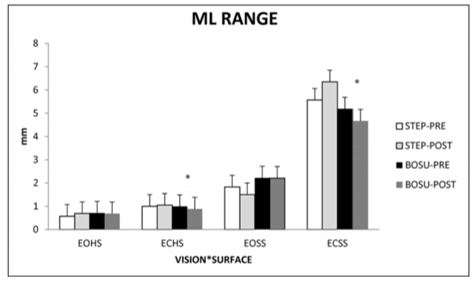
Figure I. Results on variations (mm) in centre of gravity in the medial-lateral axis in the step group, pre-training (white bar) and post-training (light grey bar); and in the bosu group, pre-training (black bar) and post-training (dark grey bar); under conditions of open eyes on hard surface (EOHS) and soft surface (EOSS), and closed eyes on hard surface (ECHS) and soft surface (ECSS); the higher the bar the more the subject moved (worse).
However, these results were not observed in variations of the anteroposterior axis (AP).
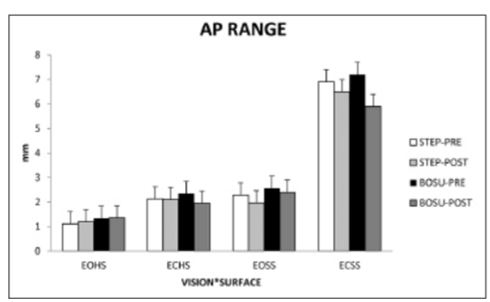
Figure II. Results in variations (mm) in the centre of gravity in the antero-posterous axis in the step group, pre-training (white bar) and post-training (light grey bar); and in the bosu group, pre-training (black bar) and post-training (dark grey bar); under conditions of open eyes on hard surface (EOHS) and soft surface (EOSS), and closed eyes on hard surface (ECHS) and soft surface (ECSS); the higher the bar the more the subject moved (worse).
Likewise, the area of variation of the centre of gravity in the static stability tests showed no significant differences between the BOSU and STEP group, under conditions of allowed and restricted vision.
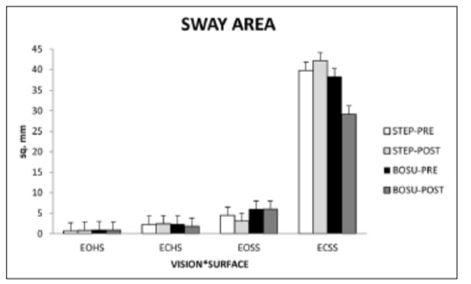
Figure III. Results on variations in the area of movement of the centre of gravity in the step group, pre-training (white bar) and post-training (light grey bar); and in the bosu group, pre-training (black bar) and post-training (dark grey bar); under conditions of open eyes on hard surface (EOHS) and soft surface (EOSS), and closed eyes on hard surface (ECHS) and soft surface (ECSS); the higher the bar the more the subject moved (worse).
Training on unstable surfaces
It has been suggested that improvement in postural balance may be a compensatory mechanism employed by an individual when vision is restricted and a compatible surface is introduced requiring the individual to rely more on the vestibular system.
Even so, this does not necessarily indicate decreased postural control, but (lack of) adherence to the demands of an unfamiliar task (Nepocatych et al. 2018)
Although the authors conclude that the use of BOSU may be a useful strategy to improve static posture and functional ability in this population, according to the results presented, this only seems to be a correct conclusion when we talk about stability with sensory restriction.
Evidence on the Effects of Unstable Training
The most interesting study I’ve found is undoubtedly the one published by Schilling et al. (2009)
In this research, 19 elderly people were subjected to a 5-week training program on unstable surfaces.
It’s important to remember that stability in this population is a relevant factor:
Much more than in other populations, as the falls that they may experience due to a lack of central stabilisation capacity, together with a decreased bone mineral density due to age, is the main cause of bone fracture, especially of the hip, which worryingly increases the morbi-mortality of this population.
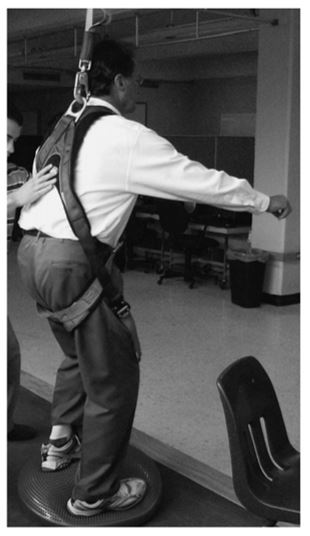
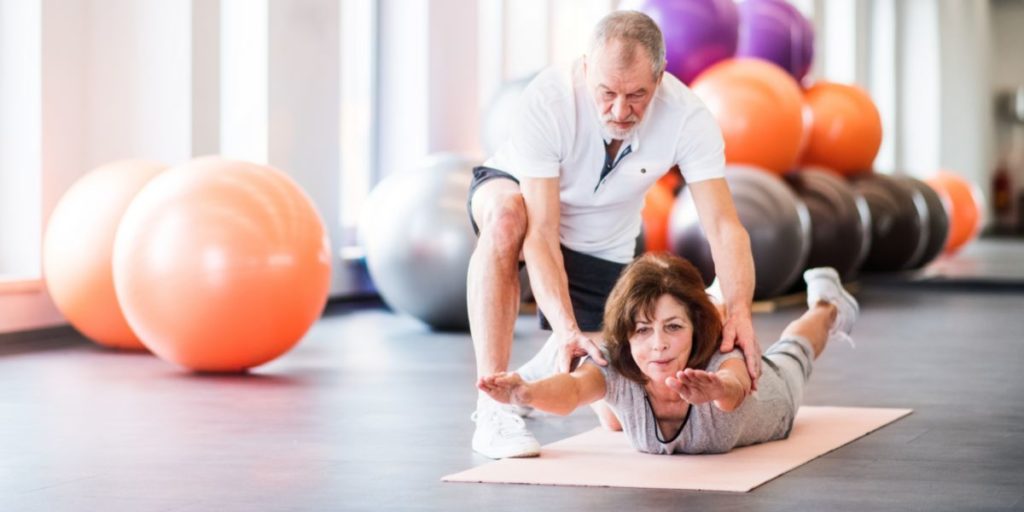
Figure IV. Elderly person assisted in training on unstable surfaces
Let me explain: the subjects who underwent training didn’t significantly improve variations in centre of gravity in any of the conditions evaluated (monopodal, bipodalsupport, with open and closed eyes) compared to subjects in the control group
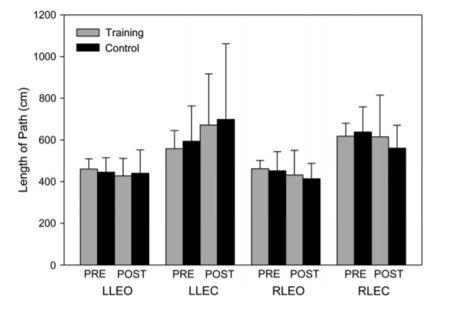
Figure V. Pre-training and post-training (PRE vs POST) centre of gravity travel length (cm) in the training (grey bar) and control (black bar) groups, in the left monopodal support with eyes open (LLEO) and closed (LLEC) and right monopodal support with eyes open (RLEO) and closed (RLEC) tests.
However, their perception of stability, assessed through the ABC questionnaire, that is, their confidence in situations of instability, increased significantly in the trained group.
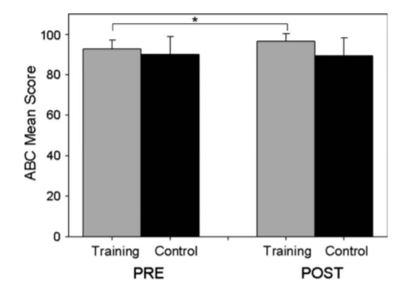
Figure VI. Average scores in the confidence test in the balance of specific pre-training and post-training activity (PRE vs POST) in the group subjected to training and control.
This may or may not be relevant, as the authors didn’t evaluate it, but it could indicate a strong placebo effect in future situations requiring stability.
This can be either positive or negative, and it requires more research to reach any conclusion on the effects of this improvement in the perception of self-efficacy
Unstable Surfaces and Sports Performance
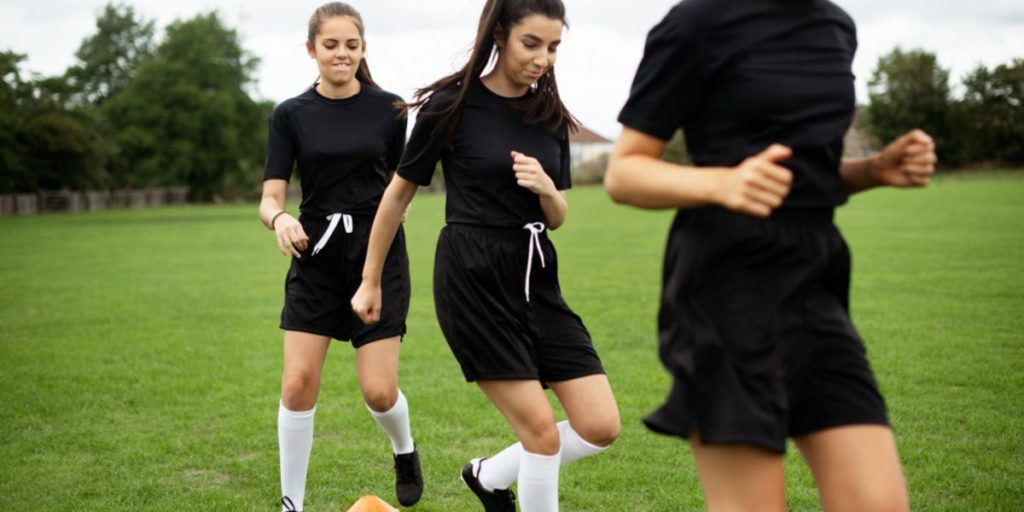
Finally, I’m interested in publishing a study on sports performance, and what better way to do this than in the football population (futsal) environment – the sport might be the biggest advocator of using this training method to improve performance and prevent injuries in athletes.
The study focused on evaluating the changes generated in 14 female footballers resulting from training on unstable surfaces compared to training on stable surfaces, on the performance in repeated sprints of 10m, CMJ (counter-movement jump) and FMS (functional movement screen test).
The results can be seen in the image below.
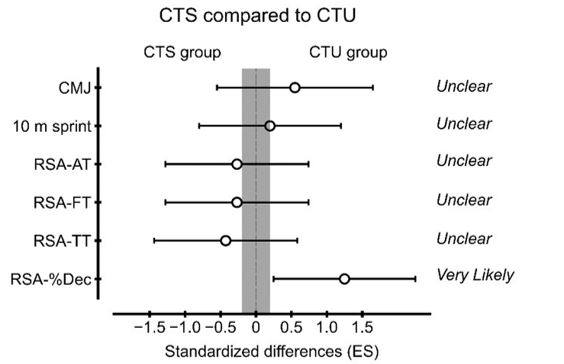
Figure VII. Standard differences in CMJ (countermovement jump), 10m sprint, RSA-AT (mean time repeated sprints), RSA-FT (faster time repeated sprints), RSA-TT (total time repeated sprints) and RSA-%Dec. (repeated sprints % performance decrease) in the group trained on stable surfaces (CTS, left) and on unstable surfaces (CTU, right)
The results show mixed evidence:
- The group that trained on unstable surfaces improved more than the group that trained on stable surfaces in CMJ, in the isolated sprint performance of 10m, and in the % decrease in performance in repeated sprints, the latter being the only output that seems to have any statistical relevance.
- Compared to a slight superiority of training on stable surfaces in the parameters of average, fastest and total time in repeated 10-metre sprints.
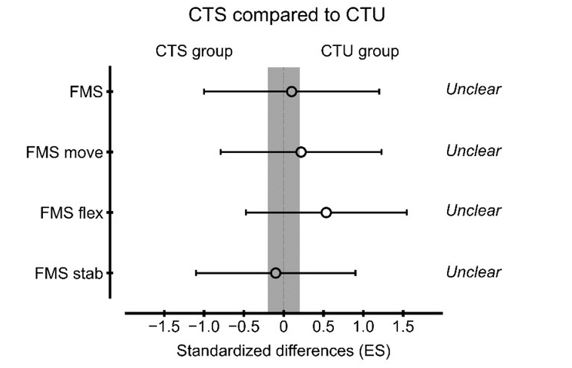
Figure VIII. Standard differences in FMS, FMS move, FMS flex. And FMS stab.; in the group trained on stable surfaces (CTS, to the left) and on unstable surfaces (CTU, to the right)
The results relating to the FMS test are non-specific, with great heterogeneity in the sample (note the “moustaches”, the bars on both sides of the circuits, which indicate the variability in the results).
The authors attribute the possible improvement in the % decrease in performance in repeated 10-metre sprint tests to an improvement in central stability (core) that serves as a link to the upper and lower limbs.
Some authors, such as Prieske et al (2016), found the same results, but others, such as Granacher et al. (2014), found no relationship between increased core strength with sprint performance
Conclusions
I know that I’ve presented a variety of results in this article, and although they’re simple, sometimes you can lose sight of what the conclusions actually are, so I’ll summarise them here:
It may reduce the risk of injury
Unstable surfaces can be a useful tool for improving static stability in very specific situations, but they shouldn’t be a go-to option for improving general static stability, dynamic stability or sports performance.
We can benefit from these improvements experienced on unstable surfaces with training on stable surfaces, with a lower risk of injury in training sessions
They don’t create adaptions
It’s important to emphasise that adaptations are produced by training, not by the environment, especially when our competition environment is stable and not unstable (see a football player on a smooth grass pitch with no irregularities).
Bibliographic Sources
- Lago-Fuentes, C., Rey, E., Padrón-Cabo, A., Sal de Rellán-Guerra, A., Fragueiro-Rodríguez, A., & García-Núñez, J. (2018). Effects of Core Strength Training Using Stable and Unstable Surfaces on Physical Fitness and Functional Performance in Professional Female Futsal Players. Journal of Human Kinetics, 65, 213–224.
- Nepocatych, S., Ketcham, C. J., Vallabhajosula, S., & Balilionis, G. (2018). The effects of unstable surface balance training on postural sway, stability, functional ability and flexibility in women. The Journal of Sports Medicine and Physical Fitness, 58(1–2), 27–34.
- Schilling, B. K., Falvo, M. J., Karlage, R. E., Weiss, L. W., Lohnes, C. A., & Chiu, L. Z. (2009). Effects of unstable surface training on measures of balance in older adults. Journal of Strength and Conditioning Research, 23(4), 1211–1216.
Related Posts
- Strength Training for Seniors
- Full-body vibration training to improve strength and power
- Nutrition, supplementation and injury prevention in football