Fitness, Nutrition, Health and Sports Blog In the HSNstore Blog you will find tips about Fitness, sport in general, nutrition, and health – HSNstore.com

If you’re looking for new strategies to lose weight, improve your health, and also boost your athletic ability, I recommend giving High-Intensity Circuit Training (HICT) a shot
If you remember, we recently talked on the blog about a particular case where 2 kg were lost in just 4 days in untrained subjects. There, we concluded that it’s better to be consistent and persistent than to pile up a huge volume of work in such a short time. You can check out the post here: Losing 2 kg in 4 days (plus some thoughts)
That’s why it’s a good idea to look at the opposite case, where things are well planned and studied. The goal of the study was to find out how a high-intensity circuit training (HICT) program affected key physiological markers in sedentary obese men (body fat percentage > 26 %).
Exercises for HICT
The subjects completed a four-week HICT program, with three 30-minute exercise sessions per week, totaling 6 hours of exercise. The exercises (with maximum allowed ROM) they followed in each session were, in order:
- Squats
- Bench press
- Ab crunch
- Deadlift
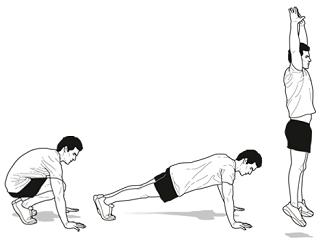
- Burpees
- Barbell row
- Military press
As you can see, the exercises performed are multi-joint, free weight, and basic, except for the ab crunch. Personally, I strongly back this kind of exercises because they generate the best hormonal and nervous system response, plus they burn more calories.
They completed 3 rounds of the circuit with the minimum rest possible between exercises and rounds, allowing for 8-12 strict reps.
Effort markers
- HEART RATE: stayed elevated throughout the workout: 85 ± 3.6% max HR (around 158 beats per minute for the subjects’ average age, 34 years).
- SUBJECTIVE RATING OF PERCEIVED EXERTION (BORG SCALE): This scale, as you know, rates intensity from 1 to 25 according to the subject. The subjects started the program with a perception of 19/25, but by the end it had dropped to 16/25. So, there was a clear adaptation to the effort.
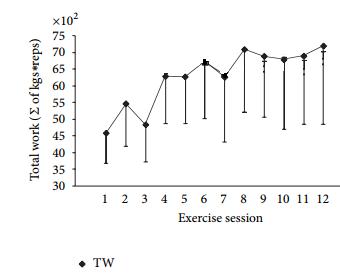
- TOTAL WORK PER SESSION, as shown in the graph below, was periodized across sessions, although it increased by the end of the full mesocycle (progression principle), and still, as mentioned before, the perceived effort scale kept going down.
Health markers
They were measured before and after the program:
- Body composition: 3.6 % decrease in body fat percentage caused by two factors, fat percentage reduction and lean mass increase (+2%).
- Decrease in total cholesterol (13%), triglycerides (37%) and LDL mainly.
- Glucose and insulin (18% decrease).
- Systolic blood pressure (SBP): 5.5 % decrease.
- Resting heart rate: 16% decrease.
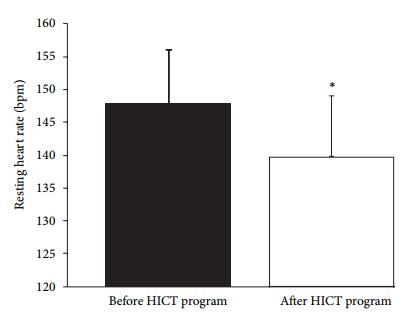
In other words, overall, they experienced a significant improvement in biochemical, physical characteristics, and body composition with just 1h30min of work per week.
Comparison with “losing 2 kg in 4 days”
As you can see, the results at the end of the 4-week program were more than significant. If you remember, in the post linked at the start, subjects were doing up to 9h of exercise daily… which physically and mentally drained them.
This program makes way more sense, since it’s done in less time per session and more intensely. The results obviously take longer to show up, but the process is way more fun, it’s much easier than cramming all the work into 4 days, and it ensures better exercise adherence.
Plus, the exercises used in this program are the ones every beginner should try to learn when starting with weight training because they help you progress the most in less time.
Sources
- Matthew B. Miller, Gregory E. P. Pearcey, Farrell Cahill, et al.. (2014). “The Effect of a Short-Term High-Intensity Circuit Training Program on Work Capacity, Body Composition, and Blood Profiles in Sedentary Obese Men: A Pilot Study,” BioMed Research International, vol. 2014, Article ID 191797, 10 pages.