 Fitness, Nutrition, Health and Sports Blog In the HSNstore Blog you will find tips about Fitness, sport in general, nutrition, and health – HSNstore.com

We present our Military Press Guide in full detail: how to do the military press, muscles worked, technique, key points, common mistakes, exercises to improve…
Index
- 1 Shoulder joint anatomy
- 2 Management of training variables for the Military Press
- 3 Military Press Technique
- 4 Control and Correction
- 5 Importance of the Shoulder Girdle in the Military Press
- 6 Exercises for the rotator cuff and periscapular muscles
- 7 Tips for performing the Military Press
- 8 Warm Up (Joint Mobility and Activation)
- 9 Bibliographic Sources
- 10 Related Entries
Shoulder joint anatomy
Eovaldi & Varacallo (2018) describe on anatomy of the shoulder and upper body by differentiating the following structures:
Joint Structure
The shoulder joint (glenohumeral joint) is a ball-and-socket joint with the longest range of motion in the human body.
In terms of the joint, it’s important to comment on the following general aspects:
- The upper limb is attached to the appendicular skeleton through the sternoclavicular joint.
- The three joints of the pectoral girdle are the sternoclavicular joint, coracoclavicular joint, and the acromioclavicular joints.
- The bones of the pectoral girdle are the clavicle, scapula and humerus.
- The scapula (the central bony structure of the shoulder) is a flat bone with multiple muscle adhesions.
- All muscles of the shoulder joint interact with the scapula.
- The scapula connects to the clavicle through the coracoclavicular and acromioclavicular joint.
- The most important structural ligaments of the shoulder joint are the glenohumeral ligaments and coracoacromial ligament.
- The glenoid fossa meets the joint function with the humeral head at the lateral angle of the scapula.
- The glenohumeral joint is the point of articulation between the humerus, scapula, and thoracic cavity.
- On the side of the scapula is the articular surface of the glenohumeral joint: the glenoid cavity.
Muscle Structure
Shoulder muscles work dynamically in performing a wide range of motion.
Specifically the muscles of the rotator cuff, which function to move the shoulder and arm, as well as provide structural integrity to the shoulder joint.
They also play a critical role in providing stability to the shoulder joint.
The primary muscle group that supports the shoulder joint are the rotator cuff muscles.
The four rotator cuff muscles are: supraspinatus, infraspinatus, subscapularis, and teres minor.
| Muscle | Function |
| Rotator cuff | They provide considerable structural support to the glenohumeral joint and hold the humeral head in a firm position as it articulates with the scapula within the glenoid fossa. |
| Supraspinatus | It works by abducting the humerus up to 30º as well as stabilising the glenohumeral joint. |
| Infraspinatus | It works by externally rotating the humerus. |
| Teres Minor | It acts to externally rotate the humerus and assists with abduction of the humerus |
| Subscapularis | It works by internally rotating and abducting the humerus. |
| Rhomboid Minor | It acts to depress the shoulder in the lower trapezius, which is assisted by gravity in the upright position. |
| Trapezius | Responsible for the elevation and depression of the shoulder, depending on whether the upper or lower muscle fibres are activated |
| Deltoides | The anterior deltoid flexes and generates medial rotations of the humerus, the middle deltoid abducts the humerus, and the posterior deltoid performs the actions of extension and external rotation of the humerus. |
Management of training variables for the Military Press
Load magnitude
Building big, strong shoulders isn’t easy (Bentley, 2016)
The deltoids wrap around the shoulder joint complex as armour, which means that it’s impossible to build muscle thickness from front to back with any elevation (Bentley, 2016).
The methodology and planning of the magnitude of the shoulder training load is complex due to the fact that this muscle group is traditionally described with three muscle heads (anterior, middle, and posterior).
But actually there are seven individual segments, although there may be other intramuscular segments too (Bentley & Beardsley, n.d.; Bentley, 2016).
Regarding the type of deltoid muscle fibre, they appear to have a type of mixed fibre, meaning deltoid training needs to incorporate both heavy loads and lighter loads (Bentley, 2016).
The deltoids (anterior, middle, posterior) have a relatively large physiological cross-sectional area compared to other muscles in the upper body (Bentley, 2016).
In terms of movement, in the sagittal plane, the anterior and middle deltoids are the two primary shoulder flexors and display their greatest strength with the arm above horizontal (importance for training dynamics in the vertical pattern) (Bentley, 2016; Ackland et a., 2008).
The rear deltoid works like a primary shoulder extensor throughout the range of motion, with the greatest contribution when arms are below horizontal (Bentley, 2016; Ackland et al., 2008).
Training Volume
- Maintenance Volume (MV): the anterior deltoid does not need direct work for its maintenance, in almost all cases, Compound Pressing is enough. At the same time, the rear deltoid can also be maintained without direct work, as long as traction work is developed for the back. However, the side needs at least 6 sets/week of direct work to maintain its size for most intermediate to advanced lifters.
- Minimum Effective Volume (MEV): most intermediate athletes can achieve huge gains in the anterior deltoid without direct work, and horizontal and incline push work, plus overhead pressing or triceps work, is more than enough. On the other hand, most mid-advanced lifters need at least 8 sets/week of rear and lateral deltoid work to make gains. To be more specific, at least 6 sets/week with isolation exercises.
- Maximum Acceptable Volume (MAV): many people respond better with between 6 and 8 sets/week of work of direct targeting of the anterior deltoid, including (average) overhead pressing. For the posterior and lateral portion, people react better with between 16 and 22 sets/week.
- Maximum Recoverable Volume (MRV): the front deltoids take quite a bit of damage from push training and have a very limited fatigue threshold when isolated in conjunction with pectoral training. More than 12 sets/week from overhead pressing or front delt raises could become a recovery issue with other chest training. Finally, the rear and lateral deltoids will manage 26 sets/week (anything above this figure could cause recovery issues).
Training Intensity
The anterior deltoid musculature responds well to hard work
Presses of more than 12 repetitions per set seem to be best for pain tolerance than front delt stimulators. It’s recommended you perform sets of between 6 to 10 repetitions for different types of presses.
Regarding the rear and side part, due to the type of fibre and for safety reasons, heavy work below 8 repetitions isn’t a reliable method.
Training Frequency
Optimal training frequency for the anterior deltoid is 1-2 times/week
This is because any direct work of the anterior part would start interfering with the work of the pectoral. Pectoral training is sufficient for the anterior deltoid.
Like the biceps, the lateral and rear deltoids are not made to be exposed to mechanical damage. They produce such little force and are comparatively small that they can recover from limited volumes in a very short space of time.
Military Press Technique
The barbell Military Press is a key multi-joint exercise within the vertical position
This is because:
- There is high muscle involvement (primary muscles and stabilisers).
- It resets the balance between the anterior and posterior deltoids.
- It balances the horizontal pattern (Bench Press).
- It’s good for progress in the Bench Press (high transfer).
Bar support rack
The Rack, where the bar will rest during the intra-set breaks, must be at sternum height so that you can start and end the exercise safely and comfortably.
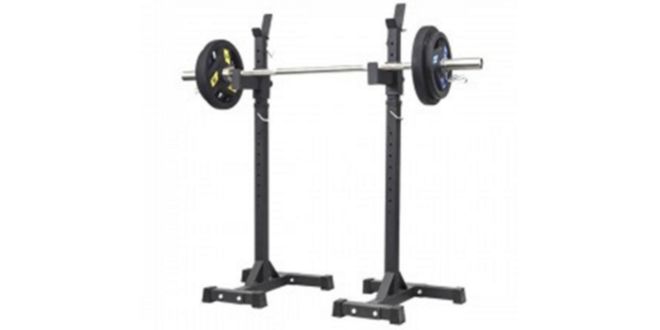
Bar support rack in the Military Press (standing and with bar)
Grip
Your grip should be at deltoid height (neither too wide nor too narrow). Specifically, the index finger should touch the anterior deltoid. We should also take into account the advantages and disadvantages of using a Suicide Grip.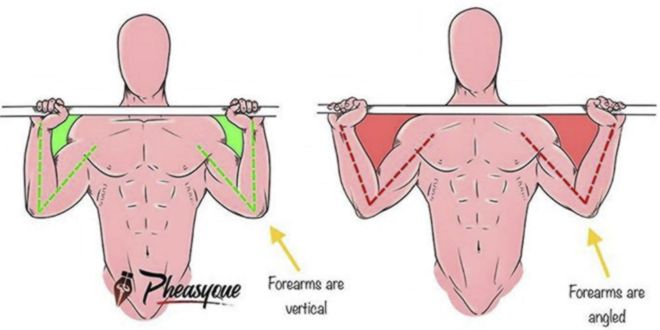
Grip in the Military Press (standing and with a bar)
The bar
The bar should rest on the shoulders.
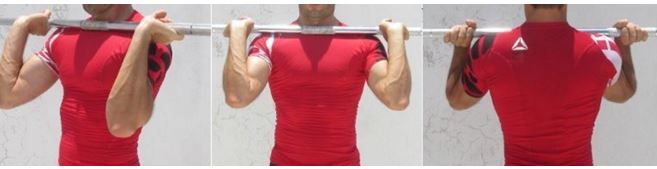
The bar in the Military Press (standing and with a bar)
Support
The weight of the bar should fall on the heel of the hand, avoiding the load being positioned on the palm and preventing the bar from falling backwards or bending the wrists too much.
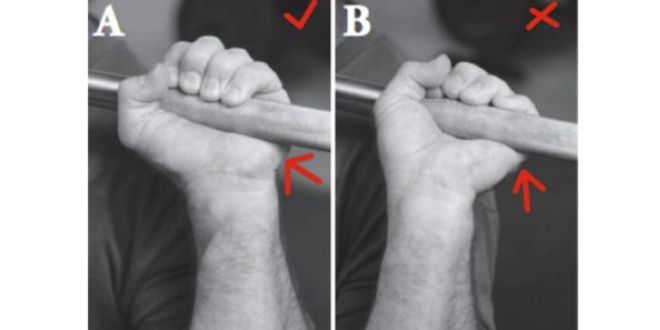
Support in the Military Press (standing and with a bar)
Elbow placement
Elbows should be ahead of the bar, pointing forwards (figure 10). Avoid aligning them with the bar or positioning them behind.
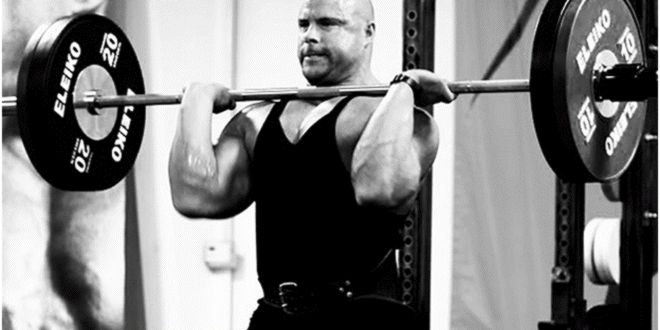
Placement of the elbows (1) in the Military Press (standing and with a bar)
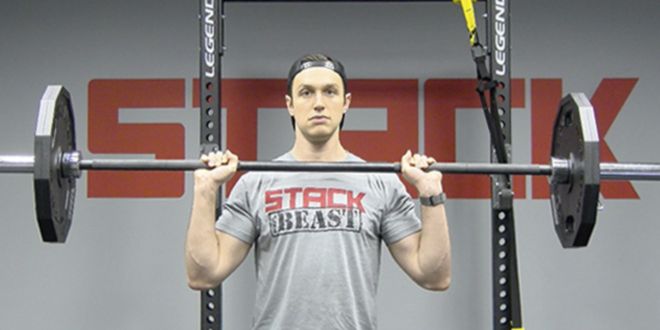
Placement of the elbows (2) in the Military Press (standing and with a bar)
Gaze
You should focus on a specific point. And with the neck in a normal anatomical position.
Where to look in the Military Press (standing and with a bar)
Foot placement
Foot placement dynamics are exactly the same as in the squat. Shoulder width apart, or slightly wider:

Foot placement in the Military Press (standing and with a bar)
Breathing, Core and Scapular Retraction
These three elements will be key for projecting the bar with the highest possible force and speed, effectively and efficiently
In terms of breathing, you should take in a lot of air before grabbing the bar and starting the movement, then release it once it starts. This is to increase intra-abdominal pressure, improving the lifting of the bar.
The second point is the Core and the co-contraction capacity of the entire lumbo-pelvic musculature (the glutes should also be tight), to increase spinal stability.
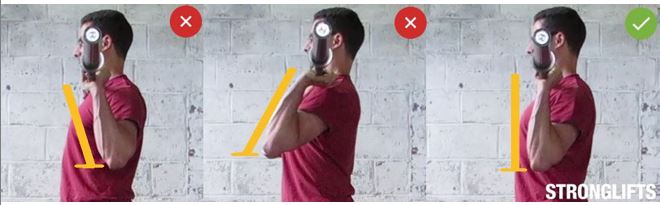
And lastly, scapular retraction is needed to prevent the shoulders from moving forward and to ensure the movement is vertical and stable.
Bar movement
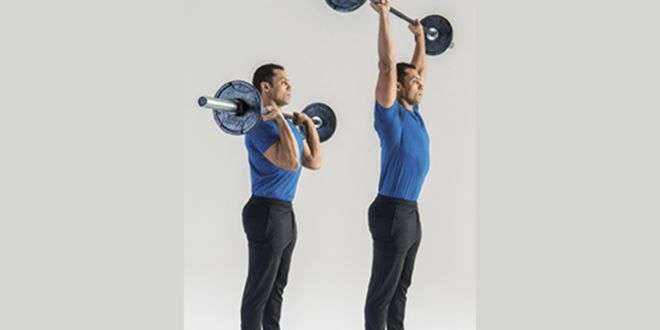
The movement of the bar will be initiated by lifting upwards and as close to the face as possible.
Once over the head, the bar doesn’t go backwards; on the contrary, we have to go beyond the vertical line of the bar (by leaning forwards). Finally, the bar descent should be exactly the same as the ascent phase.
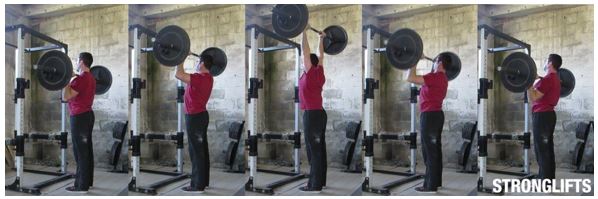
Bar movement in the Military Press (standing and with a bar)
Control and Correction
Heredia, Miguel & April (2005) give a series of basic guidelines that can serve as a general aid to strength exercises; in this case, the Military Press
Balanced Tonic Postural Attitude (ATPE) is commonly used for work on body control and body awareness in psychomotor skills and basic physical education.
However, this group of authors also uses it to define the position that, encompassing all the parameters relating to muscle tone, posture and balanced body positioning, is suitable for the maintenance of the structural and functional health of the locomotor apparatus, as well as its possible modifications depending on the activity or task to be carried out.
Importance of the Shoulder Girdle in the Military Press
The relationship between the Military Press and proper shoulder girdle function is obvious, because the exercise is performed in the sagittal plane through repeated shoulder flexion-extensions.
A narrative review by Cricchio and Fraicier (2011), whose objective was based on helping occupational and physical therapists to prioritise the exercises for a shoulder fitness program, was fundamental in this respect.
By way of summary, the review synthesises a group of evidence-based exercises that focused on stabilising the scapulothoracic and scapulohumeral joints while promoting scapulohumeral rhythm.
More specifically, this optimal relationship (Vertical Press and Shoulder Girdle) is justified by (Cricchio and Fraicier, 2011):
- The rotator cuff, as well as the periscapular musculature, play a crucial role in stabilising the glenohumeral and scapulothoracic joints for effective pain-free shoulder movements.
- The rotator cuff musculature provides dynamic compressive forces to keep the humeral head seated in the concave glenoid fossa.
- Absent or insufficient rotator cuff compressive forces result in superior migration of the humeral head and often result in posterior subacromial space narrowing.
- Scapulothoracic Dyskinesia is “an abnormality in scapular movement and rest position”. This concept is a contributing component to glenohumeral pathology.
- Normal scapulohumeral rhythm requires proper activation of the scapular ascending rotators: upper trapezius, lower trapezius, and serratus anterior muscles. Collectively, these muscles are important in achieving full forward flexion and osteokinematic abduction.
- It’s believed that the subacromial space volume during shoulder elevation is maximised with proper scapular kinematics, which reduces the incidence of external or internal impact on the shoulder.
- Balanced active participation of the rotator cuff and scapulothoracic musculature is essential for good movement and stability through the shoulder girdle.
Exercises for the rotator cuff and periscapular muscles
Next, the authors suggest the most efficient and effective exercises to guarantee balance between the rotator cuff and periscapular musculature, while also promoting proper scapulohumeral and scapulothoracic rhythm:
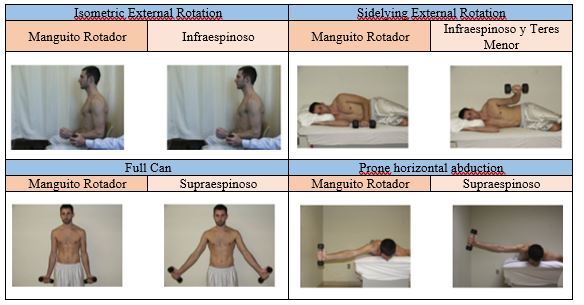
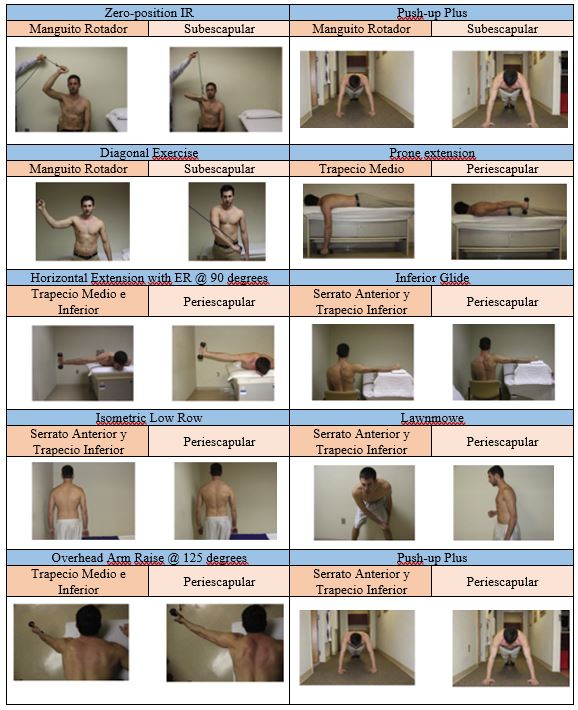
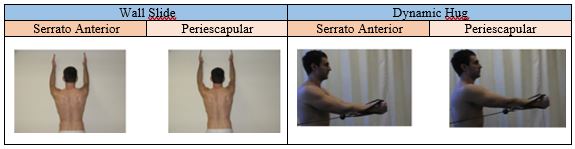
Source: based on Cricchio and Fraicier (2011)
Tips for performing the Military Press
Next, and based on the evidence presented above, let’s look at the keys to the correct development of everything related to the Military Press:
Perform full ROM to develop the anterior deltoid
- The anterior deltoid moment arm peaks at 120º of shoulder flexion (above horizontal).
- The anterior deltoid can generate the most force (length-tension ratio) between 60-120º of shoulder flexion (middle and end zone of the movement).
Use various load ranges
- The deltoids are of mixed muscle fibre, meaning they need to be nourished with heavy, intermediate and light loads.
Execution speed control
- Absolute velocities are a reliable indicator of the number of repetitions left in reserve.
Avoid doing the Military Press with dumbbells or “High Five”
- Use of safer and more efficient options such as Neutral/Inverted Shoulder Presses, or doing a Standing/Seated (75º-80º) Shoulder Press in the scapular plane.
- Military Presses behind the back of the neck should be avoided because of the high risk of injury and the small difference in activation (anterior deltoid).
Do variants
- The different variations of the Military Press as a vertical push pattern and the Bench Press as a horizontal push pattern are multi-joint exercises sufficient to develop the anterior portion of the deltoids.
- The use of single-joint or isolation exercises is not necessary.
Execution angles
- Muscle activity in the deltoid during multi-joint exercises can be affected by push angle and grip width.
- Steeper push angles appear to increase anterior deltoid activity, as does a wider grip width during an incline push.
The best option for Military Presses
- A standing dumbbell Military Press is the best option as it activates the anterior and lateral deltoids more.
- However, there are other good secondary options too: the standing barbell Military Press and the seated dumbbell Military Press
Dumbbell Military Press
- This exercise will work the anterior and middle deltoids
- It requires high activation of the supraspinatus, subscapularis, upper trapezius, and superior and inferior serratus anterior.
Intensity
- Use ranges of between 8 and 20 (or more) repetitions per exercise, leaving 0-2 repetitions in reserve (RIR), or even 3-4 RIR for beginners or in transition or discharge phases.
Frequency
- 1-2 times/week for the anterior deltoid and 2-6 times/week for the medial and posterior deltoids.
Optimal technique for the classic Military Press (standing and with a bar)
- Respect all points mentioned above: bar support rack, grip, bar, support, elbow placement, gaze, foot placement, breathing, core, scapular retraction and movement of the bar.
Warm Up (Joint Mobility and Activation)
Finally, we’re going to look at a varied, effective and efficient series of warm-up exercises (Mobility, Static Stability and Analytical Motor Control) oriented towards development of the vertical pattern, with the Military Press (standing and with bar) being one of them.
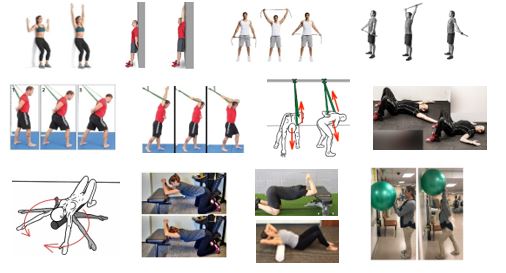

Military Press warm up
Bibliographic Sources
- Eovaldi, B. J. & Varacallo, M. (2018). Anatomy, Shoulder and Upper Limb, Shoulder Muscles. In StatPearls [Internet]. StatPearls Publishing.
- Morán-Navarro, R., Martínez-Cava, A., Sánchez-Medina, L., Mora-Rodríguez, R., González-Badillo, J. J. & Pallarés, J. G. (2019). Movement velocity as a measure of level of effort during resistance exercise. The Journal of Strength & Conditioning Research.
- Salles, J. I., Velasques, B., Cossich, V., Nicoliche, E., Ribeiro, P., Amaral, M. V., & Motta, G. (2015). Strength training and shoulder proprioception. Journal of Athletic Training, 50(3), 277-280.
- Escalante, G. (2017). Exercise modification strategies to prevent and train around shoulder pain. Strength & Conditioning Journal, 39(3), 74-86.
- Escamilla, R. F., Yamashiro, K., Paulos, L., & Andrews, J. R. (2009). Shoulder muscle activity and function in common shoulder rehabilitation exercises. Sports Medicine, 39(8), 663-685.
- Sweeney, S. P. (2014). Electromyographic analysis of the deltoid muscle during various shoulder exercises (Doctoral dissertation).
- Uribe, B. P., Coburn, J. W., Brown, L. E., Judelson, D. A., Khamoui, A. V., & Nguyen, D. (2010). Muscle activation when performing the chest press and shoulder press on a stable bench vs. a Swiss ball. The Journal of Strength & Conditioning Research, 24(4), 1028-1033.
- Williams, J. M., Hendricks, D. S., Dannen, M. J., Arnold, A. M., & Lawrence, M. A. (2018). Activity of Shoulder Stabilizers and Prime Movers During an Unstable Overhead Press. Journal of Strength and Conditioning Research.
- Bentley, A. & Beardsley, C. (s.f). Deltoids. Strength and Conditioning Reseach. Retrieved from: https://www.strengthandconditioningresearch.com/muscles/deltoids/
- Bentley, A. (2016). What You Don’t Know About Training Delts: 10 Research-Driven Tips for Building Shoulders. T-Nation. Retrieved from https://www.t-nation.com/training/what-you-dont-know-about-training-delts
- Israetel, M. (2017). General Training: Mesocycle Design for Hypertrophy. Retrieved from https://github.com
- Revive Stronger (2017). Revive Stronger. Retrieved from: https://revivestronger.com/training-volume/
- Ackland, D. C., Pak, P., Richardson, M., & Pandy, M. G. (2008). Moment arms of the muscles crossing the anatomical shoulder. Journal of Anatomy, 213(4), 383-390.
- Heredia, J. R., Miguel, R., & Abril, M. (2005). Criterios para la Observación, Control y Corrección de Ejercicios de Musculación para la Salud. PubliCE Standar pid, 426.
- Cricchio, M., & Frazer, C. (2011). Scapulothoracic and scapulohumeral exercises: a narrative review of electromyographic studies. Journal of Hand Therapy, 24(4), 322-334.
Related Entries