Fitness, Nutrition, Health and Sports Blog In the HSNstore Blog you will find tips about Fitness, sport in general, nutrition, and health – HSNstore.com

Weeks of training, matches piling up, and your knees, ankles, or Achilles tendon are starting to send warning signs. It’s no coincidence. Football is one of the sports that places the greatest demand on connective tissue: changes of pace, explosive turns, jumps, landings, and hundreds of impacts per match that your body has to absorb week after week.
This is where collagen comes into play. Not as a cosmetic supplement or a passing trend, but as the main structural component of tendons, ligaments, and cartilage. If you don’t give your body the nutrients it needs to keep this tissue in good condition, sooner or later you will feel it.
In this article, we explain why collagen is especially relevant for football players, what types exist, which one may suit you best depending on your goals, and how to include it in your supplementation routine.
The science of collagen in impact sports
Football is not running in a straight line. It is stopping suddenly, turning on one foot, jumping and landing, repeating that cycle for 90 minutes, several days a week, on surfaces that are not always the kindest to your joints.
Artificial turf, so common in amateur leagues and youth categories, is one of the factors that places the greatest strain on connective tissue. Unlike natural grass, the boot does not slide: it sticks. This means that when you turn, the force is not dissipated outward but travels directly upward, concentrating on the knee and Achilles tendon.
What happens at a structural level? Menisci and tendons absorb continuous impacts, and they need to be properly nourished and have adequate elasticity to do so. Collagen is the protein that provides structure to connective tissue: without enough available collagen, the tissue’s ability to withstand load can become compromised over time.
That is why, in impact sports such as football, collagen is not an extra. It is part of the foundation.
What is the best type of collagen for a football player?
Not all collagen is the same, and not all types will give you what you need if you play football. The body contains different types of collagen depending on the tissue involved, and in football, the focus is clear: tendons, ligaments, and cartilage.
You need a collagen that reaches the target tissue. And for that, the form matters.
Hydrolyzed collagen: absorption and bioavailability
When we talk about hydrolyzed collagen, we are referring to collagen that has undergone a process of enzymatic hydrolysis: its protein chains have been broken down into small peptides that the body can digest and absorb much more efficiently.
Non-hydrolyzed collagen reaches the intestine as a large protein. The digestive system has to work to break it down, and part of that collagen may not efficiently reach the joints. With hydrolyzed collagen, that process has already been done beforehand.
If you are looking for options, go for neutral powder formats: they are the most versatile, easy to combine with protein shakes or simply with water, and allow you to adjust the dose precisely.
The importance of Type I and Type II in connective tissue
Within the world of collagen, two types are of particular interest for sport:
Type I collagen: This is the most abundant type in the body and the main component of tendons and ligaments. It provides tensile strength to these structures, meaning their ability to withstand traction without deforming. It is relevant for ankles, knees, and any area exposed to repeated tension.
Type II collagen: This is found mainly in articular cartilage, the tissue that acts as a cushion between bones. In joints such as the knee, which absorbs continuous impacts with every jump, change of pace, or ball reception, keeping cartilage in good condition is key for long-term performance.
Common football injuries and the role of collagen
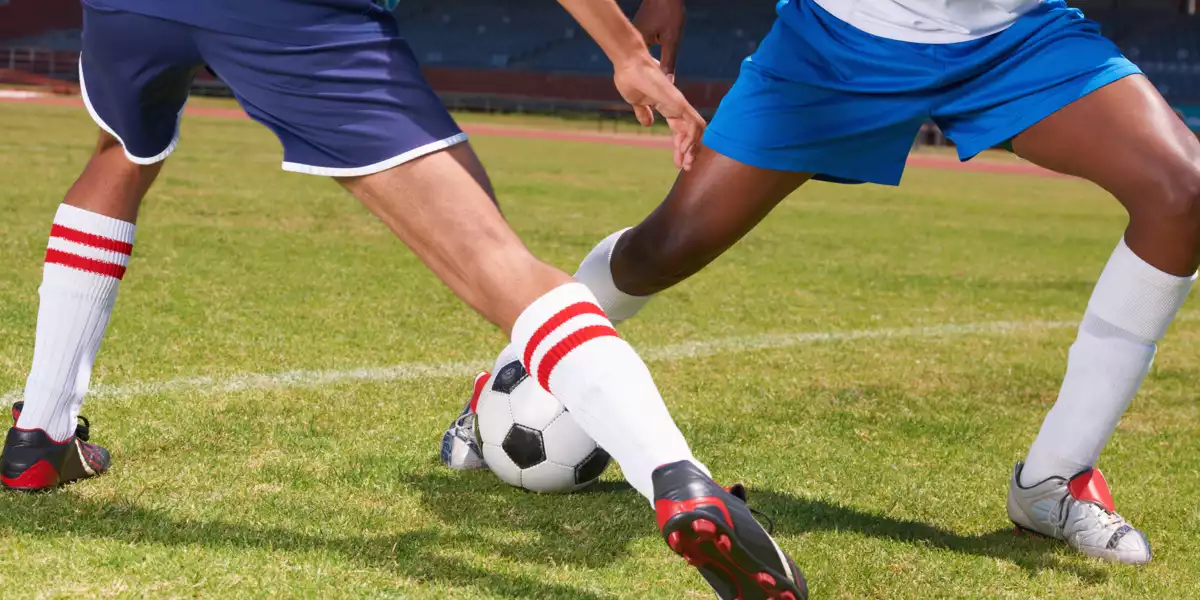
Football has a very characteristic injury profile, and most of these injuries have something in common: they affect connective tissue. Tendons, ligaments, and cartilage are behind many of the most common absences, especially in amateur categories where training volume is not always matched by structured recovery.
Collagen, as a structural nutrient for connective tissue, contributes to maintaining the mechanical properties of these structures as part of a balanced diet and healthy lifestyle. Below, we explain the most common injuries and why well-nourished connective tissue makes a difference.
Ankle sprain
It is the most common injury in football.
The lateral collateral ligament is the one most affected in a classic twist. Ligament tissue is mainly made up of Type I collagen, so ensuring an adequate intake of this nutrient is part of a good long-term joint care strategy.
Anterior cruciate ligament (ACL) tear
One of the most feared injuries.
A well-nourished ligament with good mechanical properties is in a better structural condition to withstand the load involved in the explosive movements of football. Connective tissue nutrition is a factor that should not be overlooked in physical preparation.
Patellar and Achilles tendinitis
The patellar tendon and Achilles tendon accumulate enormous load in football: every sprint, every jump, and every sudden stop puts them to the test. The microstructure of the tendon depends largely on Type I collagen. Maintaining a regular intake contributes to the normal maintenance of connective tissue, especially during periods of high training load.
Conclusion
Football places high demands on connective tissue. Consecutive matches, hard surfaces, explosive changes of pace, and long seasons are a combination that tests tendons, ligaments, and cartilage week after week.
Hydrolyzed collagen, taken regularly and as part of a balanced diet, is one of the most interesting nutrients for football players who want to take care of their connective tissue in the long term. It is not a substitute for training or rest, but it is a piece that fits well into a well-planned sports nutrition strategy.
If you train consistently, take care of yourself with the same consistency.
Related Posts
- What is the unhappy triad injury in football and how to recover from it
- Anterior cruciate ligament tear in football
- What sports supplements should a football player take?
- How to avoid quadriceps injuries in football