Fitness, Nutrition, Health and Sports Blog In the HSNstore Blog you will find tips about Fitness, sport in general, nutrition, and health – HSNstore.com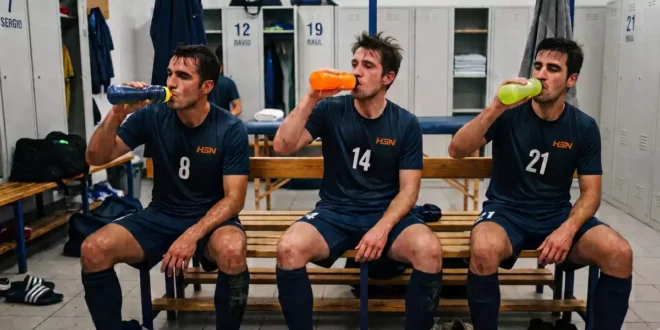

The final whistle doesn’t mark the end of the effort, but rather the beginning of the most decisive phase for any football player: recovery. What happens in the hours following the 90 minutes directly determines the player’s condition for the next training session or match. It is during this window that the difference is made between returning at full capacity or carrying accumulated fatigue.
Fatigue and muscle soreness after exertion are not a minor side effect: they are a sign that the body requires a structured recovery strategy, rather than simply waiting for “the body to recover on its own”.
What happens to your muscles after 90 minutes?
A football match subjects the body to a triple impact, explaining why recovery cannot be left to chance.
Exercise-Induced Muscle Damage (EIMD)
The braking, jumping, changes of direction and accelerations that define football involve a high proportion of eccentric contractions, meaning the muscle lengthens while producing force. This type of contraction is particularly demanding on muscle fibres, causing microtears that are responsible for the delayed onset muscle soreness (DOMS) typically experienced in the days following a match.
Depletion of muscle glycogen stores
Muscle glycogen is the body’s primary energy source during high-intensity intermittent exercise. After 90 minutes of competition, these stores may be significantly depleted, especially in the muscle fibres most heavily involved during explosive actions throughout the match.
Acute dehydration
The loss of water and electrolytes through sweat compromises the body’s fluid balance. If this imbalance is not corrected promptly, nutrient delivery to damaged muscle tissue slows down, delaying the overall recovery process.
The “3 Rs” recovery strategy for football
To counter this triple impact, sports recovery has traditionally been based on three fundamental pillars:
Rehydration, Glycogen Replenishment and Muscle Repair (the “3 Rs”)
Neglecting any of these doesn’t simply result in incomplete recovery; it may extend the time required to return to baseline performance from 48 to 72 hours, a critical difference during demanding competition schedules.
1. Optimal rehydration (water and electrolytes)
One of the most common mistakes, even among experienced players, is drinking only water after the match. Far from being harmless, this approach may promote dilutional hyponatraemia: replacing water without electrolytes dilutes blood sodium concentration precisely when the body needs it most, increasing urine production and reducing effective fluid retention.
Effective rehydration requires replacing water together with the sodium and potassium lost during the match, two essential minerals for restoring the osmotic balance between the intracellular and extracellular compartments. Without this balance, rehydration becomes less effective and the restoration of normal cellular function is delayed.
2. Glycogen replenishment (fast-absorbing carbohydrates)
With muscle cells depleted of their main energy substrate, the immediate priority is to begin glycogen resynthesis. This requires high-glycaemic carbohydrates that can be absorbed and metabolised rapidly.
At this stage, not all carbohydrate sources are equally effective in a locker room setting. The ideal choice is next-generation carbohydrate sources specifically designed to minimise digestive discomfort while maximising absorption speed, such as cyclodextrin (Highly Branched Cyclic Dextrin, HBCD) or amylopectin. Their molecular structure allows faster gastric emptying than conventional carbohydrates, enabling glucose to reach the bloodstream more quickly when muscle tissue is most receptive to replenishing glycogen stores.
3. Muscle repair (fast-absorbing amino acids)
The third pillar directly addresses the structural damage caused by the match’s eccentric contractions. To reduce muscle protein breakdown and stimulate muscle protein synthesis (MPS), the body requires a rapid and concentrated supply of amino acids in the bloodstream, with leucine playing a key signalling role in activating the anabolic response.
During this post-exercise window, the format is just as important as the quantity. Whey protein isolates and hydrolysates, as well as free-form Essential Amino Acid (EAA) complexes, offer a clear advantage: they require minimal digestion and reach damaged muscle tissue within minutes, precisely when the anabolic window is at its peak.

Key natural supplements to accelerate recovery
The foundation of any recovery strategy is, and should always remain, a well-planned diet. No supplement can replace proper nutrition.
However, within the context of a congested schedule of matches and high-intensity training sessions, targeted supplementation can optimise recovery times when the interval between efforts is limited and nutritional needs cannot always be fully met through food alone.
Whey Protein and Essential Amino Acids (EAAs)
Protein contributes to the growth and maintenance of muscle mass, making it a key nutrient for muscle rebuilding after a match. Whey protein and EAA complexes provide the amino acids required for this process, supporting the repair of muscle fibres damaged by eccentric exercise.
When choosing a product, it is advisable to consider its amino acid profile. Selecting options with balanced BCAA (branched-chain amino acid) ratios is an important criterion for tailoring supplementation to an effective recovery strategy.
Recovery carbohydrates
Carbohydrates contribute to the recovery of normal muscle function after highly intensive and/or long-lasting physical exercise leading to muscle fatigue and the depletion of glycogen stores, when consumed according to the recommended intake pattern over the hours following exercise. In supplement form, ingredients such as cyclodextrin (Highly Branched Cyclic Dextrin, HBCD) and amylopectin are characterised by molecular structures specifically designed to minimise digestive discomfort in practical post-match situations.
These formulations provide a convenient complement to a nutrition strategy adapted to demanding training and competition schedules, particularly when recovery time between sessions is limited.
Mineral salts
Electrolyte replacement is the natural complement to water intake after exercise. Magnesium contributes to electrolyte balance and normal muscle function, while potassium also contributes to normal muscle function. Together with sodium, these minerals are lost in significant amounts through sweat during a football match.
These formulations become especially relevant in hot environments, high humidity or matches involving heavy sweating, where mineral losses are substantially greater.
Creatine and antioxidants
Creatine is often thought of as a supplement exclusively associated with the gym, strength training and muscle growth. In football, however, its role is different but equally important: creatine is essential for rapidly replenishing cellular phosphocreatine, the energy system muscles rely on during the explosive, repeated actions that characterise football, such as sprints, jumps and changes of pace.
Related Posts
- Football Nutrition Guide by Playing Position
- Diet for Football Players
- The 6 Best Supplements for Football Players
- Glycogen Replenishment in Football