Fitness, Nutrition, Health and Sports Blog In the HSNstore Blog you will find tips about Fitness, sport in general, nutrition, and health – HSNstore.com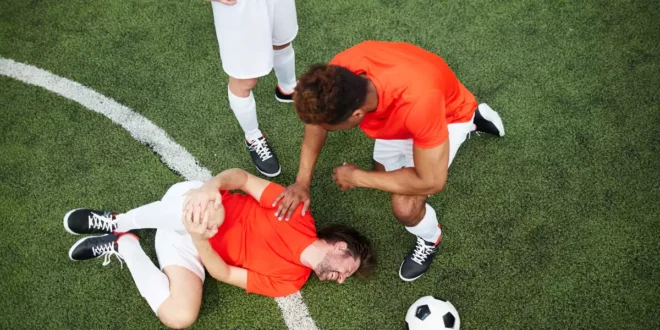

From six to nine months of recovery. That is the period of time an Anterior Cruciate Ligament (ACL) injury can keep a football player away from the pitch. High-profile cases in elite football constantly remind us of the severity of this setback.
Do you want to know how it occurs, how it should be approached, and what role advanced nutrition plays in safely shortening recovery times? Here are the key points from the perspective of science and elite-level rehabilitation.
What is the anterior cruciate ligament (ACL) and what is its function?
The anterior cruciate ligament (ACL) is an intracapsular structure located inside the knee that connects the distal end of the femur to the proximal end of the tibia.
Its main objective is to provide bidirectional stability to the joint. Working in synergy with the posterior cruciate ligament, it prevents the tibia from sliding forward relative to the femur (anterior translation) during flexion and extension movements. In addition, it is the main structural restraint against hyperextension and internal rotational forces of the knee.
Why is it the most feared injury in football?
Its rupture is the worst-case scenario for any football player due to three critical factors:
- Long recovery time: The biological process of graft ligamentization requires between 6 and 9 months out in the best-case scenario.
- Complex rehabilitation: It requires the coordination of a multidisciplinary team (orthopedic surgeon, physiotherapist, and physical rehabilitation specialist).
- Psychological barrier: Fear of reinjury (tearing it again) is a limiting factor that affects the player’s performance once medically cleared.
How does a football player tear the ACL?
To understand this injury, we must distinguish between two clear mechanical scenarios:
Contact vs. non-contact injury
A contact injury occurs due to direct trauma (for example, an opponent’s tackle to the knee). However, approximately 85% of ACL tears in football occur without direct contact. The injury mechanism often happens intrinsically due to an environmental disturbance (an opponent’s dribble or loss of balance in the air).
The danger of dynamic valgus and internal rotation
The classic injury pattern in football occurs when the foot remains fixed on the ground while the knee undergoes a valgus force combined with excessive internal rotation. This torsion generates tension that exceeds the elastic limit of the ligament fibers.
In football, this biomechanical failure is concentrated in two specific actions:
- Sharp changes of direction: Aggressive decelerations where the stabilizing musculature is fatigued and unable to absorb the impact.
- Landings after a jump: Unstable landings where the athlete loses motor control of the hip and the knee collapses inward.
The artificial turf factor: Using boots with aluminum studs or studs that are too long on worn artificial turf drastically increases the risk. The stud “sticks” excessively into the surface, locking the foot and transmitting all the torsional force directly to the knee.
Types of ACL tears
Depending on the macroscopic level of fiber damage, ACL tears are classified as:
- Partial tear: Some ligament fibers are damaged, but the structure maintains a degree of continuity.
- Complete tear: Total loss of fiber continuity. The knee loses its main restraint and becomes completely unstable. (It is often associated with the feared Triad, combined with meniscus and medial collateral ligament tears).
Treatment: Surgical or Conservative?
There are two treatment pathways following MRI diagnosis:
Conservative treatment
This approach is based on avoiding surgery and strengthening the surrounding musculature (quadriceps, hamstrings, glutes) to compensate for the ligament’s function. This option is practically ruled out for an active football player, since the residual instability would accelerate joint degeneration and lead to premature osteoarthritis in the medium term.
Surgical treatment (Operation)
This is the standard choice in football. It consists of arthroscopic reconstruction using a graft (autograft). The two most commonly used tissues are:
- Patellar tendon (B-T-B): High consistency, widely used in professional football.
- Hamstring tendons (Semitendinosus/Gracilis): Lower morbidity in the anterior knee area.
Prevention and rehabilitation
Although zero risk does not exist, ACL injury incidence can be drastically reduced through a neuromuscular training program focused on mitigating multifactorial risk factors.
The role of the gluteus medius and motor control
Weakness of the gluteus medius causes the femur to fall into internal rotation and adduction, leading to the dangerous knee valgus position. Strengthening the hip abductors and stabilizing musculature is the first line of defense.
Essential preventive training routine
Every football player should include the following in their weekly routines:
- Eccentric plyometrics: Teaching the body to cushion landings by absorbing impact with the muscles, not the ligaments.
- Eccentric hamstring strength: Exercises such as the Nordic Hamstring help protect against anterior tibial translation.
- Deceleration and change-of-direction drills: Training braking technique with controlled external perturbations.
Frequently Asked Questions (FAQ)
How long does it really take for a football player to return after tearing the ACL?
Current scientific evidence (Hägglund et al., 2013) shows that returning before 6 months exponentially increases the risk of reinjury. Safe return timelines in modern football are between 7 and 9 months, linked to passing symmetrical strength tests (LSI > 90%) rather than purely time-based criteria.
Can you play football without an anterior cruciate ligament?
In competitive football, it is not viable. Turning, braking, and kicking require rotational stability that the musculature alone cannot sustain under high-intensity demands.
What is the most important supplement after ACL surgery?
Whey protein combined with creatine is essential during the first weeks to counteract the anabolic resistance caused…
Sources consulted:
- Yu, B., & Garrett, W. E. (2007). Mechanisms of non-contact ACL injuries. British Journal of Sports Medicine, 41(suppl 1), i47-i51.
- Dragoo, J. L., Braun, H. J., & Harris, A. H. (2013). The effect of playing surface on the incidence of ACL injuries in National Collegiate Athletic Association American Football. The Knee, 20(3), 191-195.
- Waldén, M., Hägglund, M., Magnusson, H., & Ekstrand, J. (2011). Anterior cruciate ligament injury in elite football: a prospective three-cohort study. Knee Surgery, Sports Traumatology, Arthroscopy, 19(1), 11-19.
- Hägglund, M., Atroshi, I., Wagner, P., & Waldén, M. (2013). Superior compliance with a neuromuscular training programme is associated with fewer ACL injuries and fewer acute knee injuries in female adolescent football players: secondary analysis of an RCT. British Journal of Sports Medicine, 47(15), 974-979.
Other related content you shouldn’t miss:
- Most common knee injuries
- Supplements every football player should take
- All the benefits of protein in football
- Does muscle volume improve performance?