 Fitness, Nutrition, Health and Sports Blog In the HSNstore Blog you will find tips about Fitness, sport in general, nutrition, and health – HSNstore.com
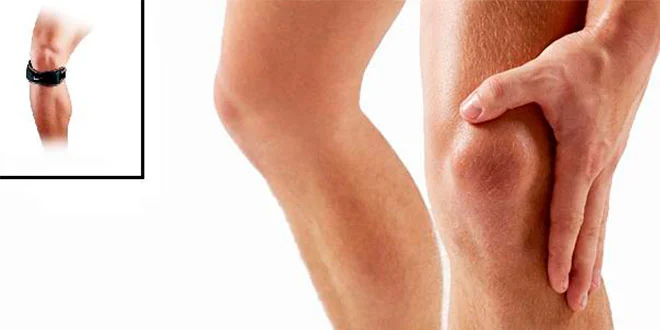

A tendinopathy is an injury where tissue alterations occur at the tendon level. Among them, the patellar tendon is located below the kneecap and is the continuation below it of the quadriceps insertion tendon.
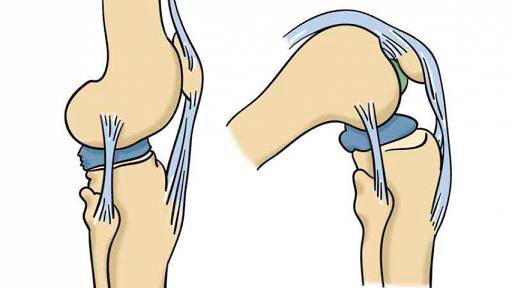
The position of the patellar tendon is a common spot for a condition known as “jumper’s knee” due to the huge stresses it has to endure and because it’s a condyle-femoral contact zone during knee flexion-extension movements, increased by the degree of this. This can cause pinching of the fibers at the patellar insertion on the kneecap, leading to injury.
What causes it: Trigger factors
Intrinsic: Age, weight, structural alterations of the lower limb (genu valgum, genu varum, ankle…), joint hyperlaxity…, but an increased Q-angle is perhaps one of the lesser-known yet most important and individual causes that could contribute to patellar tendinopathy.

Regarding extrinsic factors, things like footwear, hard surfaces, and mechanical overloads that happen in some activities, especially when done very repetitively (running, multiple jumps, squats…), cause the tendon to experience repetitive stretches above 4-5% of its elastic limit capacity, where transverse ruptures of collagen fibers start to occur.
Another intrinsic factor, but caused by fatigue from physical activity (an extrinsic factor), is overload of the patellar tendon. Fatigue in the muscles mainly involved in flexion-extension and knee stability in general (quadriceps, hamstrings, glutes, iliotibial band, calves…) affects their load absorption capacity.
At first, some of the factors mentioned above may cause pain after intense sports or work efforts. This usually improves with rest. However, later the pain could progress and appear before exercise and persist afterward; if not treated properly, it can lead to constant chronic pain, even during daily activities.
Possible solutions to recover
You should never stop exercising, but reduce intensity, frequency, or duration depending on the discomfort, since immobilization would cause tendon atrophy. What might seem crazy is called “optimal post-effort loading”.
The metabolic response is highest in the 24-72 hours post-effort, with increased collagen production, so mechanical stimuli are actually beneficial in the repair process. Among these, for safety reasons, I’d go for early mobilization by a specialist within the pain-free range of motion (though some discomfort might occur).
On the other hand, reading all this probably reminds you of the deep squat. Well, in these cases, always individualizing for each person, special attention should be paid to:
- Eccentric phase and/or eccentric exercises: eccentric exercise seems to be the most effective option, introduced in all three training phases, though not necessarily every day in all of them: warm-up, main or effective phase, and cool down (stretching).
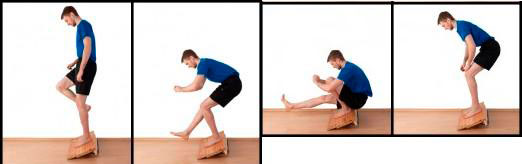 This type of work or emphasizing the eccentric phase boosts tendon cell metabolism by improving Type I collagen production and strengthens the tissue’s tensile capacity. Of course, this also improves neuromuscular coordination, which sometimes gets overlooked in favor of “peripheral” work (focusing only on the injured anatomical area). Enhancing that eccentric tension by involving the knee as much as possible can help us progress faster. For that, we move on to the second point:
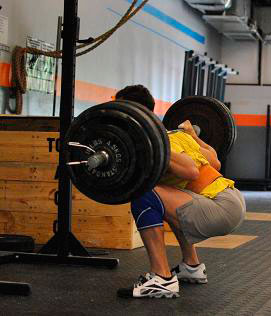
- Working with weightlifting shoes or wedges (dorsiflexion): Wearing heels, working with weightlifting shoes or on a declined surface (like in the previous image) involves the knee extensors more and the hip extensors less, compared to squatting on a flat surface. This helps us progress faster in recovery. The main reason the torso stays more upright with this type of footwear is due to a passive increase in ankle dorsiflexion, which increases range of motion and knee stability.
Sources
- Almekinders, L. C., Vellema, J. H., & Weinhold, P. S. (2002). Strain patterns in the patellar tendon and the implications for patellar tendinopathy. Knee Surgery, Sports Traumatology, Arthroscopy, 10(1), 2-5.
- Murtaugh, B., & Ihm, J. M. (2013). Eccentric training for the treatment of tendinopathies. Current sports medicine reports, 12(3), 175-182.
- Purdam, C. R., Jonsson, P., Alfredson, H., Lorentzon, R., Cook, J. L., & Khan, K. M. (2004). A pilot study of the eccentric decline squat in the management of painful chronic patellar tendinopathy. British journal of sports medicine, 38(4), 395-397.
- Rutland, M., O’Connell, D., Brismée, J. M., Sizer, P., Apte, G., & O’Connell, J. (2010). Evidence–supported rehabilitation of patellar tendinopathy. North American journal of sports physical therapy: NAJSPT, 5(3), 166.
- Schoenfeld, B. Williams, M. (2012). Are deep squats a safe and viable exercise. Strength & Conditioning Journal, 34(2), 34-36.
- Wasielewski, N. J., & Kotsko, K. M. (2007). Does eccentric exercise reduce pain and improve strength in physically active adults with symptomatic lower extremity tendinosis? A systematic review. Journal of athletic training, 42(3), 409.