Fitness, Nutrition, Health and Sports Blog In the HSNstore Blog you will find tips about Fitness, sport in general, nutrition, and health – HSNstore.com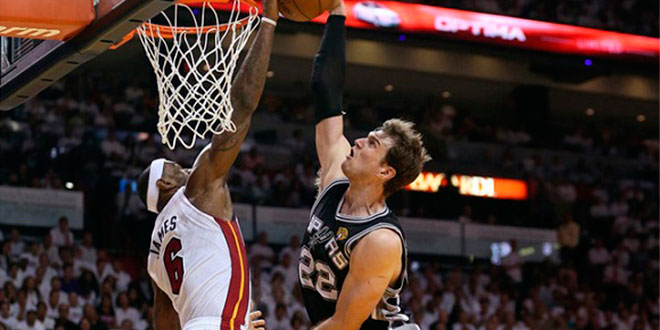

First off, it’s important to point out that if the shoulder is limited in a certain range of motion, restoring it before starting strengthening exercises is key. This instability, especially in athletes who play throwing sports (volleyball, basketball, handball, rugby, shot put, javelin, hammer throw…), usually comes from weakness in the scapulothoracic joint, mainly due to dysfunctions in the serratus anterior and lower trapezius.

That’s why we’ll focus on exercises that boost these muscles, like, among others:
- Dips with added scapular retraction: Decker et al. (2003, cited by Escamilla, Yamashiro, Paulos, & Andrews, 2009) reported very high electromyographic activity in this exercise compared to other more isolated open kinetic chain exercises.

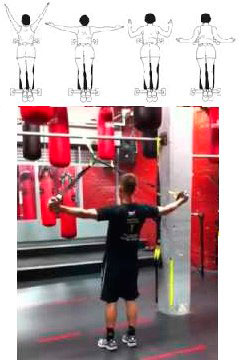
- YTWL with TRX: Suspension training pull exercises activate the core muscles intensely (McGuill, Cannon & Andersen, 2014), and the proposed movements target the muscles responsible for scapular stability and the rotator cuff, using just your own body weight.
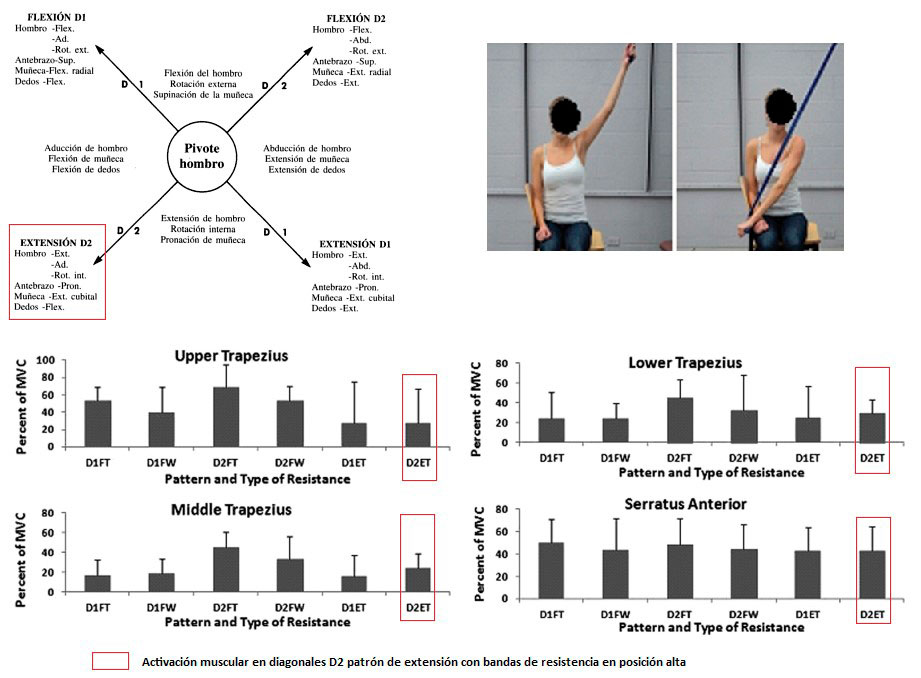
- D2 diagonal extension pattern: The final phase of a spike or throw, after contacting the ball in volleyball for example, requires arm deceleration through strong eccentric contraction of the rotator cuff muscles, serratus anterior, biceps brachii, deltoid, and latissimus dorsi to keep the scapulohumeral joint stable (Andersen et al., 2006; Escamilla et al., 2009).
This exercise, done from a high pulley or with resistance bands placed high, minimizes upper trapezius activity while maximizing lower trapezius and serratus anterior (Witt, Talbott, & Kotowski, 2011), muscles often dysfunctional in these cases.
In all of these, it’s crucial there’s no pain and muscular endurance is the goal until instability is overcome, since rotator cuff muscles are stabilizers. So, when exercises get easy, we’d increase reps before upping the weight in more isolated exercises.
Behind-the-neck exercises: a risk in the gym
Shoulder instability is also closely linked to forced external rotation combined with abduction behind the head (especially behind-the-neck lat pulldowns and military presses) (Corrao et al., 2010). So, we aim for:
- Exercises done in front of the face so the glenohumeral joint moves in the scapular frontal plane or in front of it for extra safety.
- Preferably using neutral or supinated grips since this significantly reduces axial load and anteroposterior stress on the glenohumeral joint compared to pronated grips, which may avoid biomechanical strain on surrounding soft tissue (Kolber, Corrao, & Hanney, 2013).
Warm-up as PREP for the main workout
Many forget that the specific part of the active warm-up aims to better prepare the person for the main activity. Thinking of warm-up as a chore is a mistake; it should be seen as prep for the workout ahead, which only starts when the person feels truly ready.
In these cases, prioritizing protection of shoulder instability by mimicking similar movements and situations to training and/or sport. Exercises like YTWL, face pull, and external humerus rotation on a mid pulley engage the shoulder’s dynamic stabilizers, which can get chronically fatigued in throwing sports and are very likely the cause of that instability. 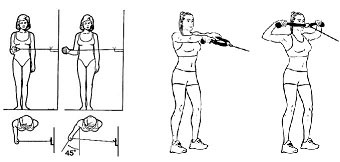
Sources
- Andersen, L. L., Magnusson, S. P., Nielsen, M., Haleem, J., Poulsen, K., & Aagaard, P. (2006). Neuromuscular activation in conventional therapeutic exercises and heavy resistance exercises: implications for rehabilitation. Physical therapy, 86(5), 683-697.
- Corrao, M., Pizzini, G. H., Palo, D. R., Hanney, W. J., & Kolber, M. J. (2010). Weight training modifications for the individual with anterior shoulder instability. Strength & Conditioning Journal, 32(4), 52-55.
- Escamilla, R. F., Yamashiro, K., Paulos, L., & Andrews, J. R. (2009). Shoulder muscle activity and function in common shoulder rehabilitation exercises. Sports medicine, 39(8), 663-685.
- Kolber, M. J., Corrao, M., & Hanney, W. J. (2013). Characteristics of anterior shoulder instability and hyperlaxity in the weight-training population. The Journal of Strength & Conditioning Research, 27(5), 1333-1339.
- McGill, S. M., Cannon, J., & Andersen, J. T. (2014). Analysis of pushing exercises: Muscle activity and spine load while contrasting techniques on stable surfaces with a labile suspension strap training system. The Journal of Strength & Conditioning Research, 28(1), 105-116.
- Meister, K. (2000). Injuries to the shoulder in the throwing athlete part two: evaluation/treatment. The American journal of sports medicine, 28(4), 587-601.
- Wilk, K. E., Meister, K., & Andrews, J. R. (2002). Current concepts in the rehabilitation of the overhead throwing athlete. The American Journal of Sports Medcine, 30(1), 136-151.
- Witt, D., Talbott, N., & Kotowski, S. (2011). Electromyographic activity of scapular muscles during diagonal patterns using elastic resistance and free weights. International journal of sports physical therapy, 6(4), 322.