Fitness, Nutrition, Health and Sports Blog In the HSNstore Blog you will find tips about Fitness, sport in general, nutrition, and health – HSNstore.com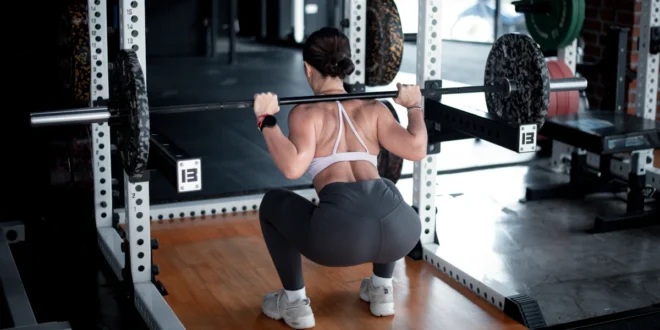

Improving your squat isn’t just about trying to go deeper. Good execution depends on a combination of ankle and hip mobility, individual anatomy, stability, coordination and technique.
If your heels lift, you lose your balance, lean your torso too far forward or struggle to reach your desired depth when squatting, identifying what is limiting the movement is the first step towards correcting it.
Improve ankle mobility
Ankle dorsiflexion allows the knee to move forwards during the descent while keeping the foot stable on the floor. When dorsiflexion is limited, reaching a deep squat can be more difficult and compensations may occur.Before training, you can perform dynamic dorsiflexion movements by progressively driving the knee forwards without lifting the heel off the floor. You can also specifically work on calf and soleus mobility through mobility exercises and stretches.
Hip mobility and anatomy, body proportions and technique also influence squat depth.Adjust your foot position
There is no single perfect stance width or foot angle for everyone. Try making small adjustments to your stance width and external rotation of the feet until you find a position that allows your hips and knees to move comfortably.
Your individual anatomy may make it more natural for you to squat with a slightly wider or narrower stance.Allow your knees to move forwards
Allowing your knees to travel past your toes is not a technical error in itself. During a deep squat, allowing some forward movement of the knees enables the tibia to move forwards and can help you achieve greater depth.
Trying to keep your shins completely vertical can increase the backward displacement of the hips and alter your torso angle.Keep your whole foot stable
You don’t need to squat with your weight exclusively on your heels. Aim to maintain a stable base of support across the whole foot, particularly avoiding your heels lifting unintentionally during the descent.
If this happens repeatedly, review your ankle mobility, foot position and technique.Control your depth
Going deeper doesn’t always mean performing a better squat. Descend to the point where you can maintain control of your knees, pelvis and torso and perform the movement without pain.
In very deep squats, a phenomenon known as butt wink may occur, involving posterior pelvic tilt accompanied by some degree of lumbar flexion.
This does not automatically mean there is a problem, but if it is very pronounced, occurs early in the movement or causes discomfort, it may be worth reviewing your technique and range of motion.Use heel elevation if needed
Weightlifting shoes or a small, stable heel elevation can facilitate forward knee movement and allow you to perform a deeper squat with a more upright torso position.
This can be particularly useful when available dorsiflexion affects your execution, although it should not necessarily be considered a solution to a mobility limitation.Reduce the weight to improve your technique
If you want to increase your depth or modify your technique, you may need to temporarily reduce the load. Practise the new movement pattern with a weight you can control and progressively increase the intensity as you become more comfortable with the technique.
The best squat is not necessarily the deepest or the one performed with the most weight, but the one that allows you to train with an appropriate, stable range of motion that is compatible with your goal.What exercises can help improve your squat?
You can use complementary exercises depending on the specific factor you need to improve:
| If I need to improve… | Recommended exercise | What does it help with? |
|---|---|---|
| Ankle mobility | Dynamic dorsiflexion exercises and calf and soleus work | Facilitates forward movement of the tibia and helps you achieve greater depth. |
| Control and depth | Goblet squat | Helps you learn proper technique and control the deep squat position. |
| Torso position | Front squat | Encourages a more upright torso position and increases demand on the knee extensors. |
| Unilateral strength | Bulgarian split squat and split squat | Develops unilateral strength and hip and knee control. |
| Range of motion control | Box squat | Allows you to establish a specific depth and improve control during the descent. |
| Tolerance to deep positions | Supported deep squat hold | Helps you progressively become more comfortable in deeper squat positions. |
Sources
- García Manso, JM (2014). Practical Course “Olympic Movement Techniques – Weightlifting”. SPORTS TRAINING AND PROMOTION PLAN, ULPGC SPORTS SERVICE.
- González Badillo, JJ. (1991). Weightlifting. Spanish Olympic Committee.
- Poliquin, C. (2014). Achieving Greater Depth in the Squat. http://www.strengthsensei.com/. Retrieved 31 May 2014 from: http://www.strengthsensei.com/achieving-greater-depth-in-the-squat/
- Marchante, D. (2014, 28 June). SHOULD I DO DEEP SQUATS? AN EXPERT’S OPINION. http://www.powerexplosive.com. Retrieved 30 June 2014 from http://powerexplosive.com/facility/debo-hacer-sentadilla-profunda-opinion-de-un-experto-2/
- Poliquin, C. (2014, 26 June). Strength Sensei Question of the Week: Is There an Alternative to the Squat? http://www.strengthsensei.com/. Retrieved 30 June 2014 from: http://www.strengthsensei.com/strength-sensei-question-of-the-week-is-there-an-alternative-to-the-squat/
Related Posts