 Fitness, Nutrition, Health and Sports Blog In the HSNstore Blog you will find tips about Fitness, sport in general, nutrition, and health – HSNstore.com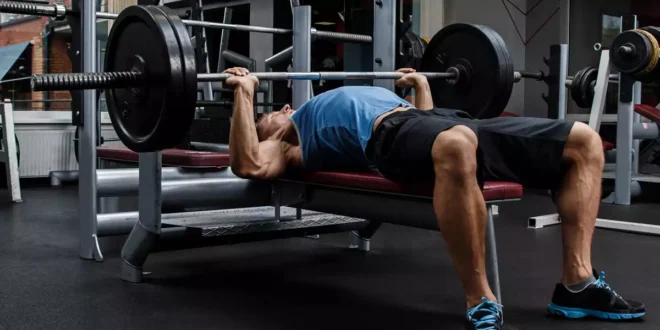

You walk into the gym, lie down on the bench, and feel the cold steel of the bar brushing against your palms—a simple gesture that brings together the strength of your chest, shoulders, and triceps. With every breath, you prepare to push not just a weight, but your own limits, proving to yourself what you’re capable of.
In this post, we’ll guide you step by step so you can learn how to place your feet, align your shoulders, and control the bar path. This way, you’ll achieve a stronger, more efficient, and safer bench press, avoiding common mistakes and gaining confidence with every repetition.

1 Starting position
- Scapular retraction: bring your shoulder blades together and down to create a stable arch.
- Glute contact: keep the entire gluteal mass or inner surface in contact, depending on your level.
- Foot support: full foot or forefoot contact to generate leg drive.
- Grip: thumb wrapped around the bar, biacromial width.
2 Unrack the bar
- Extend your arms without losing the starting position.
- Adjust the bar path to maintain the arch and retraction.
3 Eccentric phase (lowering)
- Control the bar over 1–2 seconds.
- Maintain a vertical line and avoid deviations.
4 Concentric phase (press)
- Inhale on the way down, exhale as you press.
- Apply leg drive and accelerate the bar until lockout.
- Overcome the “sticking point” with speed and a stable posture.
5 Re-rack
- Lock your elbows, stabilize, and guide the bar.
- Carefully return it to the supports.
Bench press muscles and execution variants
The bench press is an exercise especially aimed at developing the pectoralis major, anterior deltoid fibers, and triceps brachii.
The degree of involvement of the different muscles depends on many factors such as the lifter’s morphology, grip, bench position, etc.
The bench press is an exercise that presents a wide range of execution variants, with variations in:
- Bench angle.
- Range of motion.
- Positioning of the different body segments.
- Equipment used.
- Body placement.
However, for the purposes of this execution guide, we will use as a reference the only sport discipline that establishes a standardized execution of this movement: the powerlifting bench press according to the IPF, making small notes on aspects to highlight for non-competitive users.
Common mistakes and how to avoid them
| Mistake | Solution |
|---|---|
| Flared elbows | Keep them at 45° relative to the torso |
| Excessive lumbar arch | Engage core and glutes |
| Foot instability | Adjust position or use blocks |
| False grip | Always wrap the thumb around the bar |
Why train the bench press?
It is a very popular exercise due to its simple and easy-to-learn motor pattern:
✅ For its effectiveness in developing agonist and synergist muscles in upper-body pushing movements,
✅ For its general profile and therefore high transfer to specific movements across many sports, and
✅ For being one of the 3 official competitive lifts of the IPF (International Powerlifting Federation).
References
- Gillén, O. (2018). Analysis of variables in Powerlifting (Bachelor’s thesis). INEFC, University of Lleida
- Sheiko, B. (2018). Powerlifting foundations and methods. UFA
Related Posts
- Why do shoulders hurt when bench pressing?
- Bench press blitz
- Velocity–intensity relationship in the bench press
- Muscles involved in the bench press