 Fitness, Nutrition, Health and Sports Blog In the HSNstore Blog you will find tips about Fitness, sport in general, nutrition, and health – HSNstore.com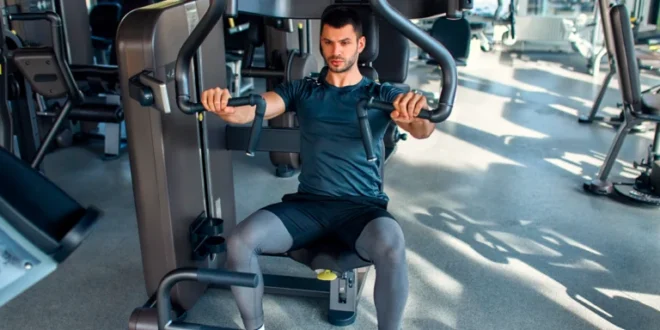

The machine chest press is a practical and safe option to work the chest when you want to focus on strength and technique without relying on a partner. Thanks to its guided path, it reduces the chance of imbalances and lets you concentrate on muscle contraction and movement control.
Keep reading and learn how to get the most out of the machine press with technique and confidence.
- Align the equipment according to your anatomy to avoid joint strain.
- Set the backrest so the handles are at shoulder height or slightly below
- Keep your entire back against the support, feet flat on the floor hip-width apart
- Grab the handles with a 45-60° angle between arms and torso
- Keep elbows aligned with wrists, without closing or opening them too much.
- Inhale as you bring the handles toward your chest, keeping shoulders down and scapulas retracted
- Exhale while pushing, extending elbows without locking them
- Control the full range: 2 seconds down, 1 second up.

A couple of “pro” tips for this machine:
- Adjust the seat height: the handles should be at mid-chest level (nipple line). If they’re too high, you’ll put too much strain on your shoulders.
- Scapular retraction: before pushing, “stick out your chest” and squeeze your scapulas back. Keeping shoulders pressed against the backrest protects the rotator cuff and puts all the focus on the chest.
Recommended sets and reps
Progression on the machine depends on your level and goals. These guidelines ensure safe muscle adaptation while avoiding overload.
| Level | Sets | Repetitions | Intensity (RIR)* | Frequency |
|---|---|---|---|---|
| Beginner | 2-3 | 10-15 | RIR 3-2 (Far from failure) | 2-3 |
| Intermediate | 3-4 | 8-12 | RIR 2-1 (Close to failure) | 2 |
| Advanced | 3-5 | 5-10 | RIR 1-0 (At the limit or failure) | 1-2 |
Muscles worked by the machine press
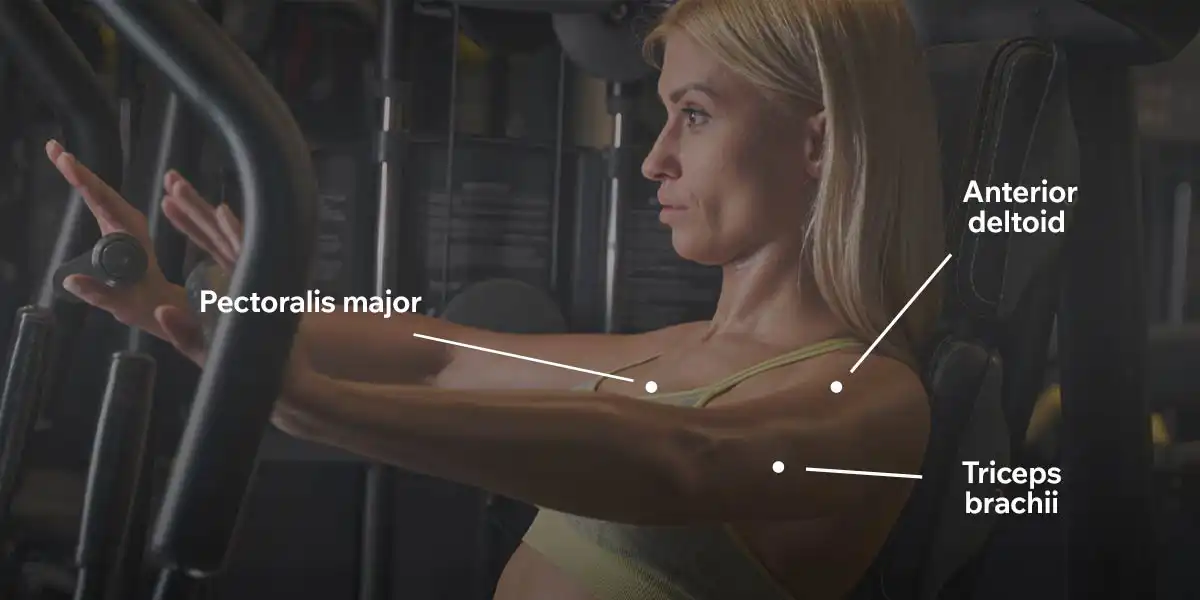
Main muscles (agonists):
- Pectoralis major: The absolute star. Depending on the machine design (whether you push straight, upward, or toward the center), you’ll target more the middle, lower, or upper fibers.
- Anterior deltoid: Helps during the initial pushing phase.
- Triceps brachii: Responsible for elbow extension to complete the movement.
Secondary muscles (synergists and stabilizers):
- Serratus anterior: that “finger-shaped” muscle on the side of the ribs that helps move the scapula.
- Pectoralis minor: stabilizes the deep chest area.
- Core (abs and lower back): even sitting down, these muscles activate to keep your back pressed against the support and transfer force properly.
Common mistakes and how to fix them
Learn how to correct small errors when doing your exercise.
| Mistake | Risk | Fix |
|---|---|---|
| Seat too low | Shoulder strain | Adjust until handles align with armpits |
| Bouncing on the chest | Sternal injury | Reduce weight and control eccentric phase |
| Too much weight | Lower back arching | Use a load that allows 10 clean reps |
| Locked elbows | Joint hyperextension | Keep a slight bend when extending |
| Scapulas lifting off | Overcompensating with shoulders | Actively press your back against the support |
Top benefits of the machine press
✅ Lets you increase load more safely by reducing the need for a spotter.
✅ Minimizes imbalances by guiding the movement path.
✅ Makes it easier to isolate the chest for better muscle contraction.
✅ Controls range of motion to avoid harmful positions.
✅ Simplifies strength progression by controlling variables (weight, reps).
✅ Reduces stabilizer demand, great for beginners or when fatigued.
✅ Allows training close to failure with less risk.
✅ Practical for rehab and re-educating the pushing pattern.
✅ Adjustable for different sizes and arm lengths, improving ergonomics.
✅ Speeds up technique and confidence before moving to free-weight variations.
Related posts
- How to master the bench press
- Speed-intensity relationship in bench press according to 1RM
- Muscles worked in the bench press
- Why do shoulders hurt when bench pressing?