Fitness, Nutrition, Health and Sports Blog In the HSNstore Blog you will find tips about Fitness, sport in general, nutrition, and health – HSNstore.com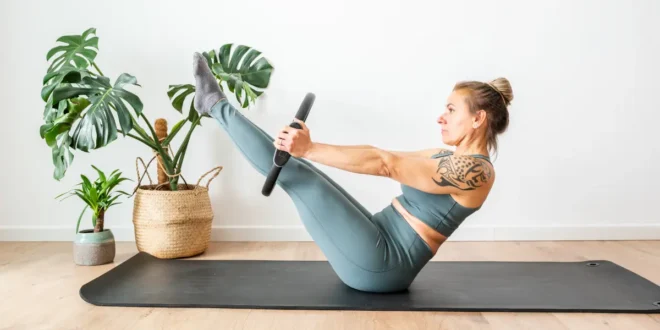

The Hollow Body Hold is a fundamental exercise for a strong core. At first glance it may seem easy, but maintaining a stable and correct posture requires control.
With this exercise, you will improve your abdominal and lower-back strength, with direct benefits for any physical activity. Learn how to perform the Hollow Body Hold correctly and boost your training with us by following these steps:
- Lie on your back on a mat or flat surface. Extend your arms above your head and keep your legs straight. Make sure your lower back is in contact with the floor.
- Press your lower back into the floor, activating your abdominal muscles. Imagine you are drawing your navel towards your spine.
- Lift your legs off the floor until they form a 45-degree angle with the floor — or less if you are a beginner. At the same time, lift your shoulders and upper back off the floor, keeping your arms straight and aligned with your ears.
- Your body should form a gentle curve, like a banana, with only your lower back and hips in contact with the floor. Keep your head in a neutral position — do not force it forwards.
- Hold the position for 10-30 seconds if you are a beginner, and gradually increase the time as you gain strength, breathing in a controlled and steady manner.
- When you finish, slowly lower your shoulders and legs to the floor, keeping your core active until the end.
Index
?️♂️ Sets and repetitions
| Level | Sets | Duration per set | Rest between sets | Javier’s tip |
| Beginners | 3 | 10-20 seconds | 30-45 seconds | Focus on maintaining the correct posture and control your breathing to avoid fatigue. |
| Intermediate/Advanced | 3-6 | 40-60 seconds | 60 seconds | Increase the intensity gradually and listen to your body to avoid injury. |
?? How to breathe to perform the exercise correctly
To perform the exercise correctly, it is essential to learn how to breathe in a controlled way by following these tips:
- Use diaphragmatic breathing — from the abdomen, not just the chest.
- Exhale during the effort — when activating the core or lifting in the movement.
- Avoid holding your breath; maintain a constant flow of air.
- Exhale during the effort phase and inhale during the relaxation phase.
- Keep your abdomen slightly contracted even when inhaling.
- Spend time practising diaphragmatic breathing every day.
Hollow Body Hold progressions for all levels
Finally, a basic exercise progression will be presented to help anyone correctly develop the necessary prerequisites to ultimately achieve the Hollow Hold.
Tuck Hollow
| Training Load | |||
| Work time | 5-20″ | Sets | 2-4 |
| Intensity | 3/10 | Rest | 20-40″ |
Tuck Hollow — pushing the knees
| Training Load | |||
| Work time | 5-20″ | Sets | 2-4 |
| Intensity | 4/10 | Rest | 20-40″ |
Tuck Hollow — arms extended
| Training Load | |||
| Work time | 5-20″ | Sets | 2-4 |
| Intensity | 5/10 | Rest | 20-40″ |
Middle Tuck Hollow — arms extended and knee bent
| Training Load | |||
| Work time | 5-20″ | Sets | 2-4 |
| Intensity | 3/10 | Rest | 20-40″ |
Hollow — knees extended and arms bent
| Training Load | |||
| Work time | 5-20″ | Sets | 2-4 |
| Intensity | 4/10 | Rest | 20-40″ |
Hollow Body Position
| Training Load | |||
| Work time | 5-20″ | Sets | 2-4 |
| Intensity | 5/10 | Rest | 20-40″ |
Benefits of performing the Hollow Body Hold
This fantastic exercise is characterised by:
- Improving your performance in other sports, as it strengthens key muscles you use in everyday and high-performance movements.
- Developing control and stability, as it requires a high level of body control.
- Activating multiple muscles at once, especially the core — abdomen, lower back and hips.
- Strengthening specific muscles, such as the serratus anterior — which helps move the shoulders forwards — the serratus posterior — involved in breathing — and the glutes — which stabilise the pelvis and improve posture.
Tips to improve your Hollow Hold
| Description | Details |
| Adjust the exercise according to your level and needs | – If you are a beginner, start with short sets and progressively increase the duration. – If you are advanced, add intensity or increase the hold time. |
| Stretch out as much as possible to improve movement efficiency | – Keep your shoulders flexed at 180º — arms stretched upwards. – Fully extend your knees, feet and toes. – Keep your legs together. – Place your arms at shoulder height. |
| Take care of your lower back and activate the right muscles | – Keep your lumbar and pelvic area pressed against the floor. – Activate your glutes to stabilise the pelvis — posterior pelvic tilt. |
| Generate tension from your arms towards your core | – Perform scapular protraction — push your shoulders forwards. – Draw your ribs inwards. – Use rib breathing — breathe from your ribs, not from your abdomen. |
Bibliography
- Paoli, C. & Sherbondy, A. (2014). Freestyle: maximize sport and life performance with four basic movements. Victory Belt Publishing Inc.
- Zlongdpt (2019). Keys to the Hollow Body Hold. The Barbell Physio.
- Contreras, B. (2016). Try Hollow Body Holds. T-Nation.
- Varela, N. (2020). Hollow Body Hold. Body by Gimnastics.
Related Posts
- Complete Guide to Planks
- How to Do the Overhead Carry
- How to Do the Side Plank
- The Best Core Exercises by Level
- Complete Guide to Abdominal Exercises