Fitness, Nutrition, Health and Sports Blog In the HSNstore Blog you will find tips about Fitness, sport in general, nutrition, and health – HSNstore.com

Hydrolysed Protein is an advanced version of whey that is widely recognised in the field of sports supplementation and fitness. Through a process of hydrolysis, proteolytic enzymes break down the protein into smaller peptides and individual amino acids, replicating digestion and facilitating absorption.
- Because it is easier to absorb, it promotes muscle recovery after intense workouts, helps repair damaged muscle fibres, and promotes muscle growth, among other health benefits.
- Compared to other protein sources, hydrolysed protein, rich in di- and tripeptides, may have a slight advantage in terms of absorption speed and efficiency.
- It is particularly suitable for those who perform intense efforts, as they require a higher protein intake to repair muscle fibres damaged during training and thus promote muscle growth.
What functions does protein hydrolysate have in the body?
Hydrolysed protein, a type of pre-digested protein, offers significant advantages in absorption, muscle recovery and sports performance.
1. Faster protein absorption
The characteristic of being a pre-digested protein allows for faster absorption compared to other forms of protein. This results in rapid availability of amino acids for recovery, protein synthesis, creatine creation, hormones and l-carnitine.
2. Protein synthesis stimulation
The di-/tripeptides in a hydrolysate largely determine the rapid absorption of the protein. These are absorbed intact, unlike tetra- or oligopeptides which need to be digested first.
A high level of di- and tripeptides results in a higher concentration of amino acids in various tissues, including muscle tissue.
3. Increased glucose uptake for muscles
The combination of hydrolysed whey protein and carbohydrates may improve glucose uptake into muscle.
Hydrolysed whey protein increases GLUT4 translocation and glycogen levels without altering health markers. This effect may be especially beneficial for muscle recovery, and possibly for people with glucose problems.
Benefits over other proteins
The main benefits of hydrolysed whey protein compared to other more common proteins such as soy or casein:
- It is suitable for people with digestion problems because it is an easier to digest and absorb protein for people with digestive sensitivities or difficulties.
- It can improve insulin response, making it ideal for diabetics: hydrolysed protein is effective in raising blood insulin levels due to the high bioavailability of amino acids in the body.
- It stimulates the immune system, as hydro protein contains bioactive peptides that can have positive effects on the immune system, helping to strengthen the body’s defences.
- Suitable for low-carbohydrate and low-fat diets: hydrolysis provides a high-concentration protein with low carbohydrate and low-fat content.
- Faster muscle recovery and protein absorption due to rapid transport of amino acids into the muscle. This is especially beneficial for athletes and people who exercise intensively and frequently.
Who is it suitable for?
Hydrolysed whey proteins are generally recommended for athletes looking to build or maintain muscle mass faster.
It is an excellent choice for those who experience stomach upset with other proteins, as its easy digestibility alleviates this problem.

It is also ideal for those on multi-meal diets who need a protein supplement that does not interfere with their next meal.
When is the best time to take it?
- Pre-workout: to maximise your workouts, have a pre-workout shake with hydrolysed protein and rapidly assimilated carbohydrates. For example, cyclodextrins provide the nutrients needed for an intensive workout, without the heaviness associated with a full meal.
- Intra-workout: di- and tripeptides, components of hydrolysed protein, are absorbed faster and are more available to muscle tissue. Consuming them during training can reduce muscle damage and improve recovery.
- Post-workout: it is ideal for post-workout recovery. Its rapid assimilation helps the body to repair damaged tissues quickly, thus speeding up muscle recovery.
Recommended hydrolysed proteins
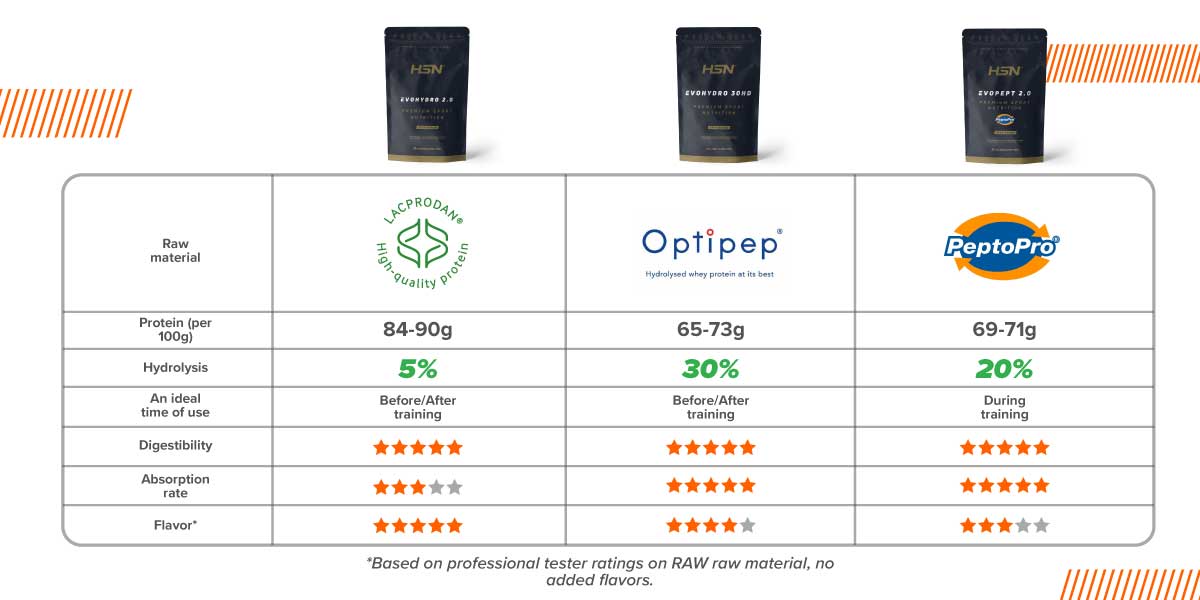
A hydrolysed protein that fits perfectly into an intra-workout supplementation protocol is Evopept with Peptopro raw material by SportSeries.
Another option is Evohydro protein hydrolysate with Lacpodran protein hydrolysate, which incorporates the raw material Lacpodran® Hydro.90 INS. It has a high degree of hydrolysis and high availability of di- tri-peptides from whey protein isolate hydrolysate.
We also recommend hydrolysed lean beef protein from beef cattle, providing an excellent product for people looking for a non-dairy source.
Conclusions
In certain sports disciplines, hydrolysed protein, provided it is rich in di- and tripeptides, may offer certain advantages over other types of protein, such as soy or whey concentrate. This is valid regardless of the type of training we do.
Sources
- THE SIGNIFICANCE OF PEPTIDES IN CLINICAL NUTRITION.G. K. Grimble
- Absorption and malabsorption of glycine and glycine peptides in man. I. L. CRAFT
- Control of protein synthesis by amino acid availability.Kimball SR1, Jefferson LS.
- Whey protein hydrolysate increases translocation of GLUT-4 to the plasma membrane independent of insulin in wistar rats.Morato PN1, Lollo PC, Moura CS, Batista TM, Camargo RL, Carneiro EM, Amaya-Farfan J.
- Acute exercise induces GLUT4 translocation in skeletal muscle of normal human subjects and subjects with type 2 diabetes.Kennedy JW1, Hirshman MF, Gervino EV, Ocel JV, Forse RA, Hoenig SJ, Aronson D, Goodyear LJ, Horton ES.
- Co-ingestion of a protein hydrolysate with or without additional leucine effectively reduces postprandial blood glucose excursions in Type 2 diabetic men.
Manders RJ1, Koopman R, Sluijsmans WE, van den Berg R, Verbeek K, Saris WH, Wagenmakers AJ, van Loon LJ. - Measuring splanchnic amino acid metabolism in vivo using stable isotopic tracers.Stoll B1, Burrin DG.
- The effect of whey isolate and resistance training on strength, body composition, and plasma glutamine.¡Cribb PJ1, Williams AD, Carey MF, Hayes A.
- Supplementation with a whey protein hydrolysate enhances recovery of muscle force-generating capacity following eccentric exercise.
Buckley JD1, Thomson RL, Coates AM, Howe PR, DeNichilo MO, Rowney MK. - Carbohydrate and protein hydrolysate coingestions improvement of late-exercise time-trial performance.
Saunders MJ1, Moore RW, Kies AK, Luden ND, Pratt CA.
Read more if you are interested in this article:
- Which is better, whey protein isolate or whey protein concentrate?
- Find out what Whey Protein is, what it is used for and its benefits for athletes.
- Is pea protein really an effective alternative?
- What are the best proteins for sports performance?