Fitness, Nutrition, Health and Sports Blog In the HSNstore Blog you will find tips about Fitness, sport in general, nutrition, and health – HSNstore.com

The close relationship between calcium and vitamin D is explained by the fact that the latter is essential for the body to absorb the former. The result: optimal bone mineral density, in other words, helping to keep at bay potential problems associated with calcium deficiency, the most abundant mineral in the human body.
What is the relationship between bone mineral density and osteoporosis?
To better understand the nature and scope of this relationship, start from the fact that the bone tissue in your body is made up of heterogeneous material. Thus, in descending order, it consists of:
- A mineral layer, hydroxyapatite (made up of crystalline calcium phosphate)
- An organic layer (∼90% type I collagen, ∼5% non-collagenous proteins (NCPs), ∼2% lipids)
- Water
What is bone mineral density? It is the amount of mineral mass found in a given volume of bone and is a cornerstone of the health and strength of the tissue.
Bear in mind that, with age, bone mineral density tends to decrease. This condition is known as osteopenia, a type of negative bone remodelling that can lead to another condition known as osteoporosis, characterised by a decrease in bone density while the bone tissue becomes fragile and susceptible to fractures.
What role does Calcium play?
Calcium is a macroelement, 99% of which is found in the bone tissue of your body. Among its most notable functions are acting as an intracellular “messenger” and hormonal regulator, while performing structural functions in bone.
This allows you to appreciate the great importance of calcium intake for bone mineral density. Indeed, this intake helps generate a positive balance (calcium retention), associated with maintaining (and even increasing) bone mineral density, a determining factor in bone health, as we have already explained.
Sources
The main sources of calcium are milk and dairy products, as you might expect, but also fish eaten with their bones, nuts, pulses and certain fruits and vegetables.
Recommended Daily Amount
As regards the Recommended Daily Amount, it would be set at around 900 mg per day for men aged 18 and over and 1,000 mg per day for children and adolescents <18 years, women and men >60 years. This is according to Spanish RDIs.

And Vitamin D?
As for vitamin D, the one that comes from the Sun, we can tell you that it is a fat-soluble nutrient for which there is a widespread deficiency among the European population and whose role in calcium metabolism is absolutely essential. It helps maintain circulating levels in the body and is vital for sports performance.
Sources
Vitamin D is preformed in the skin as 7-dehydrocholesterol and, through UV radiation from the sun, your body converts it into cholecalciferol (vitamin D3). You can also turn to foods rich in vitamin D, such as mushrooms, fish liver oils and oily fish, egg yolk, whole-fat dairy products and fortified foods.
Vitamin D Deficiency
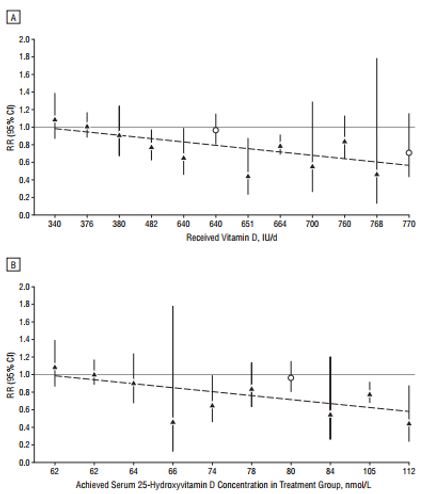
The table, taken from the article by Bischoff-Ferrari et al., 2009, shows how higher levels of vitamin D administration and higher serum concentrations in plasma (X-axis) are associated with a lower relative risk (Y-axis) of non-vertebral fractures.
Regarding vitamin D deficiency, the same authors concluded that the prevention of non-vertebral fractures with this nutrient is dose-dependent and that a higher dose should help reduce fractures by at least 20% in people aged ≥65 years.Recommended Daily Amount
A synergistic combination: Calcium & Vitamin D
As you might expect, given the close relationship between them, calcium and vitamin D act synergistically. Their functions are perfectly distributed: while calcium performs structural functions in bone tissue, vitamin D contributes to proper calcium metabolism by increasing renal reabsorption.
To care for your health, it is advisable for your body to have optimal stores of calcium and vitamin D, which are required to achieve effective pharmacological treatments against osteoporosis (Sunyecz, 2008).
How can osteopenia be reduced?
When it comes to tackling osteopenia, you can approach it from 3 different angles:
Through diet
Calcium and vitamin D intake, preferably through foods containing high amounts of both nutrients (read more), such as whole-fat dairy products (which, together with amino acids, promote calcium absorption), could be considered a smart strategy for maintaining bone health and bone mineral density.
Through supplementation
Did you know that vitamin D3 supplementation is considered practically essential for much of the European population? Such is the widespread deficiency of this indispensable nutrient. This is why doctors frequently recommend its intake. To make sure your body is not deficient in this vitamin, you should have your plasma 25-OH-cholecalciferol levels tested.
You should also pay attention to your phosphorus intake, as a high intake of this mineral increases resorption, promoting demineralisation.

Through training
Do you consume enough calcium? Then, make sure you incorporate it into the bone to improve its microstructure! Achieve this by doing exercise that stimulates the process, either through exercises with osteoarticular impact (such as running) or through strong traction forces (such as strength training).
With the information you now have, you can judge for yourself the value of including sufficient amounts of calcium and vitamin D in your diet so that your bone mineral density does not suffer the consequences of ageing. The ball is in your court!
Bibliographic Sources:
- Bischoff-Ferrari HA, Willett WC, Wong JB, Stuck AE, Staehelin HB, Orav EJ, Thoma A, Kiel DP, Henschkowski J. Prevention of Nonvertebral Fractures With Oral Vitamin D and Dose DependencyA Meta-analysis of Randomized Controlled Trials. Arch Intern Med. 2009;169(6):551–561. doi:10.1001/archinternmed.2008.600
- Boskey, A. L. (2013). Bone composition: relationship to bone fragility and antiosteoporotic drug effects. BoneKEy Reports, 2, 447. http://doi.org/10.1038/bonekey.2013.181
- Institute of Medicine (US) Committee to Review Dietary Reference Intakes for Vitamin D and Calcium; Ross AC, Taylor CL, Yaktine AL, et al., editors. Washington (DC): National Academies Press (US); 2011
- Sunyecz, J. A. (2008). The use of calcium and vitamin D in the management of osteoporosis. Therapeutics and Clinical Risk Management, 4(4), 827–836.
- Thacher, T. D., & Clarke, B. L. (2011). Vitamin D Insufficiency. Mayo Clinic Proceedings, 86(1), 50–60. http://doi.org/10.4065/mcp.2010.0567
Related Posts