Fitness, Nutrition, Health and Sports Blog In the HSNstore Blog you will find tips about Fitness, sport in general, nutrition, and health – HSNstore.com

Taurine is the trendy food supplement.
All sportspeople use it for its benefits and properties: before their sports competitions, at night before going to bed… And we are finding more and more research on its application to human health.
What is taurine?
Taurine is an amino acid that is not present in our body’s proteins, but rather in free form due to the body’s ability to create it through metabolic reactions.
It is not an essential nutrient, but under certain conditions it is considered indispensable in the diet, as in the case of growing children.

It was formerly considered an “osmolyte”, a component of the body’s liquid tissues that helped prevent loss of osmotic pressure.
What are the properties of Taurine?
It is now widely used by athletes, following the publication of a series of scientific studies in humans in which food supplementation with this compound appeared to produce benefits in physical endurance.
A review of 10 studies published by Waldron et al. (2018) concluded that doses between 1 and 6 grams in the form of a food supplement had benefits:
1. Cognitive function
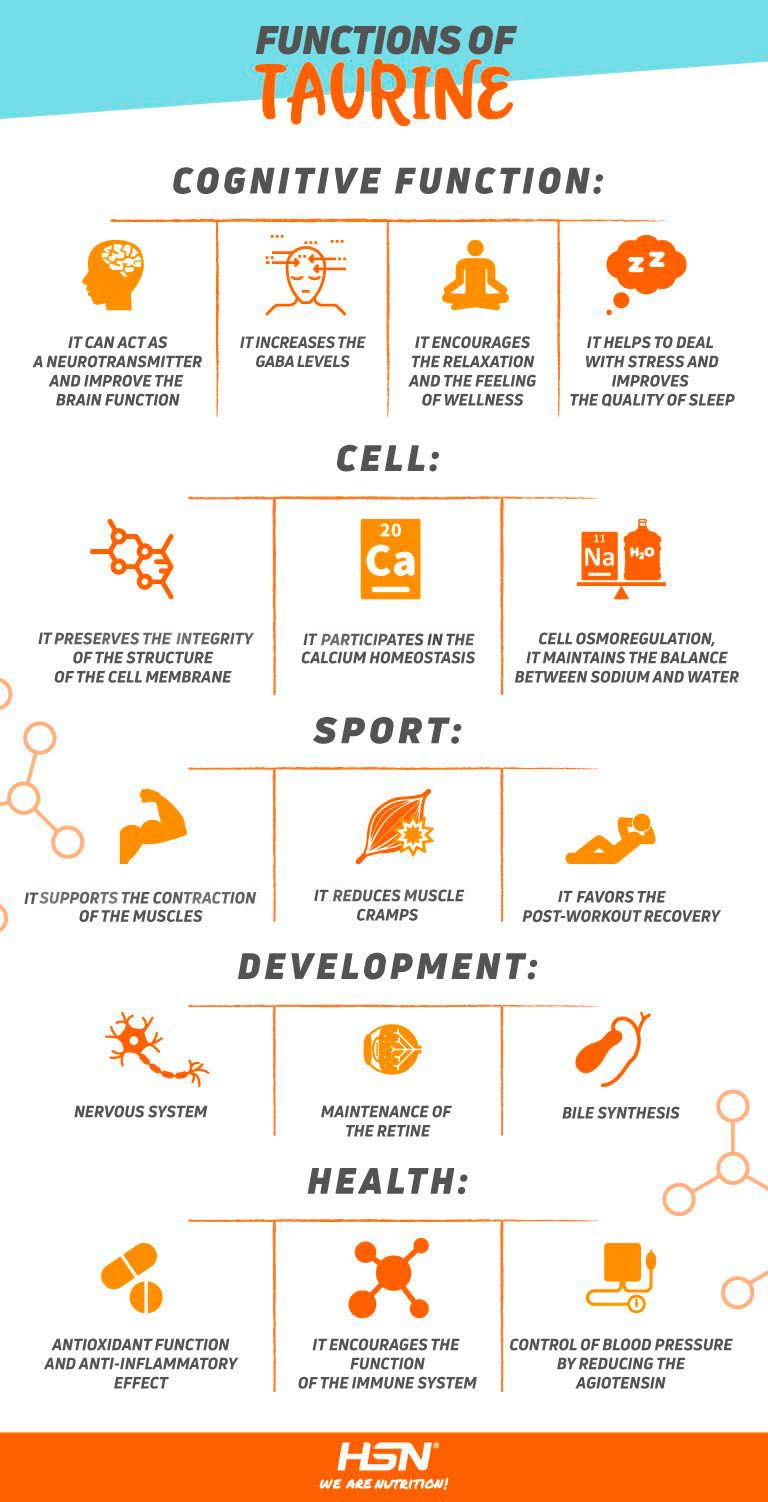
Taurine modulates neurotransmitters in the brain, helps stabilise cell membranes, which is beneficial for bladders, blood vessels and eyes. It also has antioxidant and detoxifying properties. It works as a neurotransmitter and improves brain function, increases Gaba levels, promotes relaxation and well-being, helps to cope with stress and improves sleep quality.
2. Cellular Health
Taurine is an essential compound in the maintenance of cellular health. At the cellular level, taurine helps maintain the integrity of the cell membrane structure. In addition, it is involved in calcium homeostasis, which means that it helps regulate calcium levels within the cell. Taurine also plays an important role in cellular osmoregulation, helping to maintain the balance between sodium and water within the cell.
3. Sport
Taurine is an antioxidant that helps fight free radicals and oxidative stress in the body. It has also been shown to help heal chronic periodontal disease, support muscle contractile function, reduce muscle cramps and support recovery from exercise.
4. Development
Taurine is essential for normal brain development and function, helps improve memory and cognitive ability, and prevents neurodegenerative diseases. It is also vital for the health of the retina and prevents diseases such as macular degeneration. It also, stimulates bile production, which is necessary for digestion and elimination of toxins, helping to maintain liver health.
5. Health
Taurine has a whole host of health benefits. These include improving various bodily, such as helping to reduce high blood pressure, by reducing resistance to blood flow in the walls of blood vessels. It also protects liver cells from free radicals and oxidative damage from toxins.
Contraindications
There are no specific contraindications to its use, as it is naturally present in the body and with which our body is familiar.
Consumption up to a dose of 3g has been established as a practice with a high degree of safety, although food supplementation with doses up to 10g has been evaluated without adverse effects on a widespread basis.
It is recommended to use with caution, under medical knowledge and control, during pregnancy and breastfeeding, as we do not have sufficient toxicological data in this period.
Even so, preliminary evidence tends to point to a positive effect by being able to transfer part of it through breast milk, enriching its nutritional potential.
It should not be consumed: when undergoing treatment with thrombolytic agents, anticoagulants, antiplatelet agents and/or salicylates, as it may interfere and magnify their effects.
The main side effects have been described in cases of consumption of energy drinks containing the ingredient, however, their relationship is not causal as no link between the events (mainly cardiovascular) and taurine itself could be established.
Where to buy Taurine?
You can find it in HSN products.
The pure amino acid is available in its natural chemical form in both powder form and in highly concentrated capsules (500mg):
- Are you looking for a food supplement to add to your pre-workouts? Check out L-Taurine powder by RawSeries!
- You also have the food supplement L-Taurine in vegetable capsules, completely suitable for vegans. An even easier way to dose the amino acid precisely!
Bibliographical references
- Jakaria, M., Azam, S., Haque, M. E., Jo, S. H., Uddin, M. S., Kim, I. S., & Choi, D. K. (2019). Taurine and its analogs in neurological disorders: Focus on therapeutic potential and molecular mechanisms. Redox Biology, 24, 1–15.
- Pasantes-Morales, H., Quesada, O., Alcocer, L., & Sanchez Olea, R. (1989). Taurine content in foods. Nutrition Reports International, 40(4), 793–801.
Ripps, H., & Shen, W. (2012). Review: Taurine: A “very essential” amino acid. Molecular Vision, 18, 2673–2686. - Waldron, M., Patterson, S. D., Tallent, J., & Jeffries, O. (2018). The Effects of an Oral Taurine Dose and Supplementation Period on Endurance Exercise Performance in Humans: A Meta-Analysis. Sports Medicine, 48(5), 1247–1253.
- Yamori, Y., Taguchi, T., Hamada, A., Kunimasa, K., Mori, H., & Mori, M. (2010). Taurine in health and diseases: Consistent evidence from experimental and epidemiological studies. Journal of Biomedical Science, 17(SUPPL. 1), S6.
Related Entries
- Do you want to get the most out of your Pre-Workout Supplements? We recommend you take a look at this article.
- We analyse the main energy drinks by clicking here.