Fitness, Nutrition, Health and Sports Blog In the HSNstore Blog you will find tips about Fitness, sport in general, nutrition, and health – HSNstore.com

If you want a powerful back, few exercises work as well as pull-ups. Many people try them out of curiosity or as a personal challenge, but what truly makes the difference is mastering the technique and progressing safely. Follow these steps and learn how to perform the movement with safety and effectiveness.

- Position yourself under the bar and grab it with a pronated grip, palms facing forward and hands slightly wider than shoulder-width apart.
- Lift your feet off the ground so you are hanging with your arms fully extended. Keep your core engaged and your shoulders pulled back and down.
- Initiate the movement by pulling your elbows down toward the floor, driving your torso upward until your chin clears the bar.
- Lower yourself in a controlled manner back to the starting position, fully extending your arms to complete the repetition.
Initial training plan
Consistency is key to improvement. Here is a starting point to build strength and endurance.
| Progress level | Sets | Repetitions | Rest between sets |
|---|---|---|---|
| Beginner | 3 | 5–8 | 90 seconds |
| Intermediate | 4 | 8–12 | 60 seconds |
| Advanced | 4–5 | 12–15 | 45 seconds |
Muscles involved
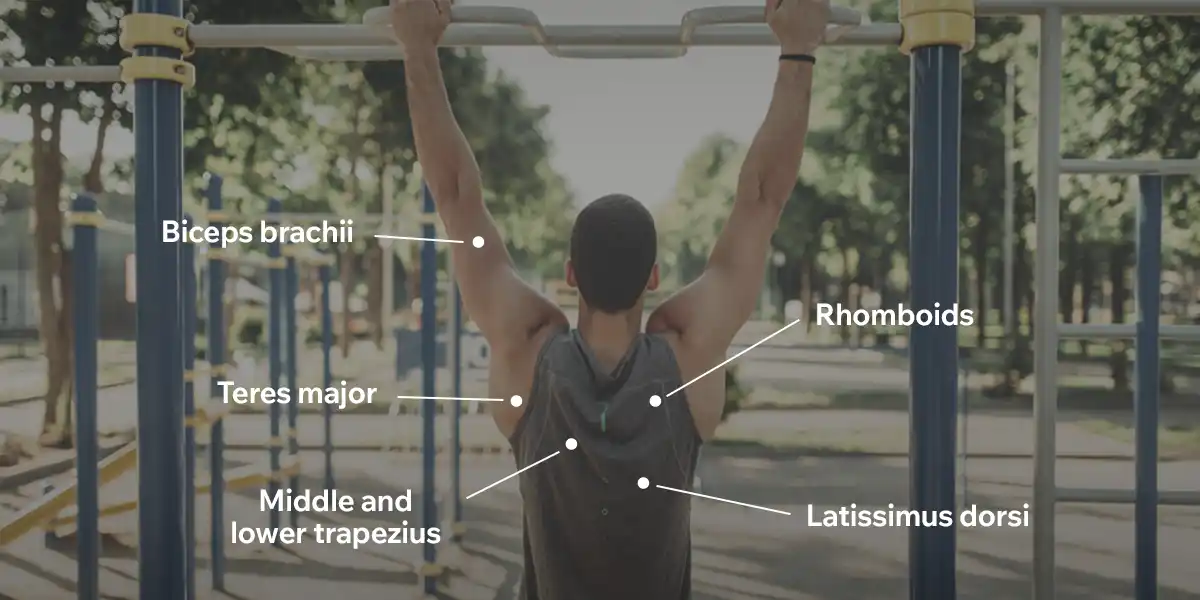
? Primary (main movers)
- Latissimus dorsi → the main muscle, responsible for pulling the elbows downward.
- Teres major → assists the lats in shoulder extension.
? Secondary (assistants)
- Biceps brachii → elbow flexion.
- Brachialis → highly active, especially with neutral or mixed grips.
- Brachioradialis → forearm muscle, important for grip strength.
- Middle and lower trapezius → stabilize and retract the scapulae.
- Rhomboids → bring the scapulae together.
- Posterior deltoid → assists in pulling.
? Stabilizers
- Core (abdominals and lower back) → keep the body stable.
- Spinal erectors → postural control.
- Grip muscles (forearm flexors).
Exercise variations with different grips
Incorporating different grips allows you to emphasize different muscle groups.
1 Supinated pull-up

?️ Grab the bar with your palms facing you and your hands shoulder-width apart.
? This grip significantly targets the biceps and the lower portion of the lats.
2 Neutral pull-up

?️ Use parallel bars or rings so that your palms face each other.
? This variation is easier on the shoulder joints.
3 Wide-grip pull-up

?️ Place your hands noticeably wider than shoulder-width apart.
? This position emphasizes the upper and outer parts of the back.
4 Mixed-grip pull-up

?️ Place one hand in a pronated grip (palm facing out) and the other in a supinated grip (palm facing in).
? This position allows you to move more load and distributes the work between lats, biceps, and forearms, making it very useful for building strength and overcoming plateaus in strict pull-ups.
Common mistakes and how to fix them
Identifying and correcting technical errors speeds up progress and protects your physical integrity.
| Mistake | Solution |
|---|---|
| Swinging the body | Cross your ankles and keep your core tight throughout the movement |
| Not lowering fully | Make sure to fully extend your arms on each repetition for a full range of motion |
| Shrugging the shoulders | Activate your back by pulling your shoulders back and down before initiating the ascent |
Benefits of doing pull-ups
✅ Builds a strong, well-defined back.
✅ Develops functional upper-body strength.
✅ Improves core stability and grip strength.
✅ Increases muscle mass in the lats, biceps, and forearms.
✅ Serves as an indicator of strength relative to body weight.
Related Links
- Best back exercises by HSN
- How to perform the Jefferson Curl correctly
- Strength training for beginners
- Main mistakes in strength training