 Fitness, Nutrition, Health and Sports Blog In the HSNstore Blog you will find tips about Fitness, sport in general, nutrition, and health – HSNstore.com

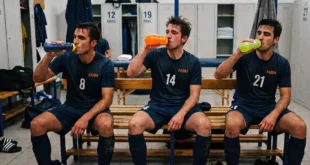
To avoid fatigue and cramps, a football player must follow a strict scientific protocol: ingest 500 ml of water 90 minutes before the match, drink 150 ml of isotonic beverage every 20 minutes during the game (taking advantage of stoppages), and replenish 150% of the weight lost after the match.
We explain everything you need to know about hydration in football. What should we drink before, during, and after the match?
Energy Expenditure and Sweat Rate in Football
Football is a high-intensity intermittent sport. During 90 minutes of competitive play, a player undergoes a very high energy expenditure averaging around 16 kcal/min (Bangsbo, 2006).
This continuous metabolic effort causes a drastic increase in body temperature. To maintain homeostasis (internal balance), the body activates sweating as its main heat dissipation mechanism. However, this physiological defense mechanism inevitably triggers dehydration if losses are not replenished precisely.
What Happens If We Become Dehydrated on the Field?
Fluid loss directly impacts a player’s physical and cognitive abilities. According to the American College of Sports Medicine consensus (Sawka et al., 2007), a loss of just 2% of body weight (equivalent to 1.5 liters in a 75 kg football player) is enough to drastically reduce:
- Aerobic endurance and the ability to perform repeated sprints.
- Muscular strength and reaction speed.
- Technical accuracy in passing and shooting due to central nervous system fatigue.
The average dehydration of a player during a 90-minute match is approximately 3.4% of body weight (Aragón-Vargas et al., 2009). This explains why most tactical mistakes and conceded goals occur in the final stages of each half.
Sodium Loss and the Impact of Ambient Temperature
We not only lose water through sweat, but also essential electrolytes, with sodium being the most critical. Sodium is the mineral responsible for helping cells retain ingested water and is vital for muscle contraction. Its absence is the direct cause of dreaded muscle cramps.
Many football players make the mistake of neglecting hydration during winter. However, science shows that dehydration remains considerable even at low temperatures.
Sweat Loss vs. Fluid Intake (90-Minute Training Session)
| Performance conditions | Average sweat loss (mL) | Average actual intake (mL) | Final fluid balance |
|---|---|---|---|
| Team A (High Temperature) | 2193 ± 365 mL | 972 ± 335 mL | Deficit (~1.2 Liters) |
| Team B (Moderate Temperature) | 1690 ± 450 mL | 423 ± 215 mL | Deficit (~1.2 Liters) |
Source: Data adapted from Maughan et al. (2005) on electrolyte balance in elite football players.
Football Hydration Protocol: Before, During, and After
To optimize glycogen stores and maintain fluid balance, it is essential to combine water with carbohydrates and mineral salts. The ideal carbohydrate concentration in a drink for football players should range between 4% and 8%.
Below is the official hydration protocol designed for high-performance football:
1. Pre-Match Hydration (Loading Phase)
Starting the match in a state of “euhydration” (optimal hydration) delays the onset of fatigue.
- Recommendation: Drink 500 ml of water between 60 and 90 minutes before stepping onto the field. You may complement this with electrolyte capsules if heat conditions are extreme.
2. Hydration During the Match
Football regulations limit hydration opportunities, so you must take advantage of every interruption in play (injuries, offsides, or official FIFA hydration breaks).
- Recommendation: Try to drink around 150 ml of isotonic beverage every 20 minutes of play.
3. Hydration at Halftime
The 15-minute halftime break is the critical window to preserve second-half performance. Here the goal is twofold: replenish fluids and restore depleted muscle glycogen.
- Recommendation: Consume between 400 and 500 ml of an advanced sports drink combining cyclodextrin or palatinose with sodium. For this phase, the ideal option is to use an optimized formula such as Evotonic by SportSeries, which provides the exact ratio of carbohydrates and electrolytes without causing stomach heaviness.
4. Post-Match Hydration (Recovery)
The deep rehydration process lasts approximately 6 hours after the final whistle.
- Recommendation: You should ingest at least 150% of the weight lost during the match (Shirreffs & Maughan, 1998). If the scale shows you lost 1 kg of body weight, you should consume 1.5 liters of fluid by combining water, natural juices, or a muscle recovery drink with amino acids and salts.
Bibliographic References
- Sawka M.N., Burke L.M., Eichner E.R., Maughan R.J., Montain S.J., Stachenfeld N.S (2007). American College of Sports Medicine position stand. Exercise and fluid replacement. Med Sci Sports Exerc 39:377-390.
- Maughan R.J., Shirreffs S.M., Merson S.J. and Horswill C.A (2005). Fluid and electrolyte balance in elite male football (soccer) players training in a cool environment. Journal of Sports Sciences 23: 73-79.
- Shirreffs, S. M. and R. J. Maughan (1998). Volume repletion after exercise-induced volume depletion in humans: replacement of water and sodium losses. Am J Physiol 274(5 Pt 2): F868-875.
- Ali, A, and C. Williams (2013). Isokinetic and isometric muscle function of the knee extensors and flexors during simulated soccer activity: effect of exercise and dehydration. J Sports Sci. 31(8):907-16.
- Aragón-Vargas, L.F., J. Moncada-Jiménez, J. Hernándes-Elizondo, A. Barrenechea, M. Monde-Alvarado (2009). Evaluation of pre-game hydration status, heat stress, and fluid balance during professional soccer competition in the heat. Eur. J. Sport. Sci. 9:269–276.
- Maughan, R.J., P. Watson, G.H. Evans, N. Broad, S. Shirreffs (2007). Water balance and salt losses in competitive football. Int. J. Sport Nutr. Exerc. Metab. 17, 583-594.
- McGregor, S.J., C.W. Nicholas, H.K. Lakomy, C. Williams (1999). The influence of intermittent high-intensity shuttle running and fluid ingestion on the performance of a soccer skill. J Sports Sci. 17(11):895-903.
- Bangsbo, J., M. Mohr, P. Krustrup (2006). Physical and metabolic demands of training and match play in the elite player. J. Sports Sci. 24:665-674.
- Aragón-Vargas, L. and Mayol-Soto, L. (2008). Hydration in Football: What Have We Learned So Far?. PubliCE.
Related Posts
- Football nutrition and supplementation to prevent injuries
- The 6 best supplements for football players
- Diet for football players
- Do football players take protein supplements?