Fitness, Nutrition, Health and Sports Blog In the HSNstore Blog you will find tips about Fitness, sport in general, nutrition, and health – HSNstore.com

Do you know any techniques for measure effort while exercising and planning your training programmes? We’re going to look at RPE, or Rate of Perceived Exertion
This article is designed for your typical weights room user, someone just starting out or that’s been training for a little while, and who, faced with the bombardment of information available on the internet, can no longer figure out what’s real, what’s biased, or what’s outright false.
Advanced users with extensive knowledge about training programmes, I recommend sticking around anyway so you can review the main ideas and maybe even learn something new.?
Intensity vs Volume
Our goal when training, regardless of its orientation (improvement of maximum strength, hypertrophy, speed, cardiorespiratory capacity…), is to generate an adaptation. An adaption is when the effect of the physical load of the training sessions generates an improvement in any of the outcomes we’re looking to improve.
Exertion dynamics are the set of factors we need to take into account when programming training sessions; and although among these factors we find concepts such as:
- Volume,
- Intensity,
- Type,
- Density, or
- Frequency.
Only the first two constitute the training load.
Load = Volume x Intensity
What is a Training Load?
A training load the sum of factors that determine the degree of fatigue generated by one or more training sessions and that, therefore, condition the recovery necessary to generate a supercompensation (adaptation) to improve on the training baseline level.
The greater this decreasing curve, the more rest we need and the greater the increasing curve of compensation and supercompensation of performance (up to certain limits, beyond which the organic damage is irreversible and we could end up below our initial level after recovery)
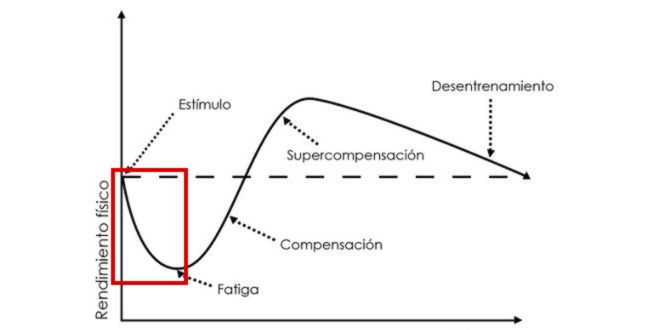
Figure I. Supercompensation cycle
What is Training Volume and Intensity?
Volume has traditionally been defined as the amount of work we do, while intensity is categorised as the quality of that work.
These factors are conditional on each other, i.e. keeping both variables high is unfeasible in the long term, meaning, in general terms, when one is high, the other is low, and vice versa.
Alternating the magnitude of these variables constitutes the basic periodisation of training; the degree, time and frequency with which these variables are modified determines the type of programme being followed.
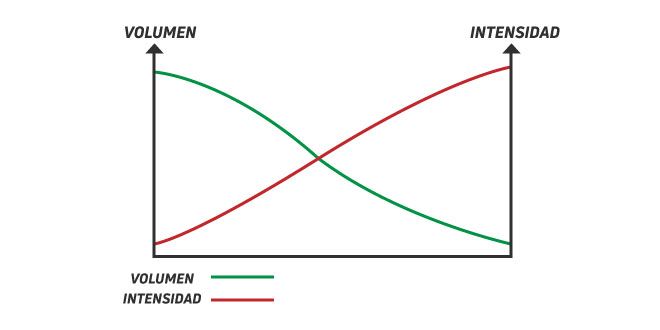
Figure II. Inverse relationship between training volume and intensity
High Volume or High Intensity
The debate about which variable is most relevant to improving sports performance has been going on since sports planning began
The traditional macrocycles of the 1950s involved very high volume training processes. This led to improvements to the point where further increases in volume were no longer feasible, at which performance enhancing drugs (PEDs) were used to further increase volume.
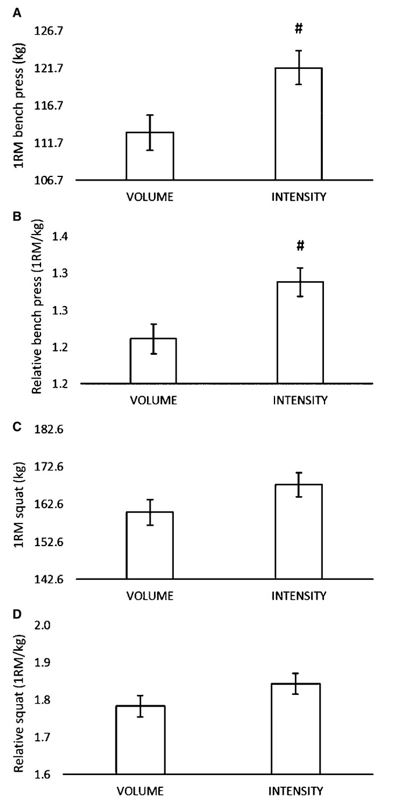
Figure III. Changes in strength with the Bench Press, absolute (A) and relative (B); and with the Squat, absolute (C) and relative (D). (Mangine et al. 2015)
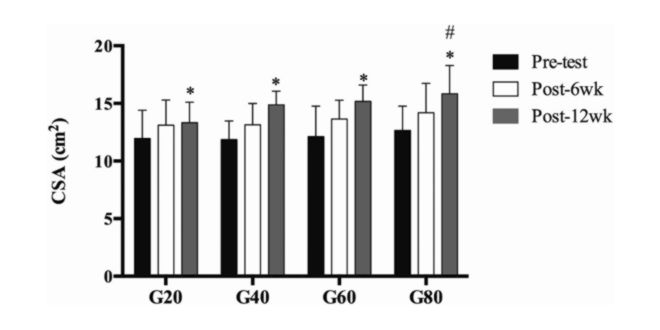
Figure IV. Increase in cross-sectional area (CSA) before training, after 6 weeks and after 12 weeks using different % of 1RM (G-20/40/60/80). (Lasevicius et al. 2018)
Intensity and External Load
It’s important not to confuse the intensity with the external load (i.e. with the weight we put on the bar)
Although this can be an easy way to quantify the intensity of training, there are limitations.
As while an individual with great muscular strength might be able to squat with 150kg, , and you can only squat with 60kg, when you both finished the show, you might not be able to do any more while he can carry on for four more reps.
RPE vs 1RM
This brings us to our next point: there are many ways to quantify the intensity of training
Among them, I’m sure you know about sports planning based on the % of 1RM.
Your 1RM is the maximum external load you can move in a given exercise within a determined range of motion. Based on this load, you can set percentages that correlate with the maximum number of repetitions you could do with that load.
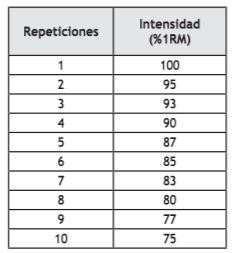
Figure V. Relationship between the number of potentially achievable repetitions based on the percentage of 1RM
However, this method has large variations between individuals, as the body tends towards training specificity.
Another major limitation is intrasession variability.
Using Encoders
Another training system is Velocity Based Training (VBT), which despite its high reliability and validity requires specific equipment (such as encoders) and extensive knowledge of sports planning based on the decrease in lifting speed that determines the degree of fatigue reached.
So, how do you measure effort?
As I explained in the previous section, the internal load is the main determinant for planning based on training intensity
For this, we can use the best and most accessible tool we have for it: self-regulation. It’s usually quantified through RPE, that is, the perceived exertion ratio that we experience in a set.
The RPE was originally designed by Borg (1962) on an exertion ratio scale of 6-20; however, in training outside of the world of clinical and research, we usually use Foster et al. (2001)‘s modification, which adapted the ratio range to a scale of 0-10.
In weight room workouts, this is related to Repetitions in Reserve (RIR). That’s to say, the closer we get to 10, the fewer repetitions we can continue to perform. You can consult the following table for reference:
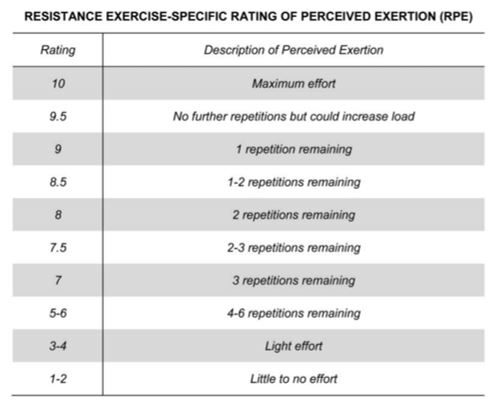
Figure VI. Relationship between the ratio of perceived exertion (RPE, left column) and repetitions in reserve (RIR, right column). (Zourdos et al. 2016)
RPE for hypertrophy and strength
Now, which RPE should we use to programme our training?
Well, this is a particularly complex question, as it’s still being researched. However, and while it’s not clear that training to muscle failure is in fact necessary to maximise training adaptions, we do know that a high perception of effort is necessary to generate adaption.
In general, the greater the intensity of the training, the better. Although we should bear in mind that the ability of an athlete strongly conditions the number of sets they can carry out at high intensity and still continue to recover and progress.
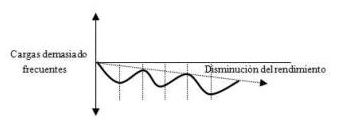
Figure VII. Negative adaptation (chronic performance decrease) due to training overload
Self-regulation is not for everyone
We also know that self-regulation is a system that needs to be practiced in order to correctly estimate the intensity we’re applying
In the following table we can see how with 100% of the athletes’ 1RM (RPE 10), the trained subjects were able to perceive the intensity applied more accurately than the untrained subjects, a large number of whom underestimated the effort exerted.
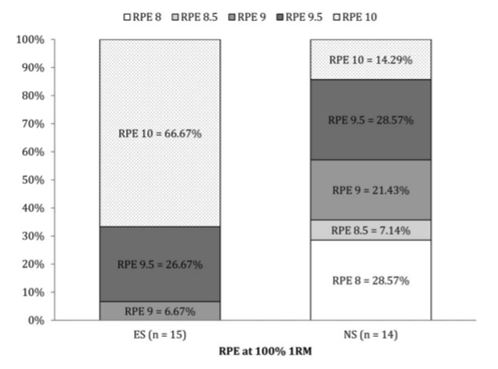
Figure VIII. Estimation of RPE at 100% 1RM in trained (left column) and untrained (right column) subjects (Zourdos et al. 2016)
By moving closer to one end or the other of the range depending on the mesocycle (time of the season) in which we find ourselves, and with the maximum possible intensity that allows us to recover and generate positive adaptations.
Conclusions
There is no significant difference between self-regulated strength or hypertrophy planning, except that maximum strength is usually trained more frequently (more times per week) to improve the specificity of the lifts, and this can significantly increase the training load.
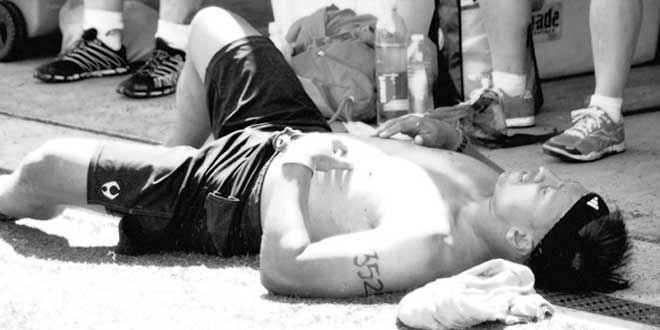
So, unless we’re genetic gods, either we do lower intensity days and get more rest, or we’ll end up with our nervous system going into overdrive (real overtraining)
What determines whether we develop greater maximum strength or hypertrophy is the range of repetitions. We know that maximum strength is developed in a lower repetition range (1-5), with a high load; while for hypertrophy the repetition range is less relevant (6-35); and the same goes for the load, as long as the effort is high.
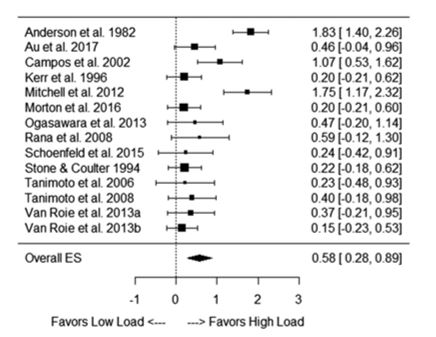
Figure IX. Tree diagram determining the superiority of training with high loads (rightward trend) versus low loads to increase maximal strength. (Schoenfeld, Grgic, Ogborn & Krieger, 2017)
Bibliographical references
- Helms, E. R., Cronin, J., Storey, A., & Zourdos, M. C. (2016). Application of the Repetitions in Reserve-Based Rating of Perceived Exertion Scale for Resistance Training. Strength and Conditioning Journal, 38(4), 42–49.
- Lasevicius, T., Ugrinowitsch, C., Schoenfeld, B. J., Roschel, H., Tavares, L. D., De Souza, E. O., … Tricoli, V. (2018). Effects of different intensities of resistance training with equated volume load on muscle strength and hypertrophy. European Journal of Sport Science, 18(6), 772–780.
- Mangine, G. T., Hoffman, J. R., Gonzalez, A. M., Townsend, J. R., Wells, A. J., Jajtner, A. R., … Stout, J. R. (2015). The effect of training volume and intensity on improvements in muscular strength and size in resistance-trained men. Physiological Reports, 3(8).
- Schoenfeld, B. J., Grgic, J., Ogborn, D., & Krieger, J. W. (2017). Strength and Hypertrophy Adaptations Between Low- vs. High-Load Resistance Training: A Systematic Review and Meta-analysis
- Zourdos, M. C., Klemp, A., Dolan, C., Quiles, J. M., Schau, K. A., Jo, E., … Blanco, R. (2016). Novel Resistance Training-Specific Rating of Perceived Exertion Scale Measuring Repetitions in Reserve. Journal of Strength and Conditioning Research, 30(1), 267–275.
Related Posts
- How do you get more Hypertrophy: High or Low Loads?
- Strength Mesocycle
- Rest-Pause: Advanced Method for Muscle Mass Gain