Fitness, Nutrition, Health and Sports Blog In the HSNstore Blog you will find tips about Fitness, sport in general, nutrition, and health – HSNstore.com

By now, I think no one can miss that to increase your muscle mass, 3 key points are necessary. These are the variables we’ll be “playing” with, and depending on how well you adjust each one, your goal will be closer:
Training + Nutrition + Rest
This time we’ll focus on the first variable: Training. Without the right stimulus, it’s pretty tough for the rest to “work out”…
It’s quite tricky to try to compensate for failing in one of the previous variables by overdoing the others. It just doesn’t work like that. We have to see it as a whole. However, within each one, we can mimic and follow certain protocols or recommendations to try to maximize them.
You’ll find tons of info about increasing muscle volume, but you could say “they’re different roads leading to the same goal”.
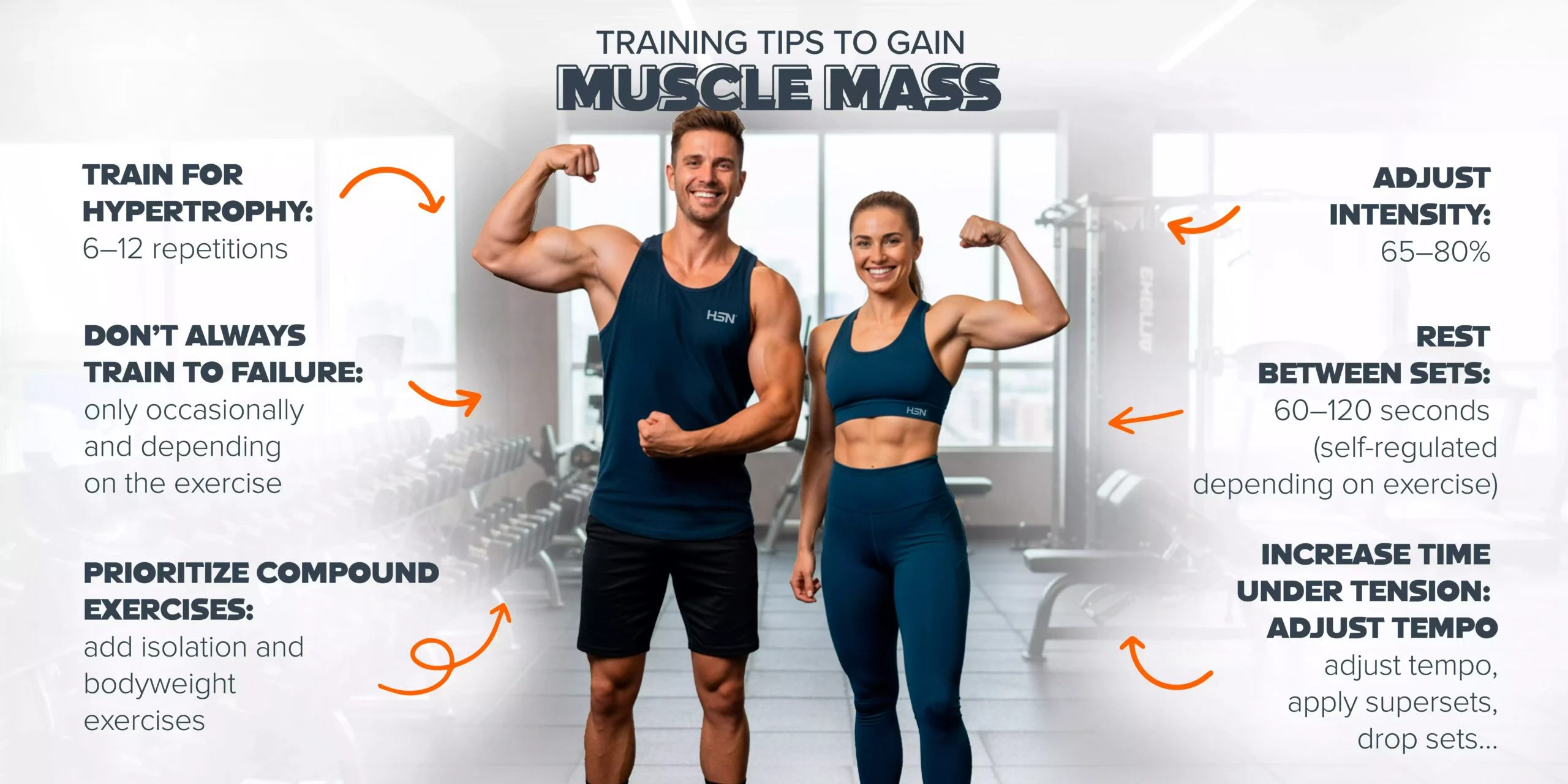
Train for Hypertrophy
If you want to gain muscle mass, focus your training on that. And here the key point revolves around aesthetics.
Just like if you wanted to compete in powerlifting or weightlifting, your training would focus on performance, not aesthetics.
Do you prefer split routines or full body? Choose the routine that suits you best, setting the training frequency that fits your life best. In the end, we want to generate stimuli, rest assured you’ll get them either way.
Adjust Intensity and Volume
By intensity, we mean the load used in exercises, that is, the % of our 1RM. This obviously applies to multi-joint exercises. Volume refers to the number of sets and reps. Generally, the relationship between these two variables is set according to the following table:
| Goal | Load (of 1RM) | Repetitions | Sets |
| Hypertrophy | 65-80% | 8-12 | 1-3 |
High volume doesn’t go hand in hand with high intensity
Rest Between Sets
The 60-120s range is considered most appropriate, as established by Brad Schoenfeld and his team as the optimal rest period for muscle growth.
Increase Time Under Tension
Use “advanced training techniques” like drop sets, supersets, bisets… Machines can be more comfortable and make applying these techniques easier (quickly removing plates). Failing on a machine isn’t the same as with a loaded barbell overhead…
Try doing a drop set on the leg press…
Exercise Tempo
“Tempo” is the way you perform exercises. One main benefit is promoting Time Under Tension (TUT), plus it helps control Metabolic Stress and Mechanical Tension. A rep can be divided into 4 phases: eccentric – pause – concentric – start
The time fraction of each phase or transition generates a specific stimulus.
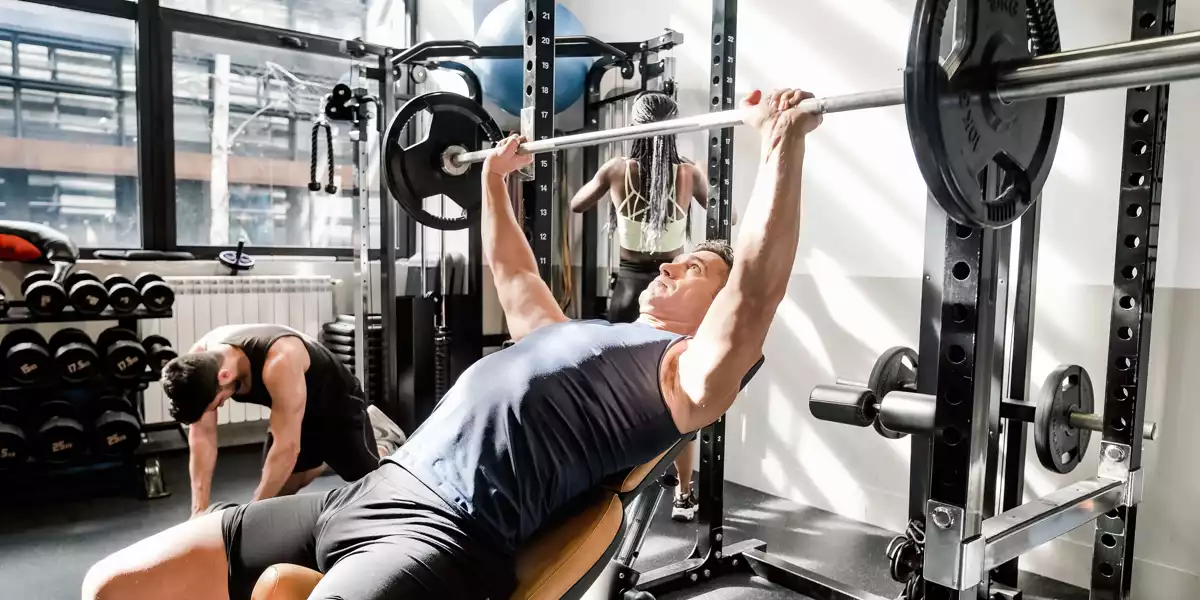
- Eccentric phase: Take the bar off the rack and keep your arms extended. Lower the bar to your chest. Count mentally 4.
- Pause: Touch your chest. Count 2 from touching your body until pushing the bar up
- Concentric phase: This is the hardest part, where you have to “push”. Count 1 until the bar reaches the start point.
- Start: You’ve reached the starting point. Count mentally 1 before starting the 2nd rep.
Control the weight, don’t let it control you
Train to Failure
Reaching muscle failure shouldn’t be the norm. However, “touching” failure or occasionally reaching it can be totally doable. With bodyweight exercises, this is less critical, and also in drop sets or when working secondary muscles or isolation exercises. Hitting failure on squats might knock you out for the rest of the session…
“Overdoing” muscle failure can fry your Central Nervous System, reducing your ability to generate the right stimulus…
Use Rest & Pause
Instead of going to failure, “stop” just before it happens. One or two reps short (failure-1 or -2) is enough. Then, drop the bar/dumbbells, breathe deeply for 15-20″, and pick up where you left off.
This technique helps extend the set and complete each one
- Warm up with the empty bar (do some sets of 15-20 Bradford Press).
- Add weight gradually (approach sets) until you reach the target load (75% of your 1RM) for working sets.
- Set a number of sets (3) and reps (12x).
- You won’t feel tired in the first set, but fatigue will hit halfway through the second (around reps 6-8). Drop the bar before you can’t lift it. Breathe for 20″. Rack the bar back on your shoulders and continue the set.
- If you have to stop before the last rep, apply the same principle.
- Finish the last set. You’ll probably use Rest & Pause earlier than in the second set.
Multi-Joint Exercises
The foundation of your training routine should be basic or multi-joint exercises, as they recruit a huge amount of muscle fibers, making the stimulus much greater. They also cause more wear, both in substrate levels and general fatigue.
Plus, the hormonal factor comes into play: these moves are known for producing a big release of testosterone and growth hormone

Isolation Exercises
Don’t forget we’re “bodybuilders”, so these exercises targeting smaller muscles are necessary. Work from all possible angles, add exercise variations, use partial range of motion if needed, increase muscle pump…
You won’t improve your biceps “peak” just by doing squats…
Bodyweight Exercises
They often go unnoticed or undervalued. But the truth is they generate very powerful stimuli for hypertrophy. To maximize TUT, perform each rep slowly and controlled. You can always add intensity with extra weight (plates, dumbbells, chains…)
Again, “tempo” will be used to achieve this goal
Stay Focused
Avoid any distractions during rest sets at all costs, your mind must stay “locked in”. While you remain
Related Posts
- What to Eat to Gain Muscle Mass?
- How to Gain Muscle and Lose Fat at the Same Time?
- What is the Optimal Protein Amount to Gain Muscle?
- What Diet to Follow to Gain Muscle Mass?
- 4 Factors to Gain Muscle Mass