Fitness, Nutrition, Health and Sports Blog In the HSNstore Blog you will find tips about Fitness, sport in general, nutrition, and health – HSNstore.com

Protein Intake Timing in Strength Sports to Optimize Muscle Protein Synthesis
We worship dietary protein in the sports world in general and fitness in particular as that essential ally when trying to boost our protein synthesis, although we already know it’s just one more variable to keep an eye on.
General Protein Recommendations
We’ve also learned that when the goal isn’t muscle anabolism but rather maximizing body fat oxidation, a good protein intake becomes even more essential.
To quickly recap daily amount and distribution throughout the day, the old recommended daily intake (RDI) of 0.8 g/kg body weight/day for sedentary people is out the window.
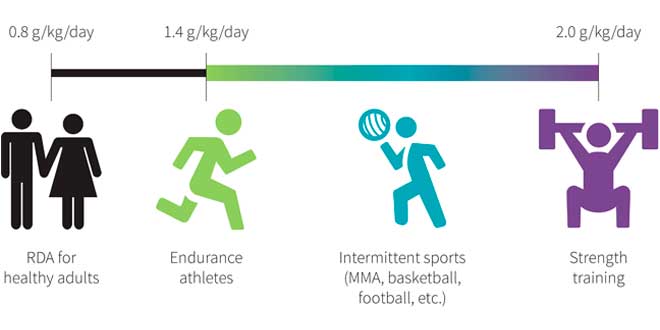
General Protein Recommendations for the Population. Source: Examine.com
Just like those crazy excesses seen in gyms around here and beyond, over 4-5 g/kg body weight/day.
What Determines How Much Protein to Take?
However, even these intakes are much lower than what most athletes report. This might mean actual requirements are below what’s needed to optimize sports performance, and the debate goes on [1].
- energy intake,
- carbohydrate availability,
- exercise duration, intensity, and type,
- dietary protein quality,
- training history,
- sex,
- age,
- nutrient timing (which is what we’re going to talk about)
Making this topic extremely complex [1]
Safe Amount of Protein
First, remember that increasing even those 1.6-1.8 g doesn’t pose a risk for healthy people
For an active person, a high protein intake like 3g/kg body weight/day is totally safe
Protein Intake Timing
Back to timing, we know it’s something to consider once other factors are already controlled
These include: total daily amount, increased energy intake if the goal is to boost protein synthesis, training type, volume, intensity, rest…
As well as your own circumstances…
Once all that is optimized, we could start worrying about the exact timing of protein intake during the day, which, in my opinion, is a bit less important than the above.

Athletes Seeking Hypertrophy
As we know, athletes aiming for muscle hypertrophy should consider that it largely depends on genetic background, age, sex, training level, nutritional status, and diet.
Simply put, hypertrophy happens when Muscle Protein Synthesis (MPS) exceeds Muscle Protein Breakdown (MPB)
Modulated by:
- the activity of stem cells,
- signaling pathways (like mTOR, MAPK, and calcium-dependent pathways),
- hormonal activity (insulin, testosterone, growth hormone), and
- the activity of cytokines that promote higher MPS.
The parameters mentioned above explain why individuals respond differently to the same training [3]
Strength Sports and Protein
It’s well known that combining strength training with nutrition triggers physiological responses that improve muscle structure and function [4].
So, people doing strength training need higher protein intake to reduce MPB, which increases after MPS [5, 6].
Protein Timing
Following this response, it’s important to consider the term “timing”, defined as:
Nutrient intake at a specific time to improve sports performance [9], or to optimize MPS and thus find the best intake moment
Protein Intake Literature Review
The goal of the literature review I mentioned was to compare different protein intakes, their effectiveness, and the optimal timing of protein consumption in strength athletes
The conclusions were that a proper strength training program (exercise type, intensity, volume, frequency, rest periods) is key to achieving muscle hypertrophy, and most errors happen here.
- It was found that both trained individuals and older adults require a stronger stimulus through the training program to get better results in body composition and/or strength gains.
- Amount, timing, and type of protein consumed are important factors during training.
- Recommended daily protein intake depends on genetics, age, experience, and training level.
- Higher protein doses are more beneficial in the early stages of strength training, with an intake of 1.6 – 1.7 g/kg body weight/day.
- Whereas in well-trained athletes, protein intake can drop to 1.2 to 1.4 g/kg body weight/day, as they tend to be more efficient at nitrogen utilization.
Post-Workout Protein Supplementation
It was observed that post-workout protein supplementation supports increases in hypertrophy and muscle strength with a consumption of 20g to 40g of protein, recommending higher doses for older adults.
Not forgetting the possible synergistic effect between protein and other components like creatine and/or carbohydrates
References
- Protein requirements and supplementation in strength sports
- Protein and amino acids for athletes
- The mechanisms of muscle hypertrophy and their application to resistance training
- The role of dietary protein intake and resistance training on Myosin heavy chain expression
- Influence of nutrition on responses to resistance training
- A critical examination of dietary protein requirements, benefits, and excesses in athletes
- Exercise training and protein metabolism: influences of contraction, protein intake, and sex-based differences
- Dietary Protein and Strength Athletes
- Effects of supplement timing and resistance exercise on skeletal muscle hypertrophy
Related Posts
- Do you use milk or water to mix protein powders?
- Why take proteins during training?
- The Best Protein Shakes
- Guide to learning how to take creatine if you’ve never done it before
- Gain muscle mass with creatine intake
- Take creatine before or after workouts?
- Maximize your results: what’s the best time for your protein shake?