Fitness, Nutrition, Health and Sports Blog In the HSNstore Blog you will find tips about Fitness, sport in general, nutrition, and health – HSNstore.com

I decided to write this article as thoroughly as possible to finally clear up whether “having carbs for dinner is the problem when losing weight”
After thinking it over and seeing the huge confusion around avoiding fruit to lose weight and carbs in the late afternoon-evening.
What to Do to Lose Weight?
The first thing to be clear about is that with a reasonable macronutrient balance (carbs, proteins, and fats), any calorie deficit will make you lose weight.
Depending on the ratio of macronutrients, this weight loss can be:
- Perfect (losing only fat)
- Mediocre (losing fat and muscle)
- Poor (losing only muscle)
Does Eating Carbs for Dinner Make You Gain Weight?
The confusion about avoiding carbs at night comes from the belief that since you won’t use them while sleeping, they’ll turn into fat.
In short, every time a personal trainer or nutritionist defends this claim, a physiologist ends up in the ER.
Our body doesn’t say “…it’s 6 PM, I’ve worked enough, I’ll store these carbs as fat…”; instead, it ramps up their metabolism, increasing insulin levels, reducing lipolysis (fat use), boosting thyroid hormones, increasing glycogenesis, and much more.
Eating Fruit at Night?
Fruit is a special case, as it usually contains both glucose and fructose. Fructose doesn’t raise insulin; it goes straight to the liver where it’s stored as glycogen or used to synthesize triglycerides (fats).
Generally, in a diet with normal carb intake, glycogen stores are almost never full, so if you’ve eaten few carbs during the day, even eating 2 fruits at dinner won’t turn into fat. It’s even beneficial to eat fruit, as studies show it reduces sweating and hot flashes in middle-aged women during sleep3.

What Are Circadian Rhythms?
Nowadays, it’s rare to find a source that doesn’t talk about circadian rhythms or “our biological clock,” as it’s popularly known. For those who don’t know, circadian rhythms are:
the hormonal and metabolic oscillations that happen throughout the day and are controlled by the suprachiasmatic nucleus
This system is governed by peripheral sensors that send messages to this brain area. These “rhythms” can influence processes like:
- Energy expenditure,
- Insulin sensitivity, or even,
- Rest.

We constantly manipulate this biological clock, with well-known jet lag from https://www.hsnstore.eu/blog/supplements/well-being/jet-lag/, or even with lighting, where low light extends the cycle.
How Are Circadian Rhythms Controlled?
At the molecular level, and going a bit deeper, two key circuits mediated by CLOCK and BMAL1 proteins stimulate the transcription of 3 genes (Per and Cry) that alter intracellular metabolic pathways. About 50% of nuclear receptors in “metabolically active” tissues are regulated by these proteins.
However, various factors like physical exercise can alter this percentage, reducing its impact.
Relationship Between Circadian Rhythms and Nutrition
Circadian rhythms can be summed up as our 24-hour biological clock or lifestyle pattern, meaning our body is primed to seek more energy in the morning and tend to feel sleepier at night. This shows early in the morning with higher testosterone and cortisol, and at night with higher melatonin (the sleep hormone).
Of course, nutrition also plays a role in this cycle.
When food is eaten at optimal times, peripheral clocks in all cells outside the brain sync with the central clock in the brain.
Eating Carbs for Dinner After Training
In athletes, this is very important, since not eating carbs during the day makes muscles more insulin sensitive, so after training muscles absorb most of the glucose consumed, increasing muscle glycogen.
This is called supercompensation, and happens post-workout, whether it’s at night or in the morning.

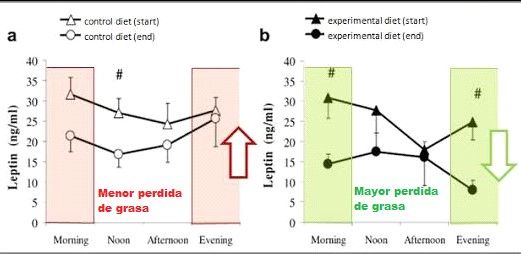
As shown in the image, the group on the right, who ate most carbs at dinner, had better insulin sensitivity. This effect is debatable since it could also be due to eating just one meal a day.
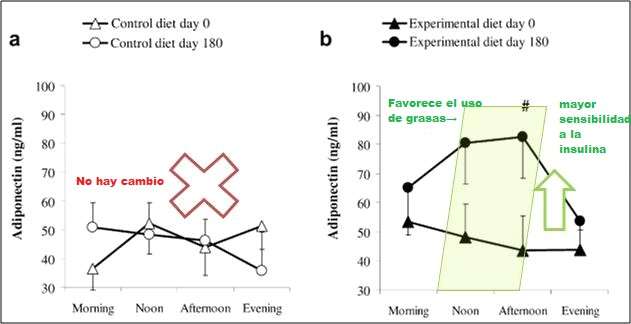
However, the image above shows that by the end of the experiment, people who ate carbs at dinner had lower leptin levels, since obese people have higher leptin but are resistant to it, meaning they have high levels but their brain doesn’t realize they’re full.
Circadian Rhythms Regulate Insulin Sensitivity
To give you an idea and a practical example, our circadian rhythm makes us more sensitive to glucose in the morning and less sensitive in the late afternoon-evening (hence the myth about avoiding carbs at night…).

However, if I trained at 6:00 PM, I’d have greater glucose sensitivity in the evening than in the morning.
How Do Circadian Rhythms Affect Our Metabolism?
At this point, many of you might wonder what metabolic effects these circadian rhythms have and if they influence calories burned and especially the substrate (fat or carbs) used for energy.
Van Moorse Study
Let’s look at the Van Moorse4 study and colleagues, who observed metabolic changes in 20 lean, non-smoking men not taking any medication.
- Sleeping from 11:00 PM to 7:00 AM
- Eating breakfast, lunch, and dinner at 9:00 AM, 2:00 PM, and 7:00 PM respectively
- No snacks or drinks other than water
- No alcohol or caffeine
- No physical exercise 3 days before the study
- Two days before the study, standardized meals in calories and macronutrients were given
On day one, standardized meals were provided, physical activity and sleep time were monitored. To avoid sedentary behavior, they had to walk 15 minutes at low intensity after each meal.
On day two, they were woken at 6:44 AM to swallow a telemetric pill measuring body temperature. Blood samples were taken via intravenous cannula throughout the day to measure various parameters. Muscle biopsies from the vastus lateralis were also taken.
Study Results
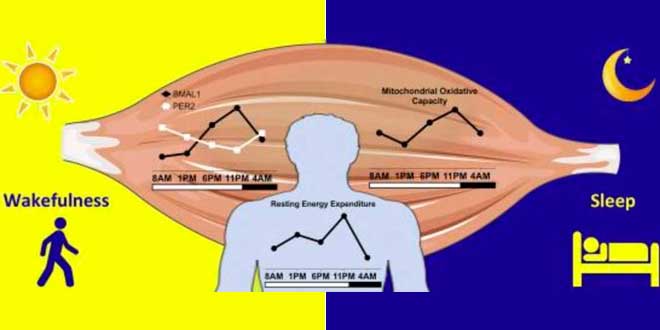
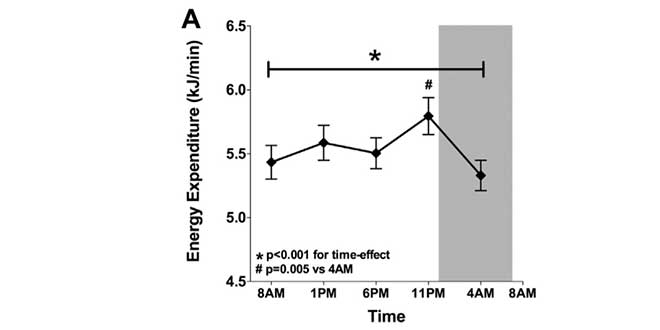
As expected, expression of the proteins mentioned earlier was higher in the late afternoon-evening. However, the most striking data is the time when the most calories were burned during the day: 11:00 PM, with the lowest point at 4:00 AM, as shown in the graph below.
Regarding substrate use, the carb peak for energy was at 11:00 PM and the lowest at 4:00 AM, matching the calorie burn data. Fatty acid peaks were at 8:00 AM and a smaller peak at 4:00 AM.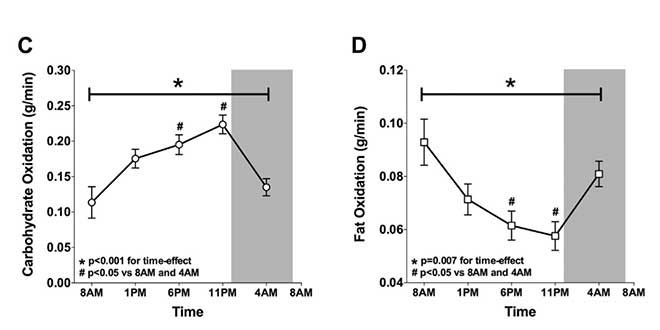
If I Eat Carbs for Dinner, Do They Turn Into Fat?
Another point of interest is what happens while we sleep. According to bro-science, if we eat carbs for dinner, glucose and insulin levels will be high, preventing fat burning. Also, since we’re sleeping and energy expenditure is low, carbs will be stored as fat. Is this true? Let’s see:
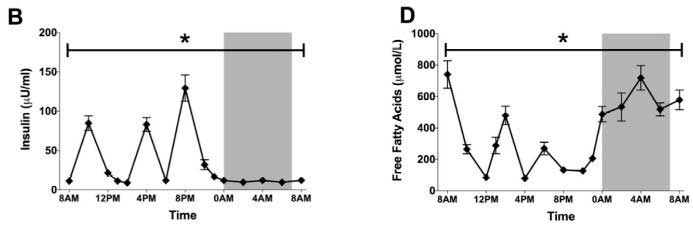 If we look at the graph above, insulin peaks at 8:00 PM but drops to minimal levels overnight while fatty acid levels rise.
What Happens If I Eat All My Carbs at Dinner?
You’ll spend the whole night using glucose as energy, but your body will burn fat during the day.
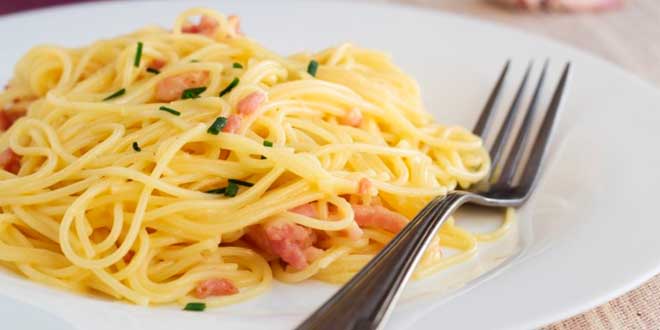
The problem comes when you eat lots of carbs both during the day and at night, which would spike your calorie intake.
Why Do I Lose More Fat When I Cut Carbs at Dinner?
Because you’re reducing your calorie intake. You don’t have to be Sherlock to realize that if you used to eat carbs at night and now don’t, your intake drops by 300-600 Kcal. Many will say they don’t really cut them but replace them with protein, veggies, and fats.
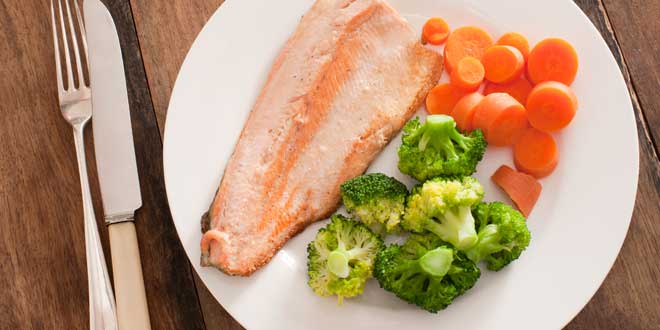
Considering protein is filling and veggies have minimal calories, the result would be similar.
Conclusions
A dinner with carbs or fruit is not only not harmful for fat loss, it can even be an effective tool for those who train at night.
Contrary to the old saying “Eat breakfast like a king, lunch like a prince, and dinner like a pauper”, the truth is quite different.
We should adapt our diet to our lifestyle, so if it’s more convenient to eat carbs at night for recovery, don’t be afraid to do so, since total carb intake matters more than timing.
As I said at the start, this is just one of many ways to lose fat; remember the key is a calorie deficit.
In short, the theory that you can’t burn fat at night if you eat carbs for dinner is wrong. Our body uses both glucose and fatty acids while we sleep, preventing fat storage (especially if we train in the late afternoon-evening).
That said, following a low-carb diet, regardless of whether carbs are eaten in the morning or evening, usually yields better results by reducing calorie intake. And as many scientific publications show, macronutrients play an important role in body composition, but it’s the food choices that determine how much success you get thanks to adherence.
Cheers!
Sources
- A controlled trial of reduced meal frequency without caloric restriction in healthy, normal-weight, middle-aged adults.
- Metabolic rate and fuel utilization during sleep assessed by whole-body indirect calorimetry.Katayose Y, Tasaki M, Ogata H, Nakata Y, Tokuyama K, Satoh M.
- Fruit, Mediterranean-style, and high-fat and -sugar diets are associated with the risk of night sweats and hot flushes in midlife: results from a prospective cohort study.Herber-Gast GC, Mishra GD.
- Demonstration of a day-night rhythm in human skeletal muscle oxidative capacity Dirk van Moorse, Jan Hansen, Bas Havekes, Frank A.J.L. Scheer, Johanna A. Jörgensen, Joris Hoeks, Vera B. Schrauwen-Hinderling, Helene Duez, Philippe Lefebvre, Nicolaas C. Schaper, Matthijs K.C. Hesselink, Bart Staels, Patrick Schrauwen
- Greater weight loss and hormonal changes after 6 months diet with carbohydrates eaten mostly at dinner.Sofer S, Eliraz A, Kaplan S, Voet H, Fink G, Kima T, Madar Z.
- Association of Leptin With Food Cue–Induced Activation in Human Reward Pathways.Martin Grosshans, MD; Christian Vollmert, MD; Sabine Vollstädt-Klein, PhD; Heike Tost, MD, PhD; Saskia Leber, MD; Patrick
- Bach, BS; Mira Bühler, PhD; Christoph von der Goltz, MD; Jochen Mutschler, MD; Sabine Loeber, PhD; Derik Hermann, MD; Klaus Wiedemann, MD; Andreas Meyer-Lindenberg, MD, PhD; Falk Kiefer, MD
- suppversity.blogspot.com.es/2012/08/carbs-past-6pm-reloaded-circadian.html
- Circadian expression of adiponectin and its receptors in human adipose tissue.Gómez-Abellán P, Gómez-Santos C, Madrid JA, Milagro FI, Campion J, Martínez JA, Ordovás JM, Garaulet M.
- Pattern of expression of adiponectin receptors in human adipose tissue depots and its relation to the metabolic state.Nannipieri M, Bonotti A, Anselmino M, Cecchetti F, Madec S, Mancini E, Baldi S, Santini F, Pinchera A, Rossi M, Ferrannini E.
- Circadian rhythm of plasma leptin levels in upper and lower body obese women: influence of body fat distribution and weight loss.Langendonk JG, Pijl H, Toornvliet AC, Burggraaf J, Frölich M, Schoemaker RC,
- Doornbos J, Cohen AF, Meinders AE.
Related Posts
- Healthy and Easy Dinner Recipes
- To Lose Weight: Is It Better to Cut Fats or Carbs?
- What Is Calorie Cycling?