Fitness, Nutrition, Health and Sports Blog In the HSNstore Blog you will find tips about Fitness, sport in general, nutrition, and health – HSNstore.com

Of the Calcium Salts, which one is the most bioavailable?
Why does calcium have to be taken in salt form?
Why not just calcium?
The forms of calcium marketed on the market are never pure calcium in ionic form (Ca2+); they are always marketed in the form of salts, such as calcium citrate [(C6H6O7)2Ca3·4H2O].
This is because calcium is a mineral with a positive electrical charge, which must be corrected in order to maintain the electroneutrality of the nutrient.
As sodium has a positive charge, it is stabilised with chloride, which has a negative electrical charge. This also occurs in the body, with the phenomenon known as the “anion gap”, which maintains the electrical neutrality of elements with unpaired valence.

Figure VI. Formula for calculating the anion gap to maintain electroneutrality.
The salts that form calcium bonds and complexes are developed to improve factors such as solubility and stability in the medium, osmolality, absorption…
Is one salt better than another?
A major mistake made by consumers is thinking that one salt has different effects from another:
“…calcium carbonate is better for bones and calcium citrate for cell function…”
No! The salt, the complex, only determines the kinetics of the mineral in the body and certain organoleptic properties.
But when it reaches the blood, it does so after having been split, and the effects in the body are always produced by the same compound, calcium, regardless of the form it comes from.
We must consider two criteria when selecting one salt of any mineral over another:
Elemental content
Let me explain:
When the salt is formed, it is not created in a 1:1 ratio; sometimes the ratios are different in order to achieve the properties we were talking about. This means that there are calcium salts such as citrate, which contains 21% of its content as elemental calcium, and others such as gluconate, which only contain 9%.
Bioavailability
The higher it is, the better, as less of the mineral will be excreted and a higher percentage will reach our blood, which is what we are interested in.
Although bioavailability is sometimes expressed with exact numbers, the truth is that it depends on a large number of intrinsic and extrinsic factors, so it is much more accurate to describe bioavailability as (high/medium/low).
Result
Both factors must be weighed using data based on our specific scenario to determine which one is most suitable, because:
And normally, the worse the bioavailability, the more gastrointestinal discomfort its consumption will cause. Therefore, my recommendation is to look for a highly bioavailable source and then consider the elemental content.
What are the Calcium Salts?
There are many calcium presentations available on the market. We are going to analyse the most common ones and explain their pros and cons in a simple way:
Calcium Carbonate
Pros:
- Very cheap.
- High elemental content.
- Good bioavailability.
Cons:
- Requires an acidic medium to be absorbed.
- Poor absorption in:[/tie_list]
- Fasting
- People with inflammatory bowel diseases.
- People who regularly use proton pump inhibitors (such as omeprazole) or antacids/alkaline salts (hypochlorhydria).
Calcium Citrate
Pros:
- Good amount of elemental content.
- Maximum bioavailability.
- It is absorbed regardless of the stomach environment (even if it is basic)
Cons:
- Slightly more expensive than carbonate.
- In capsule, pill or tablet formats, the amount that needs to be consumed to reach an effective dose can be very high.
Coral Calcium
Pros:
- The same as carbonate
Cons:
- The same as carbonate, in addition to:
- It is much more expensive.
- The creators of the “claims” attributed to this form of calcium have been legally prosecuted for misinformation.
Spoiler: Coral calcium is calcium carbonate.
Calcium Lactate
Pros:
- Good availability (comparable to carbonate).
- Good solubility.
Cons:
- Low elemental content, which makes its practical use difficult.
Calcium Gluconate
Pros:
- Good availability (comparable to carbonate).
- Good solubility.
Cons:
- Very low elemental content, which makes its practical use difficult.
Calcium Acetate
Pros:
- Cheap.
- Good elemental content.
- Can be absorbed regardless of the medium.
Cons:
- Little research in humans.
Calcium Chloride
Pros:
- Good elemental calcium content.
Cons:
- Intended for intravenous infusion.
Tricalcium Phosphate
Pros:
- High elemental content.
Cons:
- Moderate bioavailability.
- High elimination in the body due to binding to phosphates.
- Poor solubility.
Calcium Citrate and Calcium Carbonate
Which one to choose will depend on the user’s conditions and the product format:
Calcium Citrate
Calcium citrate is, in general, superior to calcium carbonate. Although it contains approximately half its elemental content, its bioavailability is very high thanks to the complex it forms with citric acid, which means that an acidic environment in the stomach is not required for its correct absorption.
Calcium Carbonate
Calcium carbonate is preferable in cases of chronic kidney disease due to its good ability to bind to phosphates and be eliminated renally, as well as because of its high elemental content, although it needs to be consumed with food in order to be used effectively.
Calcium Salts Summary Table
| Salt | Elemental Content | Bioavailability | Notes |
| Calcium carbonate | 40% | High | – Useful in chronic kidney disease patients. – Requires consumption with meals. |
| Calcium citrate | 21% | High | – Useful in intestinal disease patients. – Can be consumed on an empty stomach and by people with hypochlorhydria. – Does not increase the risk of renal calcium lithiasis in healthy people. |
| Calcium lactate | 13% | High | – Low elemental content. – Little practical use |
| Calcium gluconate | 9% | High | – Low elemental content. – Little practical use. |
| Calcium chloride | 27% | High (intravenous) | – Clinical use. – Low elemental content for its route of administration. |
| Calcium acetate | 25% | High (research lacking) | – Potential to become an option worth considering. – Human research is lacking. – Little practical use at present. |
| Tricalcium phosphate | 38% | Moderate | – Lower bioavailability than other options. – More expensive. |
New RawSeries Calcium Citrate
The main problem reported in the clinical literature about calcium citrate is that, as it has approximately half the elemental content of its direct competitor, carbonate, it is difficult to implement its use because patients need to use a large number of tablets to reach the established dose.
Powder format
For this reason, at HSN we have developed a RAW calcium citrate product, so that you can obtain the amounts of calcium you need through the convenient use of powder, without having to swallow many large tablets, which, let’s be honest, is a problem for many people because of the aversion it causes them:
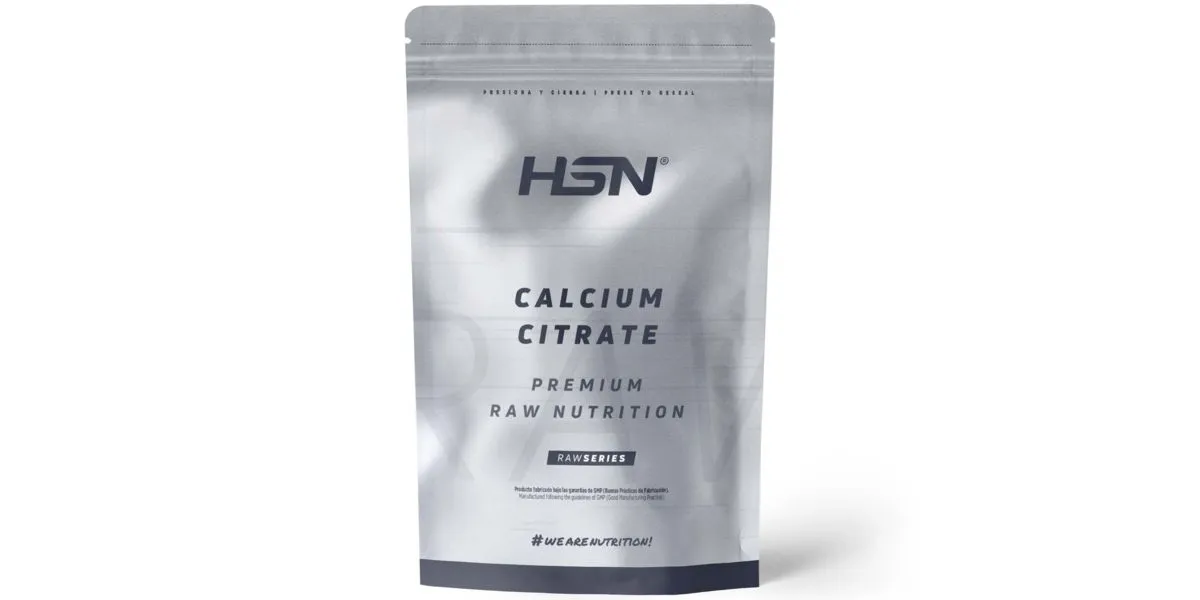
Figure VII. RawSeries Calcium Citrate.
Greater bioavailability
We bring you all the benefits of the formula with the highest calcium bioavailability on the market, in the most suitable format for use, so that we can overcome its main limitation: the need to use a large number of tablets to reach an effective dose.

Figure VIII. Jaime Hidalgo using a RawSeries product.
High solubility
The solubility of this calcium salt is good; it allows the mixture to be homogenised in water at room temperature without needing to dilute it excessively. It is convenient to take, as it can be used on an empty stomach without absorption problems and without needing to use citrus juices to enhance it.
Suitable for Vegans
The product is, of course, suitable for consumption in vegetarian and vegan diets.
This is a major advantage, as this is a population that, because it does not consume dairy products, usually has dietary calcium intakes far below daily recommendations.
Allergen-Free
It also contains no allergens such as gluten, egg, soya, fish or nuts, making it an excellent option for people who are allergic, intolerant and/or sensitive to these foods.
Bibliographical sources
- Balk, E. M., Adam, G. P., Langberg, V. N., Earley, A., Clark, P., Ebeling, P. R., … Dawson-Hughes, B. (2017). Global dietary calcium intake among adults: a systematic review. Osteoporosis International, 28(12), 3315–3324.
- Ross, A. C., Manson, J. A. E., Abrams, S. A., Aloia, J. F., Brannon, P. M., Clinton, S. K., … Shapses, S. A. (2011). The 2011 report on dietary reference intakes for calcium and vitamin D from the Institute of Medicine: What clinicians need to know. Journal of Clinical Endocrinology and Metabolism, 96(1), 53–58.
- Straub, D. A. (2007). Calcium supplementation in clinical practice: A review of forms, doses, and indications. Nutrition in Clinical Practice, 22(3), 286–296.
- Wasilewski, G. B., Vervloet, M. G., & Schurgers, L. J. (2019). The Bone—Vasculature Axis: Calcium Supplementation and the Role of Vitamin K. Frontiers in Cardiovascular Medicine, 6, 6.
Related Posts
Do you know the relationship between Calcium and Vitamin D for health? Discover it at this link.