Fitness, Nutrition, Health and Sports Blog In the HSNstore Blog you will find tips about Fitness, sport in general, nutrition, and health – HSNstore.com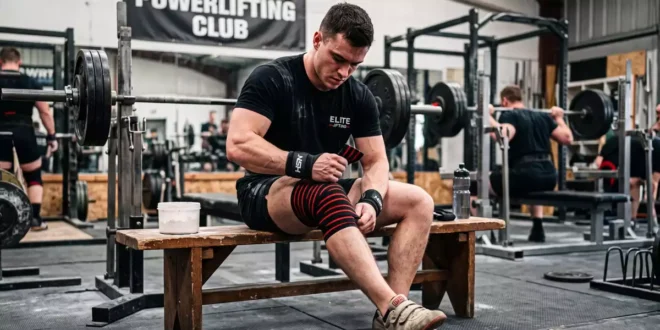

It’s easy to see knee wraps as just another staple in the free-weight area, almost something you automatically put on once you start warming up for squats. However, the biomechanical evidence available so far suggests that this habit needs quite a bit of nuance: it’s not that knee wraps “don’t work”, but rather that they change the movement in a way that is only worthwhile in very specific contexts.
What do they actually do to the movement?
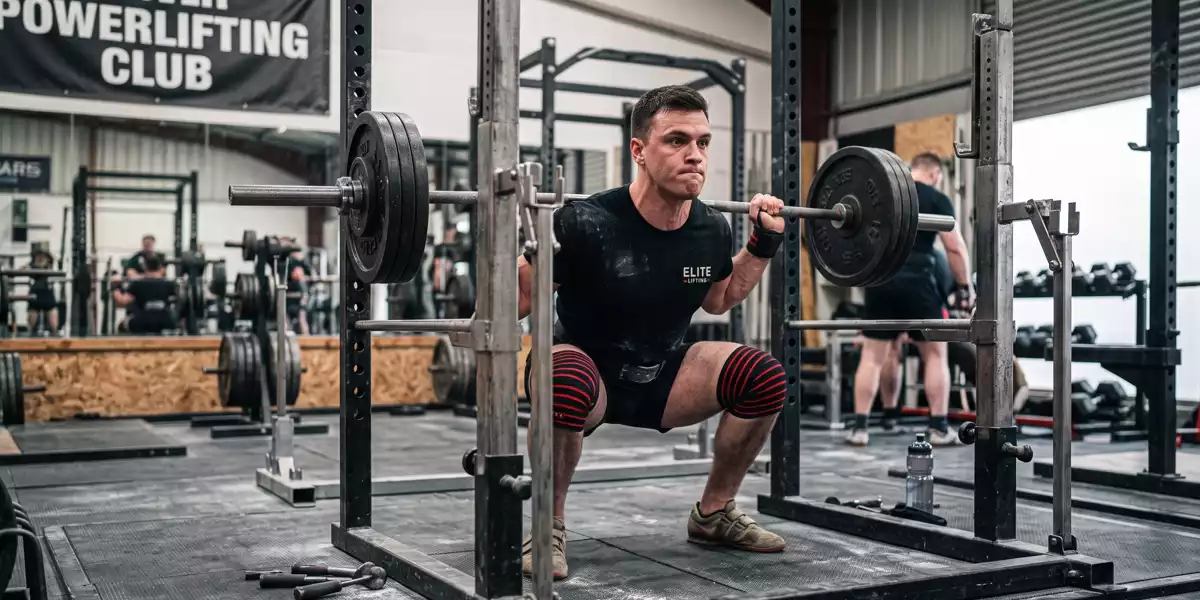
Knee wraps aren’t just passive support: they alter the bar path. During a squat, the bar doesn’t move purely vertically; there is also a horizontal component needed to maintain balance. Biomechanical studies show that this horizontal component is reduced by around 39% during the eccentric phase and almost disappears (up to a 99% reduction) during the concentric phase when knee wraps are used.
This restriction of the natural movement pattern goes hand in hand with an increase in movement velocity at the same load, resulting in an estimated increase in power output of around 10%.
Put simply: with knee wraps, you can move more weight, faster, at the same perceived effort, but at the cost of using a different movement pattern from the one you train without them.
What happens to muscle activation?
EMG analysis of the glutes and quadriceps at different intensities (60% and 90% of 1RM) shows a clear pattern:
- At moderate intensities (60% 1RM), knee wraps reduce glute activation and increase quadriceps activation.
- At high intensities (90% 1RM), glute activation remains similar, but quadriceps activation decreases noticeably.
In both cases, knee wraps also limit maximum hip and knee flexion during the descent, partly due to the stiffness of the wraps around the joint.
The most important point: the knee
This combination — less hip involvement and a more restricted range of motion — can have an undesirable consequence: an imbalance in the development of the muscles involved in the movement. On top of this, regular use of knee wraps may increase friction between the patella and femur, which could increase the long-term risk of injury and conditions such as chondromalacia.
So, when does it make sense to use them?
- Maximal or near-maximal loads (85–100% of your 1RM), where the elastic rebound and increased power output can make a meaningful difference.
- Powerlifting competitions, in federations where they are permitted.
- Occasional very heavy sets, rather than as part of every training session.
And when is it better to avoid them?
- During hypertrophy or higher-volume training with moderate loads: in this context, the biomechanical trade-off may not justify the benefit.
- As a workaround for poor technique or limited hip mobility that needs to be addressed rather than masked.
- Every day: constant use may reduce the opportunity for the joint to develop its own stability and could increase the risk of patellofemoral overload over time.
If your goal is simply to keep your knees warm, neoprene knee sleeves are a better option: they provide warmth without significantly altering movement mechanics or the amount of weight you can lift.
As with a lifting belt or wrist wraps, the key is to use them selectively and when justified, rather than making them a habit.
Sources
- Eitner, J. D., LeFavi, R. G., & Riemann, B. L. (2011). Kinematic and kinetic analysis of the squat with and without knee wraps. The Journal of Strength & Conditioning Research, 25, S41.
- Gomes, W. A., Brown, L. E., Soares, E. G., da Silva, J. J., de Oliveira Silva, F. H. D., Serpa, É. P., … & Marchetti, P. H. (2015). KINEMATIC AND sEMG ANALYSIS OF THE BACK SQUAT AT DIFFERENT INTENSITIES WITH AND WITHOUT KNEE WRAPS. Journal of strength and conditioning research/National Strength & Conditioning Association.
- Lake, J. P., Carden, P. J., & Shorter, K. A. (2012). Wearing knee wraps affects mechanical output and performance characteristics of back squat exercise. The Journal of Strength & Conditioning Research, 26(10), 2844-2849.
Related Posts