 Fitness, Nutrition, Health and Sports Blog In the HSNstore Blog you will find tips about Fitness, sport in general, nutrition, and health – HSNstore.com

In some gyms, it’s tough to find more than one squat rack, and if you don’t get there early, you end up not training your legs properly 🙁
They probably prioritize other machines instead of adding more of these…
Safety
The usual argument is that the Smith machine is there for that, which looks like a rack, plus they say it’s safer than using free weights and that it prevents the bar from falling on you… Seeing is believing ;(
That last claim isn’t true, because I’ve personally seen a Smith machine support fail, and the bar dropped like lightning, turning into a guillotine…
Unnatural Movement
As you can tell, I’m all for using free weights instead of guided machines. For example, doing squats with free weights feels like a whole different world compared to that machine.
One key point is that no one has the same structure or movement pattern, and that’s ignored when using the machine, since the rails force the movement to always be the same.
Feeling the Work
When you load a bar and unrack it, then take two steps back, your whole world changes.
You instantly focus 200%, becoming aware of what you’re about to do, sending that thought as a signal to your muscles, “please don’t let me down…”
Knee Injuries
There are probably more cases linked to using the Smith machine because the knee is forced into fixed movement patterns. Plus, once you’ve loaded the bar and aren’t positioned right, it’s really hard to fix, so the knee can suffer a bad movement.
When positioning yourself under the Smith machine, these situations can happen:
- “Feet too far behind the bar”: causes more knee flexion and therefore more stress on the joint
- “Feet too far forward”: increases knee stress because feet tend to shift forward, plus you start from a weak position for the spine
- Hip extension: when using the Smith machine, you tend to “drop” into it, causing less hip extension. This means hamstrings and knee stabilizers don’t engage. More work for the knee…
Lower Back Injuries
The fixed bar on the Smith machine makes you rest on it, “forcing” you to move in a way that’s far from natural:
- Stress on the lower back: this unnatural position causes more tension in neck muscles and pushes spinal erectors harder against the bar. So, if you try to lift heavier weights, the damage gets worse.
- Lower back rounding: placing feet too far forward positions the back in a way that’s prone to injury, especially by losing the arch at the bottom and causing rounding.
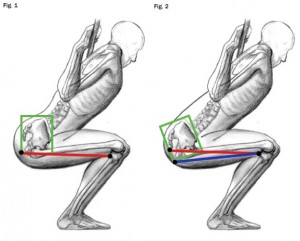
- This is a totally scientific term used to describe the posterior pelvic tilt during the bottom part of a squat, mainly caused by tight hamstrings combined with weak hip control on the descent. The hip tends to “round.” You can see it in fig.2
- Doing squats with this pelvic tilt means more stress on the lower back and can even pinch spinal discs
- That’s why it’s better to do squats with free weights than on a guided machine (the machine is always an option, but trust me, it’s not the same ;P)
Less Effort
Squats on the Smith machine are like the “light” version of this exercise. The machine’s mechanism does a lot of the work by preventing activation of your muscle stabilizers, so you don’t have to push yourself as hard.
Less effort, less growth
Less Muscle
Building on the previous point, plus the fact that adding more weight on the Smith machine can be harmful due to the position you take, your ability to create a bigger stimulus is limited.
Less stimulus, less growth
Less Strength
Once again, adding everything said so far, doing squats on the Smith machine won’t make your legs stronger.
Maybe it fits in a rehab program, a beginner’s start (and that’s debatable…) or for those who don’t want to progress…
Less progress, less strength
Muscle Imbalances
Not everything about the Smith machine is negative. Of course, you get some stimulus because you’re working. But that stimulus or strength is only in one plane.
And this, as we know, is due to the machine’s “physical” characteristics, which won’t let you activate more muscles, causing an imbalance in the lower body unless you fix it by adding other exercises.
If you have to add more exercises to get the best development, even more reason to go for an “all-in-one” with free weight squats
The Technique Is Different
Even though it’s the same type of exercise, it’s done differently with free weights than on a machine. So when you “learn” with the machine and handle certain weights, switching to free weights means dropping those weights because now you’re facing “reality” and the machine’s help is gone…
If someone’s starting leg day for the first time, it’s better to get familiar with the bar from the start—it’ll become your best “friend.” You’ll never regret it…
How to Increase Safety with Free Weights
Knowing the right technique, lifting free weights isn’t as risky as it seems at first. Like everything in life, you need a learning period to control these movements without the extra help machines provide.
Now it’s just you and the bar…
Here are some tips:
- Start “easy”: don’t let your ego take over. Everyone knows what you’re capable of, but there’s no need to impress by loading more weight than you should. Focus on light weight and perfect technique—that’s key
There’ll be time to add kilos and have everyone eyeing you
- Use a spotter: your best ally for safety and lifts, especially on bench press. This person will be there if you fail and catch the weight without hurting you.
- Use the rack: this structure can save more than one from an accident.
Think of it as the “stadium” where a team plays—without it, no game, no lift!
Uses of the Smith Machine
Finally, I don’t want to end without giving credit to this machine, which might not be (and shouldn’t be) the best for basics (squat, deadlift, bench press, overhead press), but it definitely has its uses:
- Inverted rows: you can change height and angle, with or without a bench.
- Pull-ups: for those who struggle with them, it can be extra support by keeping legs bent and adjusting bar height
- Push-ups: thanks to height adjustment, and placing feet on the bar, you can do inclined push-ups
If your gym doesn’t have a proper rack, better switch gyms…