Fitness, Nutrition, Health and Sports Blog In the HSNstore Blog you will find tips about Fitness, sport in general, nutrition, and health – HSNstore.com

Anyone can learn some basic First Aid knowledge
No one is exempt from witnessing an emergency and, in that case, you’ll surely want to know how to act. This article covers the most basic concepts as well as the protocol for First Aid action.
What is First Aid?
First Aid is the immediate care given to someone who suffers an accident, injury, or sudden illness, until the situation is resolved or advanced care arrives.
The main goals of first aid are:
- Preserve the life of the person who suffered the emergency (including the helper’s life) until advanced assistance arrives
- Prevent further injuries
- Promote recovery
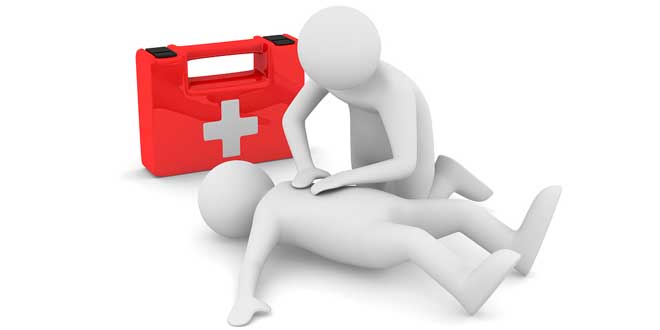
We’ll focus on the first part, since that’s mostly what will be “in our hands” without having received medical First Aid training
Main Cause of Emergency
Cardiac arrest is the most extreme emergency case. It’s basically the same as having died.
Among the reasons that cause cardiac arrest are: accidents, falls, fires, smoke inhalation, choking, drowning, allergies… On the other hand, it’s well known that there are risk factors for developing diseases that can lead to cardiac arrest.
What happens during Cardiac Arrest?
Our heart stops, it stops working. This means it stops pumping blood and the lungs stop ventilating. We stop breathing. The brain, heart, and other organs and tissues stop receiving blood flow.
In this situation, the person enters Cardiorespiratory Arrest or Cardiac Arrest
When does Cardiac Arrest happen?
Suddenly, at any moment.
Where does Cardiac Arrest happen?
Mostly outside hospitals (on the street, in public places, at home…).
Difference between Cardiac Arrest in adults and children
Ultimately, it’s the same phenomenon, although its nature can and in most cases does differ:
- In adults, the concentration of risk factors is usually the main cause (coronary disease)
- But in children, the situation is different, mainly caused by asphyxia (unless they have a pathology)

The Chain of Survival
These are measures aimed at increasing the chances that a person who has gone into arrest can survive.
It consists of 4 links, all equally important, and it’s essential that they are carried out both in order and as quickly as possible.
- Call for HELP
- CPR
- Early Defibrillation
- Advanced Life Support (performed by Healthcare Personnel)
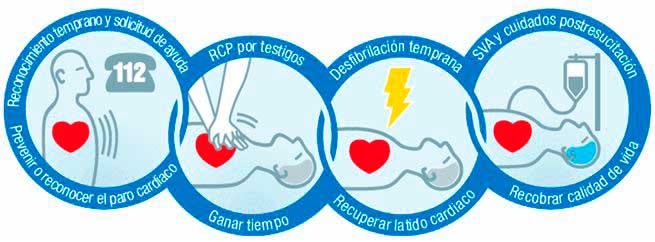
Chain of Survival (source: http://enfermeroenurgencias.blogspot.com)
Most arrests are caused by cardiac arrhythmias, which can be treated with defibrillation (electric shock). For every minute delay in this shock, survival chances drop by 10% (not counting aftereffects)
What is CPR (Cardiopulmonary Resuscitation)?
Still, we can focus our efforts on maintaining blood flow, preventing the brain and other organs from losing blood supply.
CPR Protocol
The basic Cardiopulmonary Resuscitation sequence consists of a series of steps to check if an unconscious person is in arrest, then apply the maneuvers.
Below is the algorithm to follow in an emergency. Some concepts or phases aren’t explained in detail because they should be learned in person under professional supervision.
1.- Safe approach
- We must ensure both the patient’s safety and ours (signal the accident, remove car keys, move away from fire source…)
2.- Check consciousness
- If conscious, leave them as is and call for help. Stay with them until assistance arrives.
- If the patient does NOT respond to our questions (what’s wrong?, how do you feel?…) assume they are unconscious. We must check if they’re breathing:
- Open airway -> apply the “head-tilt chin-lift” maneuver
- Check breathing by: listening for air from the mouth + seeing chest rise + feeling air on the cheek (don’t take more than 5-10 seconds and if in doubt, assume no breathing)
3.- CALL 112/061
- At this point, send someone for help, calling 112 or 061.
- Ask them to find a “AED”
- If alone, YOU MUST CALL BEFORE STARTING COMPRESSIONS
4.- 30 COMPRESSIONS / 2 BREATHS
- The sequence is to perform 2 breaths for every 30 chest compressions
- To add info on how to do compressions, again, you must have taken the course:
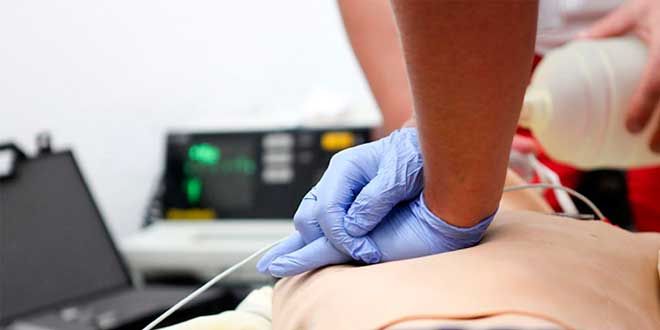
- place the heel of one hand on the center of the patient’s chest, and the other hand on top, interlacing fingers to press only with the heel (compress the sternum 5-6 cm)
- Relax pressure between compressions (we’re replacing the heart’s pumping function)
- Compression rate should be between 100/120 per minute
- Breaths aren’t mandatory if the helper decides so, but keeping the compression rhythm is what matters most
- If the person has suffered an arrest, these maneuvers WON’T REVERSE THE ARREST. Healthcare personnel action is necessary
- We can BUY TIME by maintaining circulatory and respiratory support until help arrives. After 4-6 minutes, lack of blood flow and oxygen to the brain becomes critical and causes irreversible damage
It’s IN OUR HANDS to increase the survival rate
CPR in Children
The protocol for children has one difference:
BEFORE CALLING FOR HELP, GIVE 5 RESCUE BREATHS + 1 MINUTE OF CPR (15 COMPRESSIONS / 2 BREATHS)
This is because, as we saw earlier, the main cause of arrest in children is asphyxia and, in almost all (non-severe) cases, the child recovers by doing this.
For breaths, use the mouth-to-mouth/nose technique due to their smaller size.
With this change, the algorithm is:
1.- Safe approach
2.- Check consciousness
- Open airway -> be careful with infants (keep head neutral)
- Check breathing
3.- 5 RESCUE BREATHS
4.- 1 MINUTE CPR (15 COMPRESSIONS / 2 BREATHS)
5.- CALL 112/061
6.- Continue CPR
AED (Automated External Defibrillator)
This adds a new link to the chain of survival by incorporating a defibrillator. These devices can be used by ANYONE, as they’re easy to operate with clear, precise instructions (a voice guides you through every step).
As soon as you get an AED, you should use it on the person in arrest
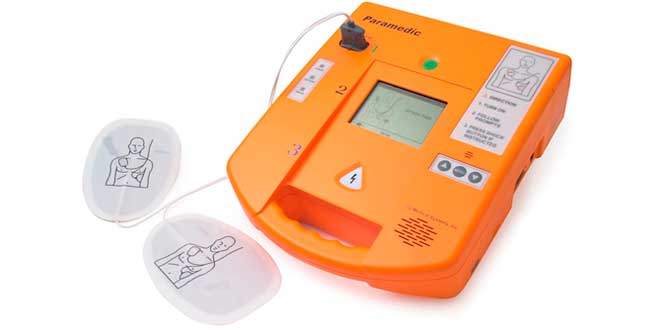
Still, it’s not complicated to use. But since it’s linked to compressions and breaths, training is recommended
More about First Aid
How to act during choking
This is a common situation. It can happen when someone chokes while eating. In children, it’s also common to swallow a toy…
A choking person will have difficulty breathing. Depending on severity, like complete obstruction, they may run out of air (fall to the ground!) and become unconscious.
If the obstruction is incomplete, our action is: encourage them to cough strongly as a measure. We urge them to cough hard, to “stay calm”. If that doesn’t clear it, apply:
5 Back Blows, between the shoulder blades
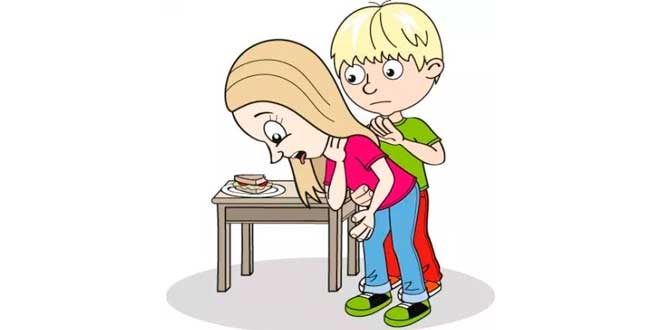
Stand behind the person, ask them to lean forward (hold them by the waist) and give firm blows.
Heimlich Maneuver
- Stand behind the person to perform abdominal thrusts.
- Make a fist with one hand and place it on the upper abdomen, thumb side against the belly. Place the other hand on top and press forcefully upward and backward.
- Perform 5 thrusts, followed by 5 back blows. Repeat this pattern.
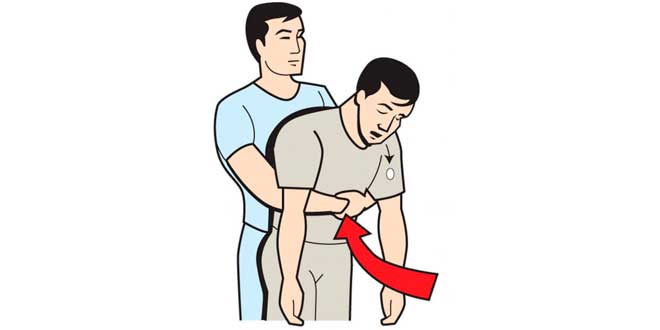
If resolved, see a doctor, especially after abdominal thrusts due to risk of internal injuries
How should we act in an emergency?
Obviously, stay calm. However, especially if the person is close to you, that’s pretty hard to guarantee. We’ll have no choice but to gather courage and act cool-headed.
Many times, if we face an emergency and there are others around, NOBODY DOES ANYTHING. And that’s pretty sad. Even more so when help arrives and it’s too late.
If you’ve read this far but haven’t taken any course, at least you have valuable information and know your action can be crucial for that person.
It could be a stranger, or it could be your partner, your child, your mom…
Related Posts