Fitness, Nutrition, Health and Sports Blog In the HSNstore Blog you will find tips about Fitness, sport in general, nutrition, and health – HSNstore.com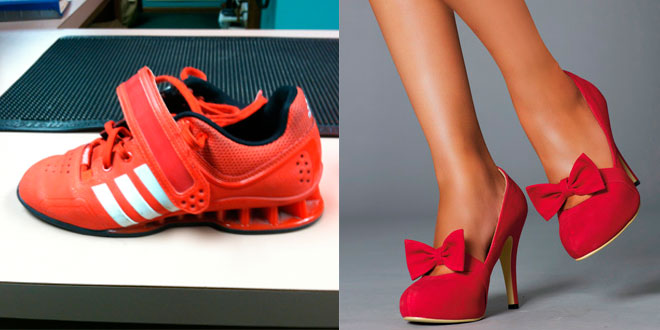

Weightlifting shoes and high heels share the feature of raising the heel above the horizontal; either to improve movements like the squat, or to look slimmer, respectively.
Skeletal muscle is a highly adaptable tissue that can adjust both morphologically and functionally to chronic changes in mechanical load. These two types of footwear share the common condition of placing the muscle-tendon units in a shortened position compared to the anatomical one. In other words, the ankle joint is forced to stay in plantar flexion temporarily.
Changes in plasticity due to shifts in functional demands are shown not only by modifications in length and pennation (fiber arrangement angle) of skeletal muscles, but also by tendons. These soft tissues are mechanically sensitive and can also adjust their size and elastic properties to keep tension constant when forces acting on them increase or decrease.
As a result, the Achilles tendon will notably respond to any change in the contractile behavior of the plantar flexor muscles induced by long-term habitual use of heels (understood as wearing heels of 3-5 cm at least 4 times a week for two years). Growing evidence shows that wearing this type of footwear is linked to increased ground reaction forces, especially with stiletto heels (smaller contact surface to support the same total body weight), indicating greater muscle activity and axial forces on the Achilles tendon. This would trigger changes such as:
- Tendon hypertrophy
- Reduction in sarcomere length of the gastrocnemius muscle, forcing it to work in an unfavorable region of its length-tension curve
- Increased stiffness of the tendon-aponeurosis complex
- Greater ankle plantar flexion angles at rest.
This would in turn result in changes in the mechanical properties of the Achilles tendon modifying its functionality, which is the really interesting part. Among these, we’d highlight the tendency for foot inversion (internal rotation, supination) and a reduced ability to perform dorsiflexion in optimal ranges, which through muscle chains could lead to structural alterations in other anatomical areas.

In fact, when walking in heels, the body’s center of mass is raised and shifted forward, forcing the plantar flexors to generate higher ground push-off torque during locomotion, possibly to counteract the destabilizing effects caused by ground reaction forces.

summary
In conclusion, regularly wearing high heels or weightlifting shoes reduces the active range of motion of the ankle due to muscle-tendon and aponeurotic adaptations resulting from changes in functional demand.
Therefore, for training purposes, it’s recommended to work on dorsiflexion even if using weightlifting shoes to improve certain exercises. Wearing high heels in women, on the other hand, is very visually appealing, but that doesn’t justify their daily use from a structural anatomy perspective.
sources
- Cronin, N. J., Barrett, R. S., & Carty, C. P. (2012). Long-term use of high-heeled shoes alters the neuromechanics of human walking. Journal of Applied Physiology, 112(6), 1054-1058.
- Csapo, R., Maganaris, C. N., Seynnes, O. R., & Narici, M. V. (2010). On muscle, tendon and high heels. The Journal of experimental biology, 213(15), 2582-2588.