Fitness, Nutrition, Health and Sports Blog In the HSNstore Blog you will find tips about Fitness, sport in general, nutrition, and health – HSNstore.com

Sedentary lifestyle is one of the major factors contributing to metabolic syndrome and non-communicable diseases, and is therefore a major contributor to morbidity (development of disease in a population) and mortality rates.
It is true, we have chosen a title that is more of a spoiler than a title.
Need to raise awareness
Moreover, I would be delighted if you stopped reading here because you got the message and decided to make the necessary lifestyle changes so that sedentary lifestyle doesn’t “kill” you.
I know that almost everyone is aware of the concept that doing sport/being active is healthy.

What is the daily life of a sedentary person like?
- He gets out of bed, gets dressed and sits down for breakfast.
- He takes the car to work (seated), sits in front of a computer (seated), has lunch (seated), continues his working day (seated), drives home (seated)…
- He sits on the sofa to relax while watching TV and eating something (seated), goes shopping in the car (seated), does the grocery shopping (very light activity), drives back home (seated), eats dinner while taking advantage of his Netflix/HBO account (seated) and goes to bed.
In the 24 hours of the day, that person will have spent about 21 hours sitting or lying down and about 3 hours standing or with very light activity.
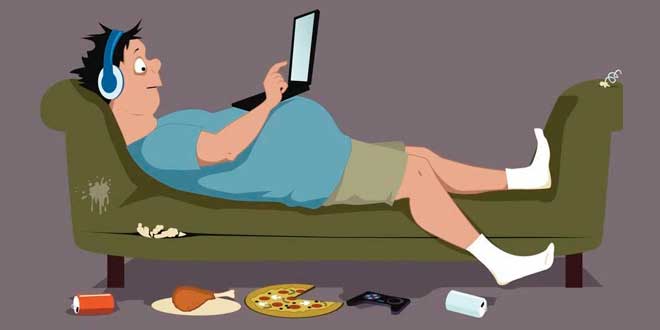
We could even say, without too much fear of being wrong, that during those 3 hours on his feet, he used lifts or escalators.
Sedentary lifestyles as a public health problem
There are 3 pillars on which a public health problem becomes a priority:
- Prevalence and trend of the problem: Situations affecting a large number of people, or involving a clear risk factor that is expanding, will be addressed.
- Magnitude of risk associated with exposure to the problem: For example, according to the WHO, consumption of processed meats and smoking are risk factors for cancer, however, the risk posed by smoking is much higher than that of red meat. Therefore, anti-smoking measures would take precedence over measures against the consumption of these meat products.
- Evidence of effective prevention and control: Following on from the example above, avoiding tobacco use is known to be a very effective strategy to prevent many types of cancer, so comprehensive strategies to prevent tobacco use are pursued.
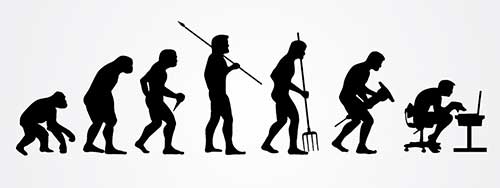
Physical inactivity and health risks
Assessing the consequences of a sedentary lifestyle
Related to this, a meta-analysis was published in 2015 that aimed to assess the association between inactivity time and its health consequences, independently of physical activity.
In other words, the aim was to see whether hours of sedentary time are harmful per se
Health factors related to sedentary lifestyles
The health factors included were:
- All-cause mortality,
- Incidence and mortality of cardiovascular disease,
- Diabetes mellitus II and cancer, in addition to
- All-cause hospitalisations.
Cardiovascular disease, diabetes mellitus II and cancer are considered the main non-communicable diseases.
It should be noted that only observational studies were included in this meta-analysis.
The greater the sedentary lifestyle, the greater the risk of disease
Specifically, the highest relative risk associated with sedentary lifestyles found in this study was the risk of developing type II diabetes, which soared to over 90% in sedentary subjects.
In relation to mortality and the incidence of various types of cancer, it appears that a sedentary lifestyle acts as a risk factor for breast, colon, endometrial and ovarian epithelial cancer.
Sedentary lifestyles and increased disease
The most important results of this analysis are that sedentary lifestyles would increase by …
- 24% the risk of all-cause mortality.
- 91% the risk of developing type II diabetes mellitus.
- 14% the incidence of cardiovascular disease.
- 18% the mortality from cardiovascular disease.
- 13% the incidence and 16% the mortality from cancer.
However, these figures should not be taken as absolute truths, since, as the authors of the meta-analysis themselves point out, many of the studies evaluated had serious limitations.
Sedentary lifestyles and the development of non-communicable diseases
Lack of physical activity is a key factor in the spread of major non-communicable diseases.
Proof of this is a study published in the prestigious journal The Lancet in 2012. The authors wanted to estimate the proportion of cases of these diseases (cardiovascular disease, diabetes mellitus II and cancer) that could have been avoided if sedentary individuals had been active, and the gain in life expectancy that this would have entailed.
This was based on the PAF (population attributable fraction), a statistical concept that estimates the proportion of cases that would not have occurred in the absence of a given risk factor (in this case, sedentary lifestyle).
According to his calculations, they could be reduced globally if all inactive individuals became active:
- 6% of cases of cardiovascular disease,
- 7% of cases of type II diabetes mellitus,
- 10% of cases of breast and colon cancer.
With these figures in hand, physical inactivity is a risk factor comparable to smoking and obesity.
Sedentary lifestyles and economic costs
Physical inactivity not only has an impact on health expenditure, but also has a global impact, as it causes indirect costs in terms of reduced productivity due to illness or premature mortality.

Ding et al. (2016) calculated the global economic cost of physical inactivity in 142 countries based on data from 2013.
Costs of physical inactivity in Spain
According to this study, in Spain alone, physical inactivity represents direct costs of more than 1700 million euros, and more than 245 million euros in indirect costs, i.e., almost a total of 2,000,000,000,000 euros.
Of these, almost three quarters are paid for by the public sector and much of the remaining fraction is paid for directly by us.
So a sedentary lifestyle not only kills, but impoverishes us as a society in every way.
What are the factors that make a person physically active or not?
There are certain factors that seem to influence the performance of physical activity (Bauman et al., 2012). Some of them act as a “fish that bites its own tail”, let me explain.
Physiological factors
These are examples of factors that are negatively related to activity performance:
- Overweight,
- perceived exertion,
- stress,
- poor health, and
- lack of self-efficacy (or not being independent in day-to-day life).

Social factors
On the other hand, educational level, having previously participated in sporting activities, the pursuit of a certain aesthetic and being in good health are factors that are related to people being more active.
Of course, there are many other influencing factors, for example, at the environmental level, such as the presence of sports facilities, the urban layout or the requirement for and availability of transport.

Or at the political level, such as educational plans that emphasise the implementation of physical activity or the promotion of exercise through campaigns at the community level.
Get up from your chair!
As mentioned at the beginning, it is possible to meet the official physical activity recommendations (about 150 minutes/week of moderate to vigorous physical activity) and still spend long periods of time sitting which compromises metabolic health.
Too much sitting is bad
It has been shown that long periods of absence of muscle loading (sitting) have biological consequences that can be counteracted by simply standing (Owen et al., 2010).
In fact, in individuals who complied with these recommendations, it has been observed that the more time they spent watching TV (sitting), the more health markers were negatively affected, such as blood pressure, waist circumference, glucose tolerance and blood lipid levels.
What to do if we have to sit for a long time?
We often have to remain seated because of our day-to-day circumstances, the most common being work.
Does this mean that an increased risk of worsening health is inevitable?
A very relevant finding of the latest research is the importance of “breaking periods of sedentary lifestyles”.

This involves something as simple as moving from sitting to standing, or from standing upright to walking and moving around.
Promote active travel
For these reasons, it is essential to try to limit the time we spend sitting, and in this context, strategies such as moving around actively, rather than using cars, become even more important.

In relation to active travel, we could include avoiding lifts and escalators where possible, or if not possible, cycling to work….
Physical activity as a protective agent
Although, as we have already mentioned, spending a large number of hours a day sitting is a metabolic risk factor.
In a meta-analysis published in 2016 by Ekelund et al., they decided to examine how physical activity affects the risk of all-cause mortality from sedentary lifestyles.
Study of physical activity and mortality risk
A study was carried out on the basis of a series of criteria with their corresponding weighting:
| Sitting Time | From 0 to 4 hours | From 4 to 6 hours | From 6 to 8 hours | Over 8 hours |
| TV hours/strong> | Less than 1 hour | From 1 to 2 hours | From 3 to 4 hours | Over 5 hours |
| Physical Activity Level | 35,5 MET-h/week (60 – 75 minutes of moderate activity per day) | 30 MET-h/week (50 – 65 minutes of moderate activity per day) | 16 MET-h/week (25 – 35 minutes of moderate activity per day) | 2,5 MET-h/week (5 minutes of moderate activity per day) |
What could be seen by cross-checking the available data was a clear dose-response association between sitting time, physical activity and all-cause mortality.
Before reading on, I would like you to be honest and place yourself in the group that you would belong to.
- To do this first, select the hours you spend sitting and then set your activity level.
- Then, choose the hours of TV/series/movies/social media/Youtube you spend per day and again combine it with your level of physical activity.
Sitting time mortality risk
As expected, the highest risk of death appeared in the group with the lowest physical activity rate (2,5 MET-h/week) and the highest sitting time (>8 hours).
This group corresponds to the highest point of those shown in the graph below, and its mortality risk was set at 58% higher than that of the reference group (the most active and with the least sitting hours).
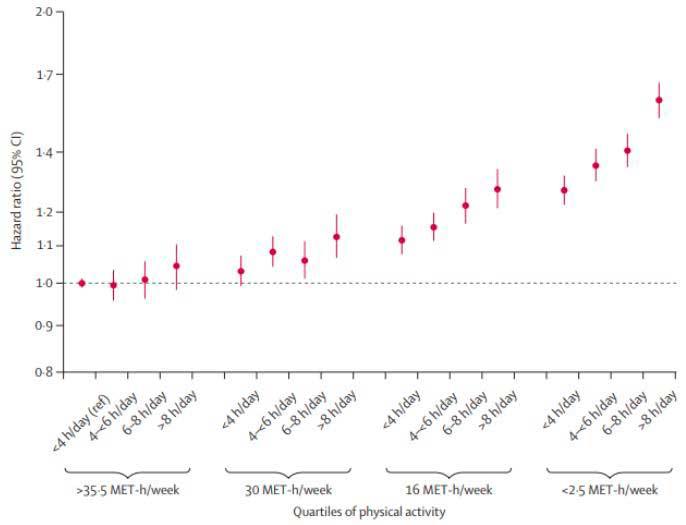
Association between mortality risk, number of sitting hours and activity level (Ekelund et al., 2016).
Mortality risk and TV hours
Regarding the risk of all-cause mortality and the relationship with TV hours, the authors found a similar distribution:
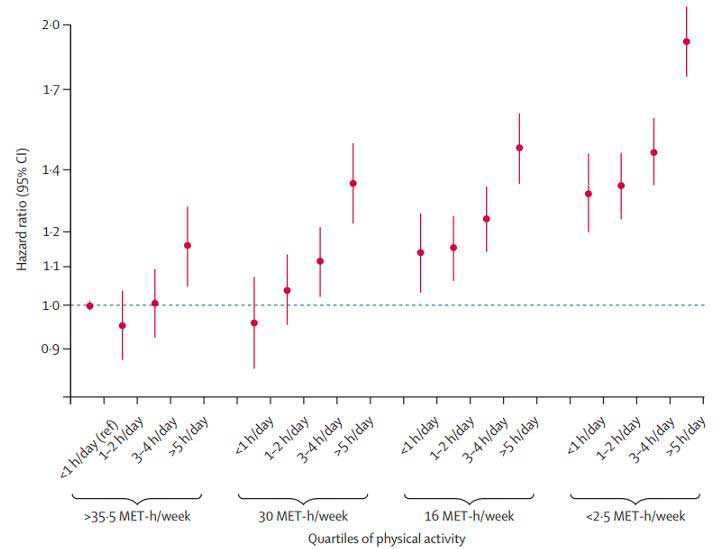
Association between mortality risk, number of TV hours and activity level (Ekelund et al., 2016).
Study conclusions
Two things are quite clear from these graphs:
- Lack of physical activity and spending too much time sitting and/or watching TV make us vulnerable and are clear risk factors for all-cause mortality.
- Physical activity minimises the risk of mortality.
I want us to remember, above all, this last sentence…
Do 1 hour of activity per day
This study shows how the risk of mortality can be drastically reduced (but not completely eliminated) when at least one hour of moderate to vigorous activity per day is undertaken.
As is the case for the 35.5 MET-h group (60 – 75 minutes of activity per day).

Even though they may spend more than 8 hours a day sitting down.
Why does watching TV “increase the risk of mortality”?
Another aspect to note, which I don’t know if you have noticed, is how hours of TV viewing increase the risk of mortality more markedly than hours of sedentary “non-TV” viewing.
But, why can this happen?
No movement at all
Surely, if a person consumes more than 3 – 5 hours of TV a day (and when I say TV, I include watching series, films or videos on Youtube), he/she will be spending most of his/her free time on it.
Therefore, avoiding any kind of physical activity.

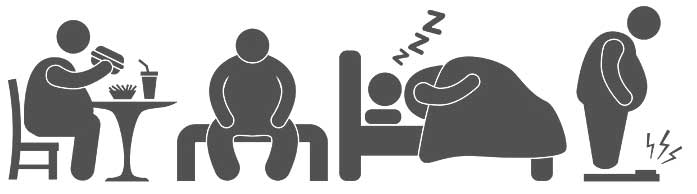
Unhealthy snacks
In addition, snacking or consuming superfluous and undesirable products (soft drinks, bagged snacks, biscuits, juices, pastries, processed nuts, etc.) while we are in front of a screen during our leisure time is typical, aggravating the problem even more.
Lack of time for sport?
Many people justify not doing sports or not being physically active with a lack of time.
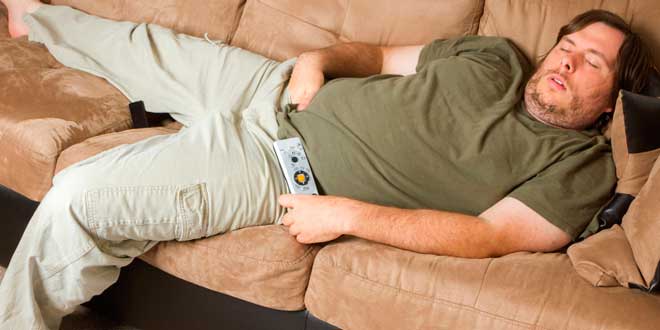
But those same people are able to watch 3 or 4 episodes of their favourite series every day and/or dedicate 1 or 2 hours to their social networks (and I am being generous in both cases).
And you, are you part of that group?
Conclusion
Much of what is stated in these lines are obvious things, but what they are intended to emphasise is the message that the earlier we start being physically active, the better, and that it is never too late to start being physically active.
Do you really need more reasons to start exercising?
Bibliographic Sources
- Owen et al., (2010). Sedentary behavior: Emerging evidence for a new health risk.
- Khol et al., (2012). The pandemic of physical inactivity: global action for public health.
- Biswas et al., (2015). Sedentary time and its association with risk for disease incidence, mortality and hospitalization in adults.
- Lee et al., (2012). Impact of physical inactivity on the world’s major non-communicable diseases.
- Ding et al., (2016). The economic burden of physical inactivity: a global analysis of major non-communicable diseases.
- Bauman et al., (2012). Correles of physical activity: why are some people physically active and others not?
- Owen et al., (2010). Too much sitting: the population-health science of sedentary behavior.
- Ekelund et al., (2016). Does physical activity attenuate, or even eliminate, the detrimental association of sitting time with mortality? A harmonised meta-analysis of data from more than 1 million men and women.
Related Entries
- Change Your Habits Now!
- Treadmill Desks