Fitness, Nutrition, Health and Sports Blog In the HSNstore Blog you will find tips about Fitness, sport in general, nutrition, and health – HSNstore.com

Knowing how to manage and choose the right weights and handling of training loads is a key factor in determining the adaptations sought with this training.
Weight guide according to type of exercise and objective
When selecting the right weights for your workout, it is important to consider both the type of exercise you will be doing and the goal you are trying to achieve.
Types of exercises and appropriate loads
- Multi-joint exercises: These are exercises that involve large muscle groups, such as the squat, deadlift or bench press, so they are more suitable for handling high loads.
- Mono-joint exercises: These are more analytical exercises that mobilise smaller muscles, such as the biceps curl or knee flexion, so the loads to be used are lower than in multi-joint exercises.
- Unilateral exercises: Compared to bilateral exercises, lower loads are handled in unilateral exercises.
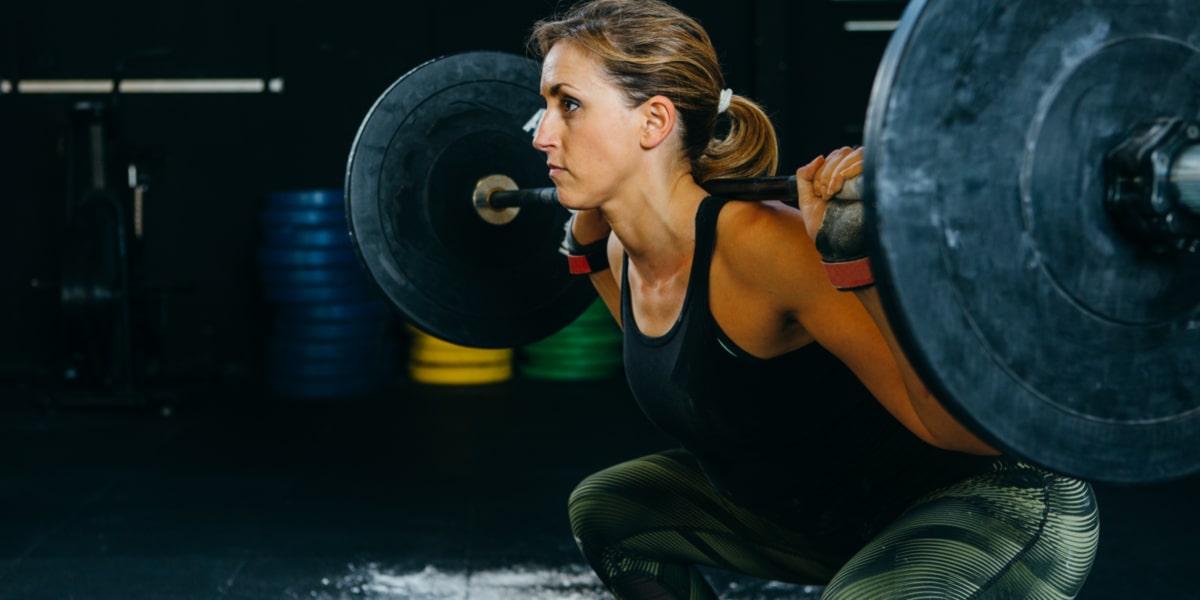
The squat is a multi-joint exercise.
Objectives and appropriate loads
- Fatigue resistance: If your goal is to improve muscular endurance in the face of fatigue, you should work with a repetition range of 15 to 20 repetitions per set and adjust the load according to the RIR (repetitions in reserve) that allows you to perform the number of repetitions correctly, without losing speed and without reaching muscle failure.
- Hypertrophy: If you are looking to increase muscle mass, the range of repetitions per set should be between 8 and 12. Although sometimes you are looking to reach muscle failure, it is important to consider the frequency and recovery between sets to produce positive adaptations in strength and power. The appropriate RIR for this goal is 4 to 5 reps.
- Maximum strength and power: If your goal is to improve maximal strength and power, you will need to work with higher and more demanding loads, and maintain a good execution technique to handle them with speed. The number of repetitions per set is low (less than 5) and the rest time between sets should be 2 to 5 minutes. The appropriate RIR for this target is 2 to 4 repetitions.
How do you know you are using the right weight in your training?
Based on these very simple criteria and in which the participant individually assesses his or her condition at the time of the training:
- Character of Perceived Exertion and Repetitions in Reserve (RIR): In this way, the athlete adjusts the loads taking into account his or her sensations, perceived effort and fatigue, thus being able to complete the optimal range and the number of sets more effectively.
- Execution speed: There are many reliable methods and apps to measure the execution speed of repetitions throughout the series. However, we can take note that when we start to lose speed in repetitions, it is an indicator that we are no longer maximising repetitions and are accumulating fatigue.
How to choose exercise weights?
Tips for beginners
Choosing the right weights for your workouts is essential to getting the best results from your fitness training. If you are a beginner, it is especially important that you learn how to choose the right weights to avoid injury and maximise progress on your fitness goals.
- Start exercising with your own body weight and depending on the exercise you can use dumbbells or kettlebells weighing between 4 and 12 kg.
- You can also start to familiarise yourself with a light barbell (10 kg) for exercises such as the squat.
- Don’t neglect exercise technique to increase weight: Quality is important and you can injure yourself if you handle loads you can’t control.
- Ask a partner to help you when you are going to perform demanding exercises with high loads and to be your spotter.
- Perform a couple of warm-up sets (like a rehearsal) to adjust the loads according to your training goal.
- Ask the trainer when in doubt about the execution, number of sets and weights that are right for you and your fitness level.
Related Entries
- We recommend this list of top low-impact exercises.
- Do you know the types of grips? We tell you all about them.