 Fitness, Nutrition, Health and Sports Blog In the HSNstore Blog you will find tips about Fitness, sport in general, nutrition, and health – HSNstore.com

For decades now, protein intake around training has gained huge popularity among sports enthusiasts. The reason behind this hype is that our body is more receptive to nutrients right after training.
This phenomenon has led many athletes and even coaches to put a big priority on consuming protein immediately after training, coining terms like “anabolic window” or “consume your protein within the first 30 minutes”.
Nitrogen Balance
The first thing to understand is that our “muscle” is a tissue with great plasticity, responding fairly easily to external stimuli. As I’ve mentioned many times, the response triggered by weight or strength training differs from the response triggered by endurance training:
- In the first case, adaptations mainly focus on recovering muscle fiber, increasing its size.
- In the second, it’s aimed at improving the oxidative system, or in other words, creating a more efficient cell that produces more energy from a smaller amount of substrate, which translates into better performance.
When we talk about muscle mass, we need to focus on two processes: protein synthesis and degradation.
For muscle maintenance or even gain to happen, synthesis must exceed protein degradation, which is known as having a “positive nitrogen balance“.
During weight training, protein degradation can rise significantly due to muscle contraction itself; however, post-workout protein synthesis increases, as shown in the image below1, supporting the theory of the anabolic window:
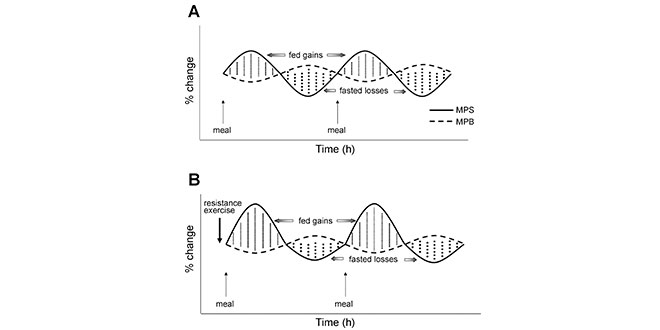
Weight training improves nitrogen balance, which is why diet alone isn’t enough to maintain muscle mass.
Looking at this, two big questions come up: how long does this anabolic window last? and does this intake really matter?
Anabolic Window
The biggest factor influencing this (besides training type) is the person’s experience, meaning whether we’re dealing with a sedentary person or someone who’s been training for a while.
For experienced athletes, the situation changes drastically, with the peak shrinking considerably. This is far from the basis of many coaches who recommend consuming protein within 30 minutes post-workout at most.
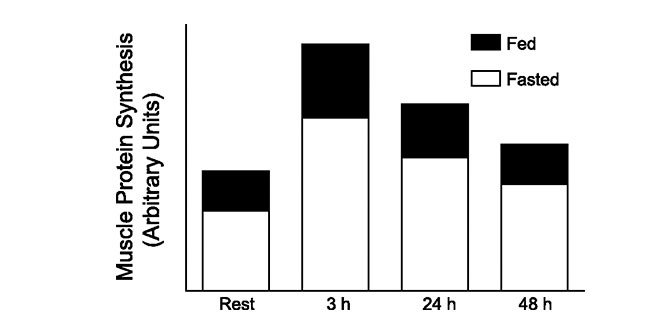
The chart above shows the relationship between time and protein synthesis
If we look closely, even after 48 hours post-training, protein synthesis remains higher than at rest, but the peak happens between 3 and 24 hours post-training.
Cell Signaling and Protein Synthesis
Another important detail is understanding the difference between CELL SIGNALING and PROTEIN SYNTHESIS, let me explain:
When we subject the body to stress, like in weight training, a cascade of reactions kicks off that leads to an effect.
However, many people think that boosting cell signaling will increase the effect, which is wrong. After a certain point, the effect plateaus even if cell signaling keeps increasing.
In this case, protein synthesis follows this phenomenon, as shown in the image below:

Conclusions
In short, we can see how protein synthesis is maximized with weight training and amino acids (especially with BCAAs) without needing to consume them in the first hours post-workout or adding carbohydrates to spike insulin. Unlike carbs, protein “timing” isn’t as critical since the window is wider (5h vs. 2-3h for carbs).
Still, there are situations where protein intake becomes important, like for people doing intermittent fasting and training early in the morning or those with really low protein intake.
With this, I’m not saying protein intake isn’t important—I believe it’s one of the most important factors for fat loss/muscle gain. What I’m saying is that immediate post-workout protein intake isn’t a key factor to obsess over.
Calculate the amount of protein you need, split it across your meals, and train hard—your mind and time will thank you.
Cheers!
What should you take? Creatine or BCAAsSources
- 1. Exercise training and protein metabolism: influences of contraction, protein intake, and sex-based differencesNicholas A. Burd , Jason E. Tang , Daniel R. Moore , Stuart M. Phillips