Fitness, Nutrition, Health and Sports Blog In the HSNstore Blog you will find tips about Fitness, sport in general, nutrition, and health – HSNstore.com

Today I’m going to talk to you about Nutrient Timing in Sports and what’s really true about it.
If sports and nutrition enthusiasts had to get together and pick a topic that’s talked about in every gym corner, it would undoubtedly be: “eat every 3 hours so your body doesn’t go catabolic and lose muscle.”
nutrient timing theory
Followers of this idea base it on three theories to justify it:
- Being more than 3 hours without eating makes your body switch to fat storage mode because there are no nutrients available
- Having more meals increases the energy expenditure by our body to digest food, so by the end of the day you’ll have lost more fat
- Eating large amounts of macronutrients in just a few meals makes the body not absorb them well or even not absorb them at all
what happens if we skip a meal?
At first, we might think that going several hours without eating (without needing to fast) can cause stress, cortisol elevation, muscle tissue loss, increased hunger, decreased metabolic rate, and a long list of other things.
It’s true that these processes can happen in our body; in fact, some of them are normal and everyday
However, to talk about muscle danger, we’d need to talk about days without eating, never just hours.
what about fasting?
An example of this can be seen in the following graph, where we observe that the first 24 hours of fasting lead to a high loss of water and carbohydrates (due to glycogen depletion and consequently water loss), some fat, and some protein (approx. 50 g).
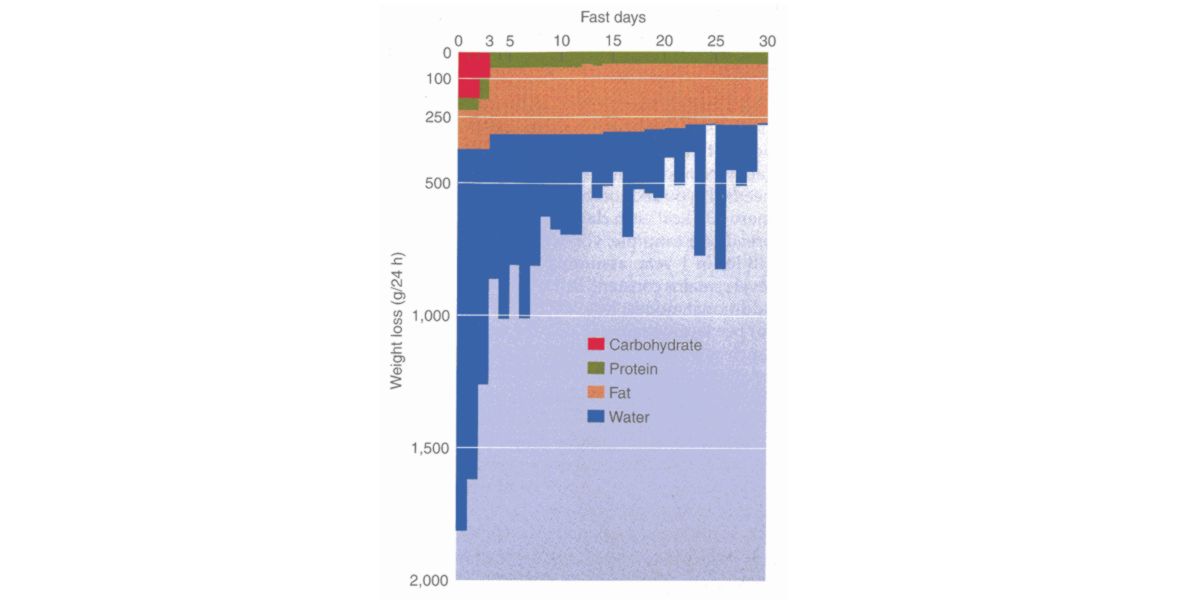
That is, 24 hours of complete fasting could lose about 50 g of protein, which doesn’t necessarily have to come from our muscles but from the liver and visceral tissue
leangains theory
As the literature shows, it can contribute up to 40% while muscle tissue decreases slightly (Swick and Benevenga 1977), which aligns with the LeanGains theory by M. Berkhan:
Martin states that muscle catabolism happens at 40 hours, something I agree with and would even like to expand on
Generally, our body tries to lose as little protein as possible as hours without eating go by. Reflecting this, as we enter fasting, the amount of nitrogen excreted (a marker that tells us how much protein we lose) decreases, reaching an excretion of 3-7 g of nitrogen/day when a normal person loses 12 to 16 g.
what happens with athletes?
However, despite seeing that going several hours without protein intake DOES NOT cause muscle loss, in athletes there’s another factor involved: training.
When we train, protein synthesis happens in our muscles, which is practically negligible compared to the loss that occurs. That’s why training is called a catabolic process.
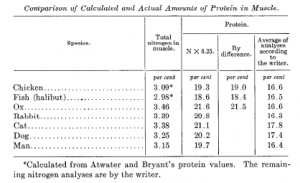
In fact, the amount of protein needed to build muscle is really low, since muscle protein content is only 16.4%(5)
can you lose muscle if you don’t eat every 3 hours?
The answer is unanimous:
Not if you consume the right amount of protein.
An example is the famous intermittent fasting. A diet based on the Ramadan philosophy, where only one meal a day is eaten.
Although hundreds of studies have been done on this, I chose one that puts us in an ideal situation: healthy, non-overweight subjects who exercise(7).
This study observed body changes during Ramadan, with the following result: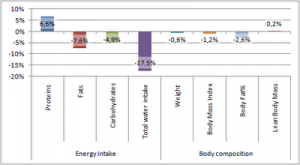
As we can see, almost 3% fat was lost and muscle was barely affected.
In fact, as seen in other studies (9), even if we go more than 24 hours without protein intake (ADF or “Alternate Day Fasting” protocol where you fast more than 24 hours), our lean tissue barely changes.
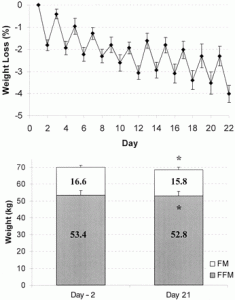
Obviously, this kind of eating pattern isn’t very practical in our world where people usually eat 5 to 8 meals a day to avoid “muscle loss” and try to maximize muscle gain. However, you don’t need 8 meals a day to build good muscle; actually, 3 meals are enough.
This theory was proven at the University of Oslo, where 16 men and 11 women were split into two groups:
- Group A ate all their calories in 6 meals
- Group B ate all their calories in 3 meals.
The intake was 1.5-1.7 g protein/kg/day and 5-7 g carbs/kg/day. Participants did strength training 4 times a week for 12 weeks.
The study’s result was:
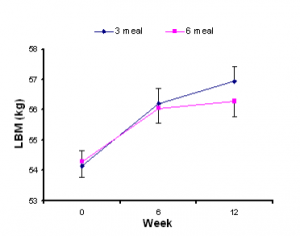 As we can see, the group that ate 3 meals (blue line) gained more muscle than the 6-meal group (pink line), and as we see below, strength gains were also higher in the 3-meal group.
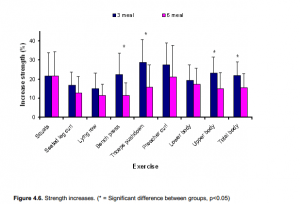
Personally, I think muscle gains or losses will be very similar whether you eat 4 or 6 meals a day.
conclusions
Catabolism isn’t just not counterproductive, it can even be beneficial as it helps cellular turnover
Remember that even if you eat all your protein in three meals, you’ll provide enough amino acids for your body to work properly at the muscle level, no matter if 3 or 5 hours pass between meals until you eat protein again.
You know it, no catabolism means no protein synthesis (Bentzinger study. 2013). Cheers to all!
references
- Increased intestinal amino-acid retention from the addition of carbohydrates to a meal. Deutz NE, Ten Have GA, Soeters PB, Moughan PJ.
- Effect of the pattern of food intake on human energy metabolism. Verboeket-van de Venne WP, Westerterp KR, Kester AD.
- Meal frequency and energy balance. Bellisle F, McDevitt R, Prentice AM.
- Acute dietary protein intake restriction is associated with changes in myostatin expression after a single bout of resistance exercise in healthy young men. Snijders T, Verdijk LB, McKay BR, Smeets JS, van Kranenburg J, Groen BB, Parise G, Greenhaff P, van Loon LJ.
- THE PROTEIN CONTENT OF MUSCLE. J. Biol. Chem. 1916, 25:185-188.
- Muscle Protein Breakdown and the Critical Role of the Ubiquitin-Proteasome Pathway in Normal and Disease States. Stewart H. Lecker*, Vered Solomon*, William E. Mitch†, and Alfred L. Goldberg*,3
- Effects of Ramadan Fasting on Biochemical and Anthropometric Parameters in Physically Active Men. Trabelsi K1, El Abed K, Trepanowski JF, Stannard SR, Ghlissi Z, Ghozzi H, Masmoudi L, Jammoussi K, Hakim A.
- The Meal Frequency Project : The effect of meal frequency on body composition during 12-weeks of strength training. Hansen, Øyvind
- What Do Doctors Think About Intermittent Fasting?
- 10 Classic Sports Nutrition Myths
- Diet Breaks: What You Need to Know to Lose Weight