 Fitness, Nutrition, Health and Sports Blog In the HSNstore Blog you will find tips about Fitness, sport in general, nutrition, and health – HSNstore.com

The incline bench press is a fundamental exercise for developing the upper chest and shoulders, but its effectiveness depends on impeccable technique. Many people perform it with mistakes that limit results or increase the risk of injury.
This guide details the correct movement step by step, adjustments based on your level, and how to avoid common errors to maximize strength and muscle gains.

1- Adjust the bench
- Set it between 30 and 45 degrees. Keep your upper back and glutes firmly supported.
2- Body position
- Slightly arch your lower back. Feet flat on the floor, without lifting the hips.
3- Grip
- Hands slightly wider than shoulder-width. Wrists aligned with the forearms.
4- Lower the bar
- Lower it under control toward the upper chest. Elbows at a 45-degree angle from the body.
5- Push powerfully
- Exhale as you press up, extending the elbows without locking them. Keep the shoulders stable.
Index
Muscles involved
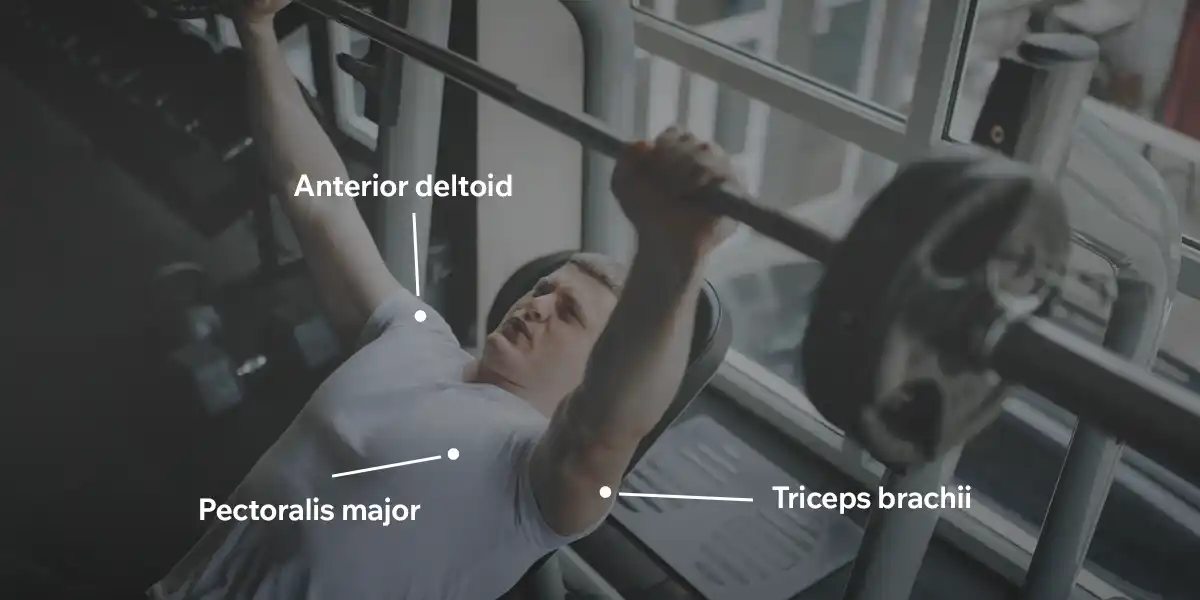
Primary (prime movers)
Pectoralis major – clavicular portion
? The most involved muscle. Responsible for pushing upward and forward.
Anterior deltoid (front shoulder)
? Assists in shoulder flexion during the press.
Triceps brachii
? Especially the long head, which extends the elbow during the press.
Secondary / synergists
Pectoralis major – sternal portion
? Works less than in the flat bench press, but still contributes.
Coracobrachialis
? Assists in arm flexion.
Serratus anterior
? Contributes to scapular stability.
Stabilizers
Middle and lower trapezius
? Keep the scapulae retracted and stable.
Rhomboids
? Stabilize the scapula during the movement.
Rotator cuff
? (supraspinatus, infraspinatus, teres minor, and subscapularis) stabilizes the shoulder.
Core (abdominals and spinal erectors)
? Provide overall stability on the bench.
Glutes and legs
? Help with stability and force transfer (leg drive).
6-week progression
- Frequency: 2 times per week
- Rest: 2–3 minutes
- Tempo: 2–1–1
| Week | Sets | Reps | Intensity |
|---|---|---|---|
| 1 | 4 | 10 | ~65% 1RM |
| 2 | 4 | 8 | ~70% 1RM |
| 3 | 5 | 6 | ~75% 1RM |
| 4 | 5 | 5 | ~80% 1RM |
| 5 | 6 | 4 | ~85% 1RM |
| 6 | 3 | 8 | ~70% 1RM (deload) |
Incline bench press variations
Other interesting modifications of the exercise:
1 Incline dumbbell press

- Set the bench to 30–45 degrees and sit with a dumbbell in each hand resting on your thighs.
- Lie back using your thighs to help lift the dumbbells into the starting position (at shoulder height, palms facing forward).
- Press upward until the arms are almost fully extended (without locking the elbows).
- Lower under control until the elbows are slightly below chest level.
? HSN Tip: control the descent to maximize muscular tension. Dumbbells allow a greater range of motion than the barbell.
2 Incline kettlebell press

- Set the bench to 20–30 degrees and sit with a kettlebell in each hand resting on your thighs.
- Lie back using your legs to bring the kettlebells into the starting position, with the forearms vertical and the kettlebells resting gently on the forearm (rack position).
- Press upward while keeping the wrists neutral until the arms are almost extended, without locking the elbows.
- Lower under control until the elbows are slightly below chest level, maintaining shoulder and core stability.
? HSN Tip: due to the unstable center of gravity of the kettlebell, prioritize shoulder stability and movement control. Use moderate loads and focus on a slow descent to increase activation of the upper chest and rotator cuff.
Benefits of the incline bench press
✅ Develops the upper chest by targeting muscle fibers near the clavicle for a more complete chest.
✅ Defines the anterior deltoids by strengthening the front of the shoulders, improving torso aesthetics.
✅ Increases pushing strength improving performance in other exercises such as the overhead press or dips.
✅ Improves joint stability and strengthens shoulders and wrists with a controlled range of motion.
✅ Prevents muscular imbalances and compensates for excessive lower chest development (common with flat bench pressing).
Related posts
- How to perform the bench press correctly
- Bench Press Blitz
- Muscles worked in the bench press
- Ultimate guide to improving the overhead press