Fitness, Nutrition, Health and Sports Blog In the HSNstore Blog you will find tips about Fitness, sport in general, nutrition, and health – HSNstore.com

Here are the most effective sports supplements for physical tests in public exams that will help you face this “competition”.
If you’re preparing for State Security Forces and Corps exams, the following info will catch your interest.
Physical Tests for Public Exams
Usually, all physical tests for public exams include a running test.
Sometimes there are two: endurance and speed.
On the other hand, it’s often the biggest challenge for many candidates, since if you don’t start from a previous athletic base and considering the call, it’s possible that the average score slips out of our hands.
However, don’t give up, and although our goal depending on the circumstances might not be to hit a “10”, we should aim as a reference for a 7 or 8, and not drop below that.
Obviously, it will also depend on the other tests (in the case, for example, of firefighters), since focusing too much on this running test could come at the expense of other strength tests..
Sports Supplements for Public Exams
What role do these supplements play?
Obviously, I hope no one thinks that showing up on the last day of preparation “still without having done the homework”, taking some of these will magically work for success. It doesn’t work like that…
This is about…
Can they help?
Of course they can…

Though I still emphasize: from the moment you decide to be a candidate, your life changes (it must) towards a more controlled and routine-focused approach.
Which supplements to take for the physical tests?
In this article, I’ll focus on types of supplements to target a specific approach:
- Boosting performance.
- Improving recovery.
Needless to say, I’m assuming you’ve applied my previous advice, and your life revolves around something planned. Therefore, your diet and food control should be too. Without that, everything will be tougher… and that’s exactly what we don’t want.
Now, under this context, the effectiveness of the following supplements increases.
- So, for the first group, I’d include: caffeine, creatine, beta-alanine, and carbohydrates.
- For the second, aimed at recovery: protein powder and also carbohydrates.
Caffeine
Caffeine is the best ergogenic substance to acutely improve sports performance, meaning right after taking it. However, it’s also true that it can cause high tolerance if not dosed properly.
On the other hand, you could say our genetics influence whether we respond better or worse to it, and in some cases, it might not be useful. Though that’s not the most common.
Caffeine is a powerful stimulant acting on the central nervous system, affecting our physiology and producing the following effects, among others:
- Raises our concentration,
- Increases alertness,
- Sharpens our senses,
- Improves response capacity,
- Reduces fatigue sensation,
- Creates a temporary state of euphoria,
As you see, all benefits to help you in your competition. But following what I said before, I advise you to only use it when you really need it, not out of habit. A pretty effective use could be 2-3 times a week.
Creatine Monohydrate
Creatine is another “must-have” supplement that any candidate should add to their arsenal. Its real potential to increase performance is scientifically proven.
Now comes the million-dollar question: what will I notice when taking creatine? Well, at first, little or nothing, let me explain. You must take it continuously to “fill” your cells with creatine so it can help you resynthesize energy.
However, as you keep taking it and progress in your training, you might be able to push more reps on bench press or pull-ups, or even shave some seconds off the clock… but what you will definitely get is better muscle recovery.
Take your dose, either all at once or split throughout the day, as you prefer, at any time. It’s not necessary to take it with carbohydrates, nor to take breaks from it.
Oh, and if you’ve heard about water retention, it’s true. But it happens inside the cells with a maximum weight gain of about half a kilo…
Beta-Alanine
Strength tests, like pull-ups, are anaerobic lactic in nature, meaning we generate a quantity of hydrogen ions that acidify the intracellular environment and reduce our performance. Running also causes this acidity.
The main effect of beta-alanine to boost sports performance is to prolong high-intensity effort for a longer time until exhaustion. Generally, in efforts between 1-4 minutes.
That is, increasing muscular endurance, both cardiopulmonary and in terms of number of repetitions.
Beta-alanine is also a long-term supplement, so its use must be continuous to get its effects: raising muscle carnosine stores, which prevent muscle pH drop during intense exercise.
If you’re vegan or vegetarian, you should take beta-alanine.
It’s recommended to take the dose spread throughout the day to avoid paresthesia (for example, split the dose into mini-doses of 1 gram and take with meals).
Carbohydrates
Here, we differentiate two types: fast-acting or as a “load”.
Among fast-acting ones, gels might interest us. These are ideal to take just before a demanding effort, such as running.
At another time, like our usual pre-workout meal, which would be within 2 hours before starting the routine, we’d choose rice flour. We could also use oats for breakfast, cooking a “porridge” or protein oatmeal.
If our training lasts more than 60 minutes, or it’s a heavy day, like for track intervals, we’d introduce an intra-workout drink based on fast-absorbing carbohydrates and also with minerals.
We’d need to ensure an 8% solution so it’s an isotonic drink and sip it during breaks.
A great option to increase concentration without affecting the drink’s osmolarity is to use next-gen carbohydrates; among them, highly branched cyclic dextrin is the most effective.
Protein Powder
The role of protein powder shakes is simply to help complement daily requirements of this macronutrient.
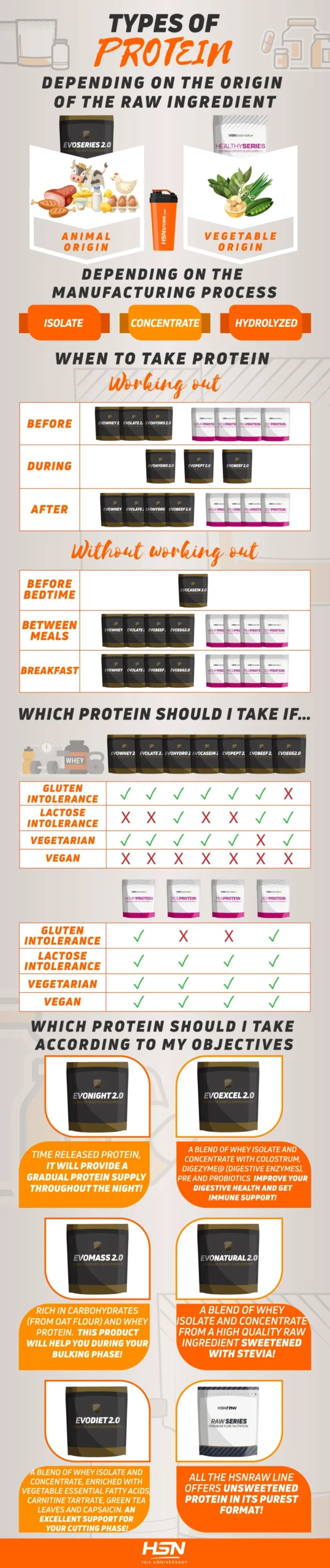
It supports your diet, so you should consider shakes as just another protein source. Within the protein catalog at HSN, you’ll find different types of proteins.
The following illustrations help you choose yours, where you’ll find info by: Raw Material, Which to Take, When to Take, and According to Goals.
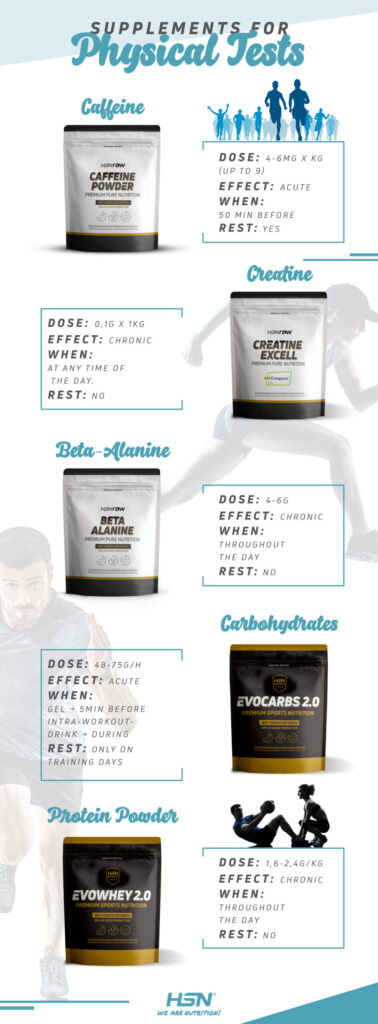
Summary Table of Supplements for Public Exam Physical Tests
Related Posts
- Supplements for Studying Public Exams.
- Do you know what Mental Strength is?