Fitness, Nutrition, Health and Sports Blog In the HSNstore Blog you will find tips about Fitness, sport in general, nutrition, and health – HSNstore.com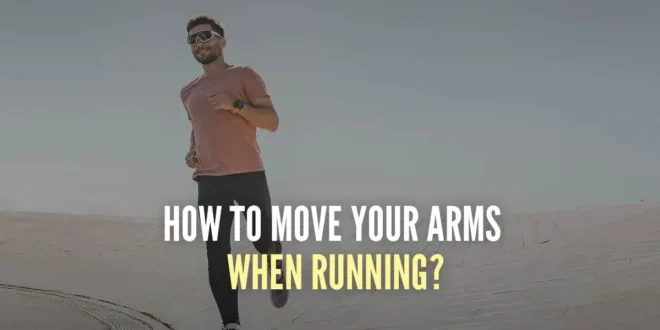

- Most of the time, when we talk about running technique and efficiency, we tend to focus on the lower limbs, how to improve a more natural support, etc.
- However, we must pay special attention to how we should carry our arms while running to optimize the run and avoid many injuries in the upper limbs.
- The body, in the running pattern, must move harmoniously to achieve efficient movement. And although we run with our legs, how we carry our arms will make that movement more or less fluid and/or forced.
- Carrying the arms almost extended and with some tension not only makes the movement pattern less efficient but can also cause recurring discomfort in the cervical area and upper back, which will also affect posture while running.
Arm rotation back and forth
For the body to move in sync, the upper and lower limbs must do so naturally.
If we look at walking, arms and legs move synchronously and naturally, to maintain balance and an aligned, correct posture.
What happens when we run?
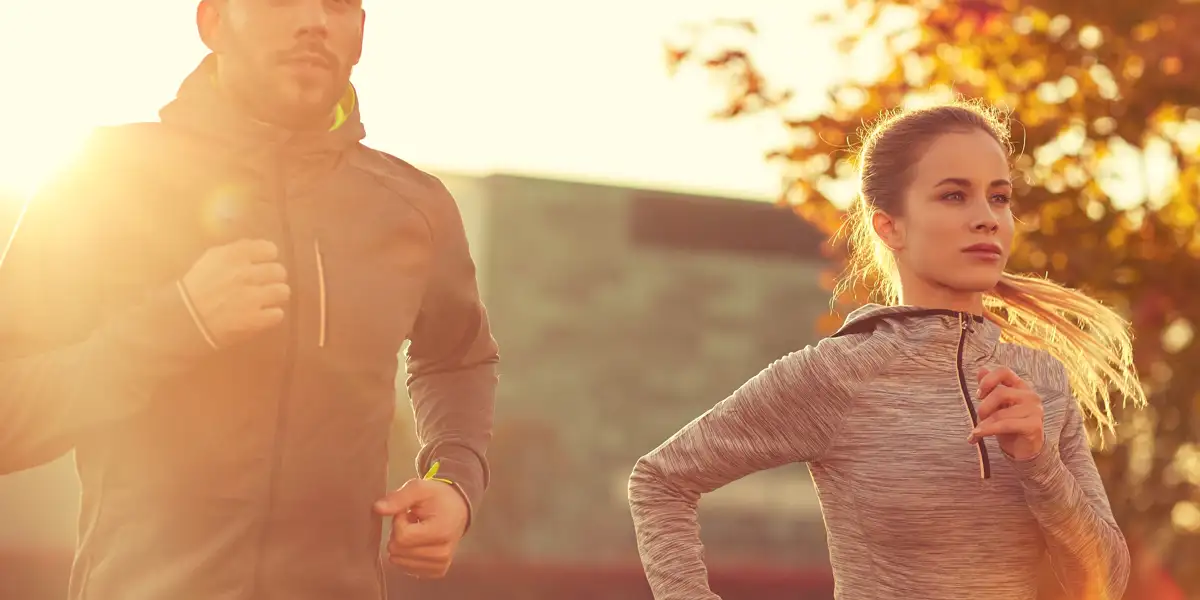
The running cycle is defined by 4 key phases: Initial contact, mid-stance, take-off, and swing.
- In the initial contact phase, the elbows are flexed at approximately a 90-degree angle.
- In the mid-stance phase, the arm opposite to the supporting leg goes backward and retracts in the take-off phase.
- In the take-off phase, the arm of the leg that takes off and extends backward, moves forward.
- In the swing phase, that retracting arm moves forward… and thus begins again that movement cycle, synchronizing arms and legs, always seeking balance and maintaining a centered posture.
Chain of linked segments
This concept defines the body as a chain of linked segments.
- Each segment performs a small movement individually, and these join the adjacent segments in broader movements along that chain.
- During the run, the body responds to ground reaction forces and rotational forces, thus producing a series of rotational movements.
- As running is an action that occurs in the sagittal plane, these rotations produce the back-and-forth oscillation of arms and legs.
- In this way, forces are transferred from the lower to the upper limbs.
Multiple counter-rotations
The sequential movement of putting one foot in front of the other implies the need for a counterweight in the upper body to maintain that forward progression. Thus, the oscillation of the opposite arm helps achieve this, just like the contraction of the torso in relation to the pelvis.
This process facilitates the diagonal stretch mechanism.
The right arm swings back as a contraction of the left arm.
Relaxed shoulders
Hence the importance of maintaining a relaxed and tension-free posture in the scapular-humeral area (relaxed shoulders), as it helps to have a more natural and efficient technique.
Looking forward
The gaze should be forward to maintain the alignment of the dorsal and cervical spine, also preventing the shoulders from falling forward into a kyphotic position.

Why do we move our arms when walking or running?
As explained in the previous point, the natural arm movement when walking or running is necessary to maintain fluid movement and balance between the upper and lower limbs.
For greater running efficiency
The posture adopted during the run is also a determining factor in its efficiency, optimizing impact absorption and energy generation.
To facilitate breathing
A posture with too much forward trunk inclination, or with shoulders fallen forward, causes a closed position of the anterior part and makes breathing difficult, as well as creating muscle tension in the cervical area.
Exercises to improve arm movement
To become aware of the importance of this synchronization between upper and lower limbs, several exercises can be practiced to help improve posture, avoid excessive torso and pelvis rotations, and carry the arms in the correct position.
- Run with arms close to the body: By eliminating the natural trunk oscillation, you will become aware of the importance of the upper limbs during the run and if you run with excessive pelvis rotation.
- In a seated position, with legs extended, swing the arms, maintaining that approximate 90-degree elbow flexion (if you tend to carry the arm very extended, you will hit the ground).
- March while raising knees, synchronizing each step with arm movements.

Conclusions
We must pay attention not only to the running technique applied to the lower limbs but also to the upper limbs.
- Maintain harmonious movement.
- Be aware of the involvement of the upper limbs while running.
- Keep your gaze forward.
- Avoid shoulder and cervical tension.
References:
- López Chicharro, José; Sánchez, Domingo. “Physiology and Fitness for Runners”, Editorial Prowellness, 2014
- Napier, Chris. “Running: Improve Your Technique, Avoid Injuries, Perfect Your Training”, Penguin Random House, 2023
Related Entries
- Tips to prevent leg fatigue while running
- Guide to running after holidays
- Why should you use a power meter while running?