Fitness, Nutrition, Health and Sports Blog In the HSNstore Blog you will find tips about Fitness, sport in general, nutrition, and health – HSNstore.com

Have you ever wondered why your body hurts not the day after training, but 2 days later? Here’s what causes muscle pain after training.
What is DOMS?
DOMS is something we’ve all suffered at some point in our lives, either because we’ve just started training again, or because we’re been pushing ourselves.
Heard of it?
It is characterised by the late onset of:
- Fatigue.
- Reduced range of joint motion.
- Muscle stiffness.
- Swelling.
- Loss of the ability to generate strength.
- Decreased proprioceptive function.
(Clarkson, Nosaka and Braun, 1992).
Who can suffer from it?
Anyone.
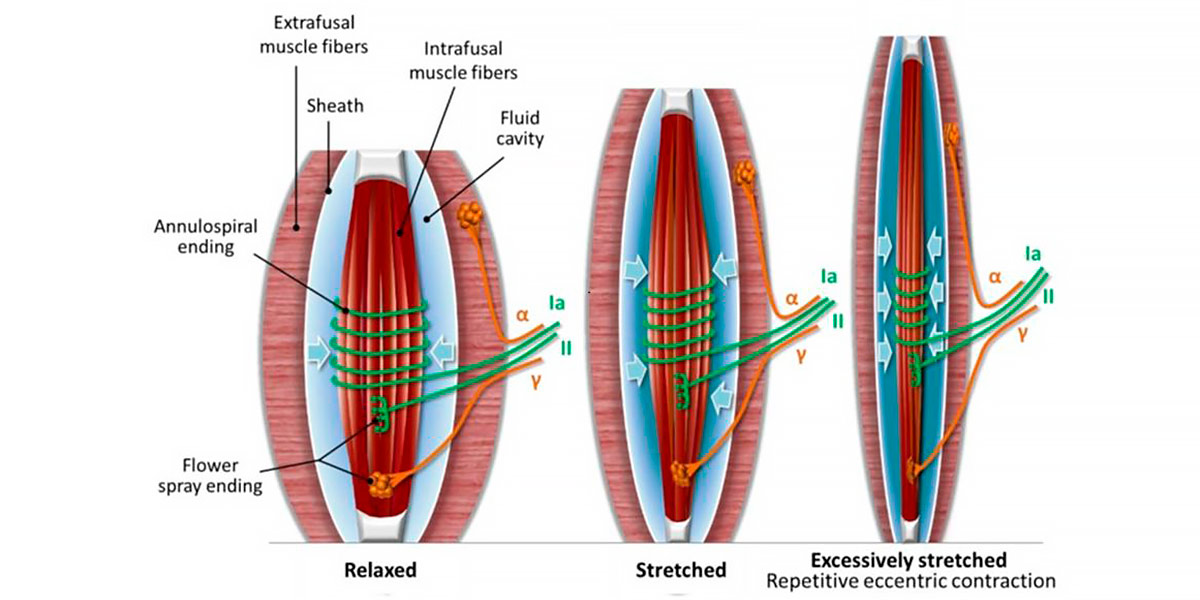
Figure I. Ultra-structural graphical representation of the musculoskeletal tissue and its nerve innervation in the neuromuscular spindle. The image shows the evolution of the etiology of muscle damage induced by physical exercise (Sonkodi et al., 2020).
This leads to subsequent inflammation of the musculoskeletal tissue, the result of muscle damage, which produces an activation of the immune system that sensitises the area.
That’s why DOMS normally appear when returning to training (or significantly changing your training programme), where the exposure to the stimulus is new and our tissue isn’t adapted.

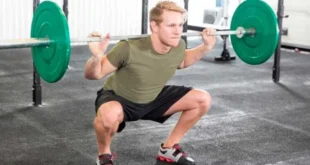
Figure II. Athlete experiencing DOMS.
IS DOMS as the same as normal aches and pains?
Yes.
“Aches” are another name for DOMS.
How to relieve muscle pain (DOMS) after exercise
Let’s start by explaining that the smartest thing to do is to avoid significant DOMS so as not to have to reduce your training load in the following sessions.
Why do I say this?
We don’t yet know of any recommended physical exercise programmes for the reduction of DOMS, it’s only been hypothesised that the positive effects are mediated by the release of endorphins and other neutrotransmitters inhibiting pain signalling.
And increased vascular flow by irrigation of the affected tissue that promotes the clearance of waste substances.
What methods work to combat DOMS?
There is a lot of variability in the studies, and no clear conclusions are reached, but by way of simplification, in the following table you can see the effectiveness of the different, most widespread methods for the treatment of DOMS.
| <6h | 24h | 48h | 72h | >96h | |
| Active recovery |  | | | | |
| Massage | | | | | |
| Compression | | ||||
| Cold immersion | | | |||
| Temperature contrast | | | |||
| Cryotherapy | | ||||
| Electrostimulation | | ||||
| Stretches |
Figure III. Effectiveness of DOMS mitigation therapies in terms of post-training timing (Adapted from Dupuy et al., 2018).
Treatments for muscle pain
There are some pharmacological treatments and dietary supplements commonly used for the treatment of DOMS symptoms, such as:
- NSAIDS: Like ibuprofen or naproxen, although they’re not recommended if you’re looking to improve your physical condition through this.
- Opioids: These aren’t recommended due to the risk of overdose, life-threatening ventilatory depression and addiction.
And among the dietary supplements, the standouts are those that work with these mechanisms:
- Reduction of muscle damage.
- Reduction of fatigue and pain.
- Reduction of inflammation.
- Improved muscle function.
Gonzalo Argo made a good graphical summary of a great review by Harty et al. (2019) that’s open-access and which you can find in the bibliographic references section:
Is DOMS a good sign in training?
No.
For many years it was thought (hypothesised) that aches and pains were a good thing, because for many years muscle damage has been proposed as a key factor in muscle mass gain:
“No pain no gain”
Now we know that this isn’t the case.
Damas (2017) published a review on the role of muscle damage on protein synthesis and the fate of this increase in MPS:
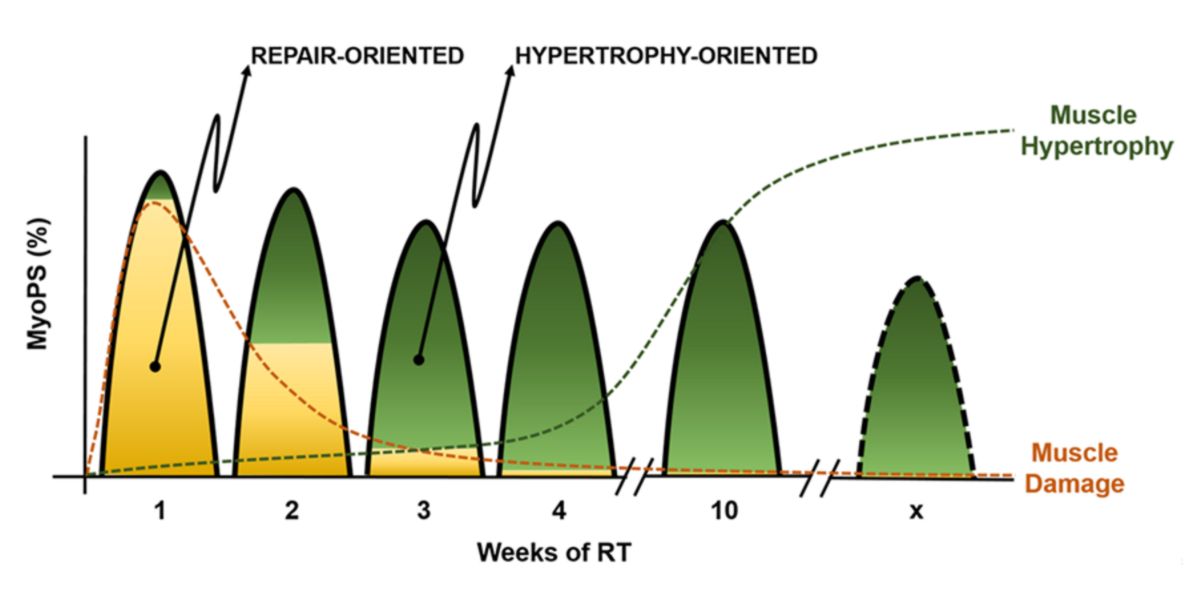
Figure V. Evolution of myofibrillar protein synthesis and its orientation in relation to muscle damage according to the weeks of training. (Damas et al., 2017).
The conclusion was that although protein synthesis increases significantly with muscle damage, it was intended for repair and did not create “new tissue”.
Can DOMS be prevented?
Yes.
It can be prevented by handling the training load.
Our body is able to exert a certain degree of voluntary effort (depending on your level of training, body composition, strength, etc.).
How do you know your ability level?
You need thorough monitoring of previous training sessions.
When should you seek medical help?
One of the risks of intense physical exercise, which produces DOMS, is the development of Rhabdomyolysis.
This is characterised as the structural disruption of muscle cells that “die” and release intracellular components into the vascular bed.
After an extremely intense physical exercise session, if you experience:
- Severe muscle pain.
- Fatigue.
- Dark urine.
Other classic but more non-specific symptoms are:
- Headaches.
- Slow mental speed.
- Thirst.
- Muscle cramps.
- Diarrhoea.
- Nausea and vomiting.
Bibliographic references
- Cheung, K., Hume, P. A., & Maxwell, L. (2003). Delayed onset muscle soreness: Treatment strategies and performance factors. Sports Medicine, 33(2), 145–164.
- Damas, F., Libardi, C. A., & Ugrinowitsch, C. (2018). The development of skeletal muscle hypertrophy through resistance training: the role of muscle damage and muscle protein synthesis. European Journal of Applied Physiology, 118(3), 485–500.
- Dupuy, O., Douzi, W., Theurot, D., Bosquet, L., & Dugué, B. (2018). An evidence-based approach for choosing post-exercise recovery techniques to reduce markers of muscle damage, Soreness, fatigue, and inflammation: A systematic review with meta-analysis. Frontiers in Physiology, 9(APR), 403.
- FarragBahbah. (2017). Rhabdomyolysis .-dr.-osama-2017 [Diapositivas].
- Harty, P. S., Cottet, M. L., Malloy, J. K., & Kerksick, C. M. (2019). Nutritional and Supplementation Strategies to Prevent and Attenuate Exercise-Induced Muscle Damage: a Brief Review. Sports Medicine – Open, 5(1), 1.
- Hohenauer, E., Taeymans, J., Baeyens, J. P., Clarys, P., & Clijsen, R. (2015). The effect of post-exercise cryotherapy on recovery characteristics: A systematic review and meta-analysis. PLoS ONE, 10(9), e0139028.
- Sonkodi, B., Berkes, I., & Koltai, E. (2020). Have we looked in the wrong direction for more than 100 years? Delayed onset muscle soreness is, in fact, neural microdamage rather than muscle damage. Antioxidants, 9(3).
- Visconti, L., Forni, C., Coser, R., Trucco, M., Magnano, E., & Capra, G. (2020). Comparison of the effectiveness of manual massage, long-wave diathermy, and sham long-wave diathermy for the management of delayed-onset muscle soreness: a randomized controlled trial. Archives of Physiotherapy, 10(1), 1.
Related Entries
- What causes Rhabdomyolysis? We tell you here
- If you want to know how to regulate your training, check out this link.
- Why should you not take anti-inflammatories after training? Find the answer inthis post.