Fitness, Nutrition, Health and Sports Blog In the HSNstore Blog you will find tips about Fitness, sport in general, nutrition, and health – HSNstore.com

CrossFit is a powerful physical conditioning system that encompasses various sports disciplines, such as weightlifting, gymnastics, etc., where the movements are executed at a high intensity and are functional in nature. Its main attraction is the competitive factor that can be seen in each training session where it “forces” us to squeeze all our potential.
Why are supplements necessary in CrossFit?
This type of training includes exercises of a very diverse nature, which will subject the body to varied efforts, where several variables are intertwined:
- Strength
- Power
- Endurance
… and even combine the maintenance of skills such as coordination, flexibility, balance or agility. Some exercises require quick bursts of energy that need to support the immediate pathways of fuel production. Others require stamina and are fuelled by the glycolytic energy production system and in other cases there are long endurance activities that are sustained by the oxidative system.
As you can imagine, this discipline involves a high energy demand, which means that if we want to obtain maximum performance, our energy intake must be correct.
Moreover, from a recovery point of view, it is particularly critical to respect the amount of protein required.

Ignoring these necessary parameters can slow down our evolution, and even have repercussions on our mood, vitality, humour…
CrossFit Supplements
Proteins
Whey protein, and specifically Whey Isolate, is undoubtedly one of the best supplements that can be used in the practice of sport and to maintain physical well-being in general.
Whey protein provides a high profile of amino acids (essential and non-essential) and is therefore characterised by its high bioavailability, together with negligible amounts of fat and carbohydrates.
Actually, this is part of the training process, since by means of the necessary stimulus we generate an “impact” on our muscles so that the organism produces an adaptive response to this effort, and therefore, the muscle regenerates itself.

When to take the Protein Shake?
After we have finished our training, we can choose to drink a Whey Protein Isolate shake that allows us to help with the regeneration phase, and on the other hand, be a liquid meal, easy to digest, especially in this post-workout moment in which our body will not be in the mood for heavy digestion.
It is also possible to take more shakes, such as upon waking, before training or between meals, in order to complete the nutritional requirements.
Creatine
Creatine is a substance that is manufactured in the body during protein metabolism from the amino acids arginine and glycine with the participation of methionine and is stored mainly in muscle tissue.
Creatine monohydrate-based supplements increase creatine and creatine phosphate (CP) stores, which together with ATP generate the energy exchange currency necessary for high-intensity, short-duration contractions.
Creatine has the ability to increase cell volume and produce greater muscle leverage and an increase in muscle size in the short and long term, in the first case as a result of cell hydration and in the second by accelerating the rate of protein synthesis that it produces.
Creatine is a must for any crossfitter.
How to supplement creatine?Two options are available: with or without the load phase. Either option will give you the same result. If you choose the second option (my favourite), you adjust 1g of creatine per 10kg of weight.
Carbohydrates
Regardless of the type of activity, carbohydrates should be at the heart of the diet of any high-performance athlete to maximise energy availability.
It is important to be aware that certain workouts are very demanding, and can knock us out at the drop of a hat if our stored energy deposits (muscle glycogen) are not “loaded”. CrossFit will generate a high glycolytic demand as a consequence of the type of training.
Also, as we exercise, and with it, increased perspiration, the excretion of minerals tends to be important, so the replenishment of mineral salts will play a strong role in our performance.
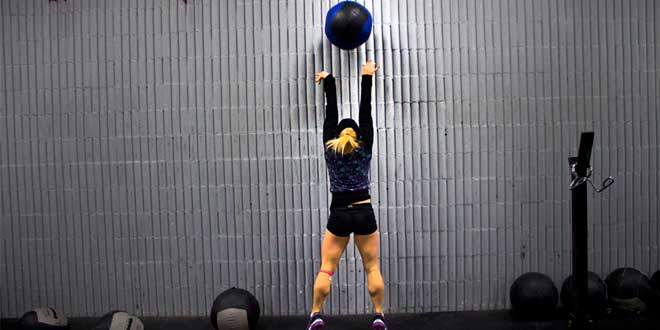
So, if you want to face an AMRAP with full guarantees, or “survive” a Murph, maintaining constant hydration and energy compensation (glycogen that we deplete quickly) will be key to guaranteeing our objective.
How to take Carbohydrates?
However, there is also the possibility of doing a “pre-loading”, before starting the exercise, and another one just after. The latter is very important for those who double their training sessions per day
Citrulline Malate
This supplement has a strong character as a performance-enhancing supplement, so it will benefit us when facing the most demanding CrossFit workouts. For such a premise it is based on:
- Boost nitric oxide (NO) production, thereby increasing nutrient transport and muscle oxygenation.
- Reduce metabolic waste as a consequence of high-intensity exercise, such as lactic acid and ammonia.
- Increase the regeneration of ATP, the energy substrate used in high-intensity, short-duration efforts.

Citrulline positively affects the phosphagen system as well as the glycolytic pathway, as it is related to the enzymes which release and obtain energy from glycogen, and those which allow ATP to be obtained from glucose. The result is more energy for longer.
How to take Citrulline Malate?
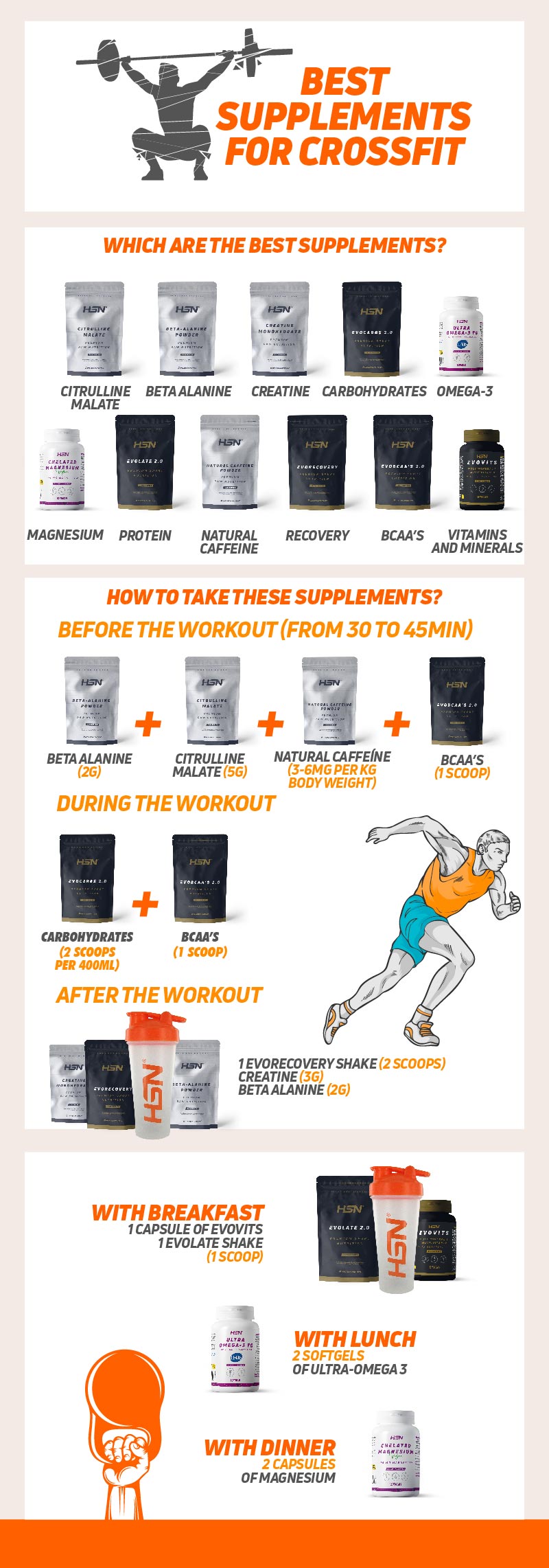
We can take two intakes, one just after waking up, and the most important one, 30-45 minutes before training. The dose can vary between 5-8g.
Beta-Alanine
Supplements that include beta-alanine improve physical performance through its ability to increase intramuscular carnosine levels by binding to the amino acid histidine. Beta-alanine can act as a buffer for lactate (delaying its appearance), which is produced during high-intensity exercise, being a waste product of anaerobic metabolism.
The result may reflect a decrease or delay in the onset of fatigue, sometimes leading to cessation of physical activity, as well as significant changes in muscular endurance and strength.
It can be perfectly combined with creatine, enhancing the performance-enhancing effects.
How to take Beta-Alanine?
In some people, doses higher than 1g may cause “paraesthesia” with localised redness and itching of the face and hands frequently. This is a benign symptom, and can be reduced after several days of taking, although another solution is to divide the dose during the day (less than 1g).
Caffeine
Caffeine supplements have the ability to stimulate the central nervous system to improve physical performance, reducing the perception of fatigue, which is very important in a sport like CrossFit. They also allow us to increase our ability to concentrate or “focus” and avoid any type of distraction, in order to focus on our physical activity.
Pre-workout caffeine increases alertness, stimulates brain activity, promotes adrenaline secretion, acts as a mild diuretic, has a tonic action on the heart muscle, promotes thermogenesis and increases lipolysis, i.e. breaks down fat into its constituent fatty acids for use as an energy source, saving glycogen.
How to take Caffeine?
In this case, a dose of between 200-400mg should help. It has even been shown that if you take caffeine post-workout, it can help to increase the rate of glycogen resynthesis.
Omega 3
Omega-3 is an essential fatty acid, whose intake is essential for the correct functioning of the organism. Within omega-3 in particular, there are two fatty acids known as EPA (Eicosapentaenoic Acid) and DHA (Docosahexaenoic Acid), which help to compensate for the unfavourable ratio of omega-3 to omega-6, which is usually the norm in diets, causing certain metabolic problems, such as inflammation.

One of the main contributions of omega-3 is its property as a natural anti-inflammatory.
How to take Omega 3?
There is no stipulation on the amount of omega-3 per day, however, in terms of supplementation, at least 1g, according to studies.
Vitamins and Minerals
Vitamins and minerals are essential nutrients because of the various functions they perform in our bodies. They act as cofactors in the formation of enzymes, hormones and other essential substances in the body.
Nowadays, due to our pace of life, in most cases, we overlook these recommendations, and we do not take a closer look at our correct diet. In this respect, multivitamins can make up for certain dietary deficiencies.

With such intense training as CrossFit, you may need supplements that provide vitamins and minerals, as it is very likely that you will not be able to cover the necessary amounts with your diet, which are higher than those of the rest of the population.
Magnesium
We can supplement with a product that contains all the vitamins and minerals, or we have the option of choosing those that can be more prominent, and that have a share in the benefit of the CrossFit athlete. One of these is undoubtedly magnesium.
This essential mineral is involved in numerous physiological processes within the body, such as regulating heart rhythm, allowing muscles to contract and relax properly, controlling blood pressure, and is even necessary in the synthesis of ATP.
How to take Magnesium?
The recommended daily dose ranges from 200-400mg.
Related Entries:
- Why train CrossFit?
- Start CrossFit training