Fitness, Nutrition, Health and Sports Blog In the HSNstore Blog you will find tips about Fitness, sport in general, nutrition, and health – HSNstore.com

Are you familiar with Omega 3 and with how much this fatty acid can do for you? However, you may not know that today’s lifestyle habits mean that the much-desired Omega 3/Omega 6 balance is far from ideal.
What is the reason? Most foods contain high concentrations of the latter to the detriment of the former, which works against the high levels of Omega 3 required to achieve the anabolic effect. But don’t panic! Support yourself with supplementation.
Omega 3 can help you improve muscle protein synthesis through 2 pathways:
- By reducing inflammation and improving insulin use
- Through the mTor pathway, which is responsible for protein synthesis
Fatty acids, what is their relationship with Insulin?
Insulin is known in “fitness territory” for its ambiguity when it comes to transporting nutrients to the cell (improving your performance) and storing excess carbohydrates as fat in adipose tissue.

Thanks to Omega 3, you will be able to make better use of it, with a lower amount of secretion. In addition, because these fatty acids act as an excellent anti-inflammatory, you may be able to reduce the inflammation produced by the stress your body has been subjected to after a tough training session.
The result? Insulin will work more efficiently, which is of great interest, given that it is considered one of the main drivers of protein synthesis.
This effect of Omega 3 on insulin is especially important in people who are overweight because, by improving insulin sensitivity, their body begins to use its fat stores.
This effect was demonstrated by Couet in a study, by replacing 6 g of dietary fat with 6 g/day of fish oil for 3 weeks, producing a notable increase in fat oxidation, as measured by RER, leading to a reduction in fat.
And what about the Plasma Membrane?
Another highly important effect of Omega 3 lies in its potential to change the composition of the plasma membrane or cell membrane. What does this mean? An increase in the release of fatty acids into the blood by adipose tissue and an increase in the secretion of toxins to the outside of the cell. In this way, a much more efficient metabolism is achieved.
As if that were not enough, dietary EPA may be beneficial by helping to inhibit the conversion of DGLA into AA (dihomo-gamma-linolenic acid and arachidonic acid), which are responsible for inflammation and the possible chronic increase in fat stores.
However, this effect on the cell membrane takes between 4 and 5 weeks, which is one of the reasons why some people “throw in the towel” just a few weeks after starting Omega 3 supplementation.
Even so, you may be wondering, How does Omega 3 help improve my musculature?
Omega 3 and Anabolic Potential
Did you know that the mechanism through which Omega 3 is beneficial to protein synthesis has still not been clarified?
In the following image, you will see that people who include Omega 3 in their diets show an increased concentration of muscle proteins. In addition to this, they also show an improvement in the RNA/DNA ratio.
You and DNA are probably already old acquaintances, but RNA may need an introduction. RNA is the messenger that travels to the ribosome so that translation can take place, giving rise to proteins.
It should be noted that this improvement was not significant enough to be taken into account. Even so, it is a useful piece of information for understanding how Omega 3 works (read the post in the link).
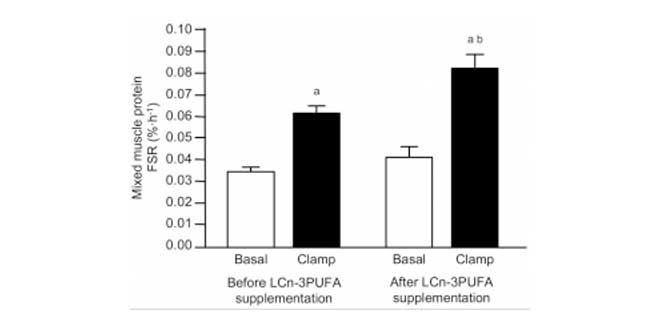
Notice that the amount of protein in the muscle increases after supplementation with Omega 3.
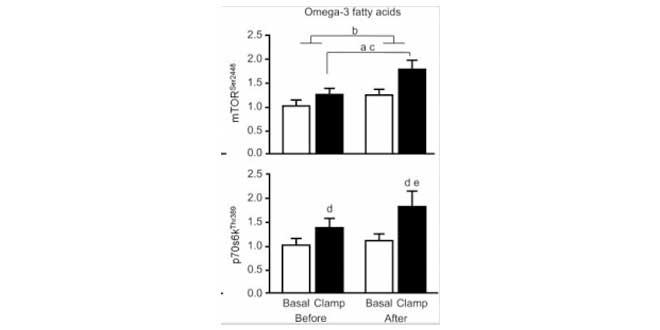
On the other hand, it was found that Omega 3 is linked to an increase in the mTor pathway, one of the main mechanisms your body uses to synthesise proteins, something many people are familiar with, since leucine acts on it.
And one final piece of information that may interest you: Omega 3 does not alter plasma glucose, leucine or phenylalanine levels (the marker of protein synthesis). Therefore, this increase in mTor may be due to a change in the behaviour of the muscle cell once the anabolic environment improves.
Take Note of the Conclusions!
Would you accept a recommendation? If you do weight training or aerobic exercise, combine a post-workout intake of 1-1.5 g of EPA taken with BCAAs (or 3-4 g of leucine) + some high glycaemic index carbohydrate. One example could be dextrose and, if it is in liquid form, even better.
What will this “combo” ensure? Fast digestion, given that the digestive system acts more quickly when nutrients are in liquid form. If you choose to take it in solid form, digestion will be longer and gastric emptying will be delayed as a result of the presence of fats.
Can you find enough reasons to introduce Omega 3 into your diet? Your performance will notice it!
Sources
- Omega-3 polyunsaturated fatty acids augment the muscle protein anabolic response to hyperaminoacidemia-hyperinsulinemia in healthy young and middle aged men and women.
- Effects of supplemental fish oil on resting metabolic rate, body composition, and salivary cortisol in healthy adults.
- Impaired anabolic response of muscle protein synthesis is associated with S6K1 dysregulation in elderly humans.
- Long-chain omega-3 fatty acids regulate bovine whole-body protein metabolism by promoting muscle insulin signalling to the Akt-mTOR-S6K1 pathway and insulin sensitivity. J Physiol 2007;579:269
- Therapeutic potential of n−3 polyunsaturated fatty acids in disease.
- Anabolic signaling deficits underlie amino acid resistance of wasting, aging muscle. FASEB
- Anabolic signaling and protein synthesis in human skeletal muscle after dynamic shortening or lengthening exercise. Am J Physiol Endocrinol Metab 2006;290:E731–8.
- Reduction of low grade inflammation restores blunting of postprandial muscle anabolism and limits sarcopenia in old rats
More information about Omega 3:
- Do you know all the benefits of this supplement? More info
- More, learn about the positive relationship between carnitine and omega 3
- Our opinion on the Omega 3 myth, more information here