Fitness, Nutrition, Health and Sports Blog In the HSNstore Blog you will find tips about Fitness, sport in general, nutrition, and health – HSNstore.com

Let’s break down the pros and cons of this recent system and finally see if electrostimulation is safe
Nowadays, most people have heard or read the word electrostimulation at some point in the context of sports performance, injury rehabilitation, or even aesthetic treatments
What is Electrostimulation?
Muscle electrostimulation (EMS) involves using electricity from a device to cause involuntary contraction of muscle fibers.
Since it’s a passive contraction, the central nervous system doesn’t actively recruit motor units in the application area beyond receiving the electrical stimulus.
What is Electrostimulation for?
Now, muscles react differently depending on the intensity (Hz) applied.
That means depending on our goal, whether rehabilitation, aesthetic, or performance, we’ll adjust the intensity of the signal and work passively and/or dynamically by doing exercise while using electrostimulation.
To give you an idea of the intensities (Hz) devices emit depending on the mode or program we use for our goal, it generally looks like this:
| Frequency | Goal |
| 1-3Hz | Muscle relaxation |
| 4-7Hz | Relaxation |
| 8-10Hz | Increased blood flow; Capillarization |
| 10-33Hz | Aerobic endurance |
| 33-50Hz | Muscle toning |
| 50-75Hz | Strength and endurance |
| 75-120Hz | Explosive strength |
Advantages and disadvantages of Electrostimulation
Listing some advantages of using electrostimulation:
- You can include a higher training volume in each session or do it in less time with the same results, since you maintain more involuntary fiber contraction activity. Thanks to this, you also reduce the chance of injuries
- If you reduce workout time and don’t need long voluntary activation, you cut down on physical and mental fatigue
- Better blood capillarization and muscle fiber irrigation, even in fast fibers, since they also activate at low frequency when using electrostimulation. This translates to greater endurance for intense work
Counterproductive effects
Still, its use also brings counterproductive effects we should keep in mind and I consider very important:
- Neuromuscular coordination work is practically zero, since there’s no muscle innervation from the brain
- It causes dysfunction in proprioceptive receptors of muscles, joints, and tendons, leading to possible injuries due to failures in musculoskeletal proprioception
- Low activation of the deepest muscle fibers
Compex Systems
These devices feature very advanced technology based on electrical impulses similar to those the brain produces in muscles, so we can use them in many ways and for different goals.

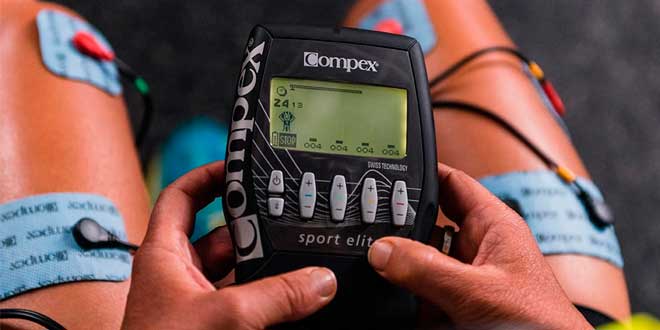
Compex is a Swiss brand dedicated to studying and manufacturing high-quality portable muscle electrostimulation systems
The brand offers a wide range of devices to choose from, with prices varying depending on the generation (1st, 2nd, 3rd, or 4th), number and/or variety of programs, and technology.
Among these is the Mi sensor, which allows measuring certain physiological muscle characteristics, analyzing them, and adapting stimulation parameters accordingly. Or Wireless, a radio wave wireless system.
Prices range from 200€ to 1200€. Some older models (1st or 2nd generation) are no longer made but can be found second-hand at affordable prices
The good news is you don’t need an ‘intensive course’ to safely operate these devices because they come with simple and intuitive software and a practical design, although unless you splurge on the wireless model, you’ll have to deal with those pesky cables every time you use it.
Still, there are plenty of online tutorials on how to use and combine them effectively with training
Electrostimulation Suit
This concept is heard more and more, not only because of the famous ”biowear” electrostimulation suit but also due to its growing evidence in improving certain health and sports performance aspects.
In the last two years, the opening of electrostimulation centers has seen a notable rise
Suits probably have special appeal to the public, and even the muscle soreness felt in the first sessions is perceived as a sign of having trained much better than conventionally, but reality is a bit different from these perceptions.
Here’s a quick note on muscle soreness VS well-done work:
Electrostimulation applied to Training
Usage methods applied to training can be grouped into:
- Isolated method: EMS is applied without doing exercise.
- Combined method: EMS is applied when not exercising, but combined with conventional voluntary exercise (without EMS). So, both methods are used but at different times.
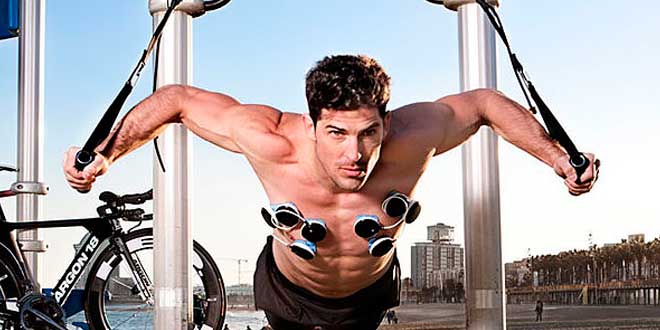
- Superimposed method (image): Voluntary exercise is done with EMS applied, either through a suit or on a specific area.

Each of these methods has its specific application
But in case of injury, any of the three respond best, as it could be a useful tool to fight muscle mass loss and function decline seen in many conditions leading to long bed rest.
How much does it cost and what can we expect from an electrostimulation session?
At an average of 20€ per session, here are some results you might expect according to centers advertising it:
- Works more than 300 muscles at once.
- Reaches deep muscle layers.
- 10 minutes EMS = 4 hours of weightlifting or 25 minutes EMS = 4 hours of intense exercise.
- Activates metabolism and burns fat 72 hours after each session.
- Improves strength, endurance, and tones with just 1 session of 20 minutes per week.
- You’ll jump higher, run faster. First system to improve speed in elite athletes.
- All this without suffering high joint impact that wears down your joints.
- Scientifically proven.
Without other references than these points, someone unfamiliar with EMS might think it’s the most revolutionary and effective method in recent years, and partly, they’re not wrong to think so.
However, professionals in the field know it’s not really like that, and in my opinion, the full truth should be told so customers can decide if they want to use it or not.

Let’s look at some of the true evidence we could rely on to assess its results in the following sections
Fat loss through electrostimulation?
One of the most promising results and why most users turn to EMS is weight and fat loss in a short time
In 2012, one of the most referenced and important studies to date compared the increase in energy expenditure when doing active exercise wearing vests with the equivalent of walking with or without poles.
More recently, other results suggest that using EMS during voluntary exercise improves cardiovascular and metabolic responses in people with metabolic diseases, as it particularly affects glucose metabolism.
This would be the part they’d want to sell us…
However, “completing the truth,” the authors also add that these improvements aren’t significant for weight loss either:

Electrostimulation to improve performance, strength, and hypertrophy
Although its use for weight/fat loss is driving EMS’s real boom, the first studies and most literature focus on its application to improve performance.
First, it should be said it’s not easy to set a work intensity like in voluntary training, where 1RM is used as a measure.
With EMS, intensity is set based on the maximum a person can tolerate, which directly depends on individual pain tolerance

So, setting training guidelines with EMS is complex, which is why each study uses a different protocol
Anyway, many studies find no improvements using WB-EMS suits compared to conventional voluntary training. Some conclusions from relevant research are:
- Simultaneous whole-body electrostimulation with exercise doesn’t compensate for possible deficiencies due to lack of voluntariness, precisely because WB-EMS lacks voluntariness.
- Involuntary work with EMS is unable to improve coordination between different muscles involved in complex movements. For example, doing a deadlift with or without a suit won’t make a difference in improving movement technique, which is key for progressing in active training.
- Joint integrity is maintained, yes; but not improved, unlike strength training. Compressive loads in strength training (within tolerance) strengthen cartilage, making it more resistant.
- EMS superimposed on voluntary training interferes with neurophysiological afference, preventing neural adaptations needed for strength generation and control.
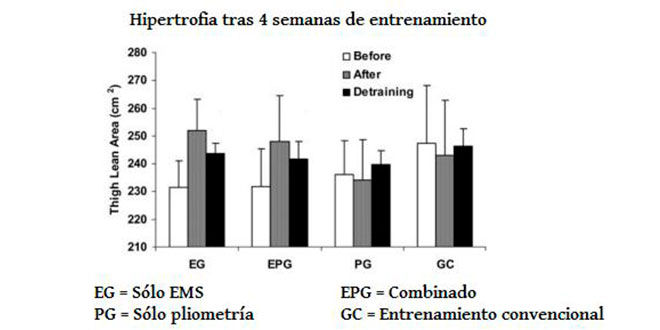
- Combining EMS and voluntary exercise, not superimposed (not at the same time), improves strength results compared to voluntary work alone in athletes. Muscle hypertrophy improvements haven’t been well evidenced.
- Strength gains with superimposed WB-EMS have been shown to be notable with at least 3 sessions per week for 5 weeks.
Is it safe?
Any training method has its contraindications, limitations, and certain risks
But with WB-EMS suits, this can be an important aspect often overlooked, mainly due to lack of knowledge about it.
Potential dangers
So, some dangerous aspects to consider are:
- Electrode placement: Suits must respect the entry of positive (+) and negative (-) poles of the current, avoiding current inside the suit itself.
- Simultaneous stimulation of chest and back can cause arrhythmias.
- It shouldn’t be used for maximal strength work (isometric), but for endurance work.
- The famous muscle soreness mentioned earlier is largely due to nerve pain from peripheral nerve stimulation, not true microtears in myofibrils.
- Real risk of rhabdomyolysis in untrained subjects, who are often the ones visiting EMS centers.
Contraindications
- Epilepsy, cardiac pacemakers, and/or severe circulatory disorders.
- Abdominal or inguinal hernia.
- Tuberculosis.
- Severe neurological disorders.
- Inflammatory diseases.
- Tendency to bleed (watch out for women during their period).
- Irritated skin, burns, and wounds.
- Diseases affecting muscle metabolism (e.g., diabetes, obesity).
Not cost-effective
Considering everything said so far, WB-EMS doesn’t provide significant extra benefits over conventional training, so you’d be paying about 80€/month (1 session per week, as advertised) without even getting those benefits, since 1 session per week is really unproductive.
To see real results with superimposed WB-EMS, you’d need to invest about 60€ weekly (3 sessions per week). Even reducing frequency to two sessions per week, which would yield “some” small results (though not better than conventional training), would cost 40€/week.
Conclusions
That is, EMS works (though it’s not a miracle method) as long as it’s used as a complement and never as an alternative to conventional resistance training (all this without considering the economic cost).
Finally, I want to highlight that although they haven’t been directly compared, medium-term (mesocycle) strength gains with EMS (3 sessions per week) aren’t superior to those obtained, for example, with the post-activation potentiation method.
Neural adaptations have been shown to increase with PAP compared to EMS
This small example shows there are other complementary training methods to conventional strength training that are equal or superior to WB-EMS, with less equipment and lower cost.
Sources
- Dehail, P., Duclos, C., & Barat, M. (2008). Electrical stimulation and muscle strengthening. In Annales de réadaptation et de médecine physique (Vol. 51, No. 6, pp. 441-451). Elsevier Masson.
- Filipovic, A., Kleinöder, H., Dörmann, U., & Mester, J. (2012). Electromyostimulation—a systematic review of the effects of different electromyostimulation methods on selected strength parameters in trained and elite athletes. The Journal of Strength & Conditioning Research, 26(9), 2600-2614.
- Kemmler, W., & von Stengel, S. (2013). Whole-body electromyostimulation as a means to impact muscle mass and abdominal body fat in lean, sedentary, older female adults: subanalysis of the TesT-III trial. Clinical interventions in aging, 8, 1353.
- Kemmler, W., Von Stengel, S., Schwarz, J., & Mayhew, J. L. (2012). Effect of whole-body electromyostimulation on energy expenditure during exercise.The Journal of Strength & Conditioning Research, 26(1), 240-245.
- Herrero, J. A., Izquierdo, M., Maffiuletti, N. A., & Garcia-Lopez, J. (2006). Electromyostimulation and plyometric training effects on jumping and sprint time. International journal of sports medicine, 27(07), 533-539.
- Ortega, F.B. (2014). Electroestimulación muscular en el mundo del fitness: base fisioógica y evidencia científica actual. Presentación en VII Simposio Internacional de actualizaciones en entrenamiento de Fuerza. Facultad Cc. Actividad Física y Deporte. Universidad Politécnica de Madrid.
- Taylor, T., West, D. J., Howatson, G., Jones, C., Bracken, R. M., Love, T. D., … & Kilduff, L. P. (2014). The impact of neuromuscular electrical stimulation on recovery after intensive, muscle damaging, maximal speed training in professional team sports players. Journal of Science and Medicine in Sport.
- Watanabe, K., Taniguchi, Y., & Moritani, T. (2014). Metabolic and cardiovascular responses during voluntary pedaling exercise with electrical muscle stimulation. European journal of applied physiology, 114(9): 1801-1807.
- “Superentrenamiento”. Mel C. Siff., Yuri Verkhoshansky. (2000). Ed. Paidotribo. 2ªEdición.
- Official Compex website and compexblog.es
Related Posts
- Muscle soreness: What it is, Why it happens, How to get rid of it
- Sports Massage, why is it necessary?